Ch. 21 - Microbial Diseases of the Skin and Eyes
Tortora - Microbiology: An Introduction 14th Edition
Tortora14th EditionMicrobiology: An IntroductionISBN: 9780138200398Not the one you use?Change textbook
Chapter 21, Problem 9

A patient exhibits inflammatory skin lesions that itch intensely. Microscopic examination of skin scrapings reveals an eight-legged arthropod. What is your diagnosis? How is the disease treated? What would you conclude if you saw a six-legged arthropod?

Verified step by step guidance
1
Step 1: Identify the arthropod based on the number of legs. An eight-legged arthropod found in skin scrapings is characteristic of mites, specifically Sarcoptes scabiei, which causes scabies.
Step 2: Understand the clinical presentation. The patient's symptoms of inflammatory, intensely itchy skin lesions align with scabies, a condition caused by the burrowing of Sarcoptes scabiei mites into the skin.
Step 3: Determine the treatment for scabies. Treatment typically involves topical scabicides such as permethrin cream or oral ivermectin to eradicate the mites and relieve symptoms.
Step 4: Consider the significance of a six-legged arthropod in skin scrapings. Six-legged arthropods are insects, not mites. Finding a six-legged arthropod would suggest a different diagnosis, such as lice infestation (pediculosis), which also causes itching but is caused by insects rather than mites.
Step 5: Summarize the diagnostic approach. The presence of an eight-legged arthropod with the described symptoms supports a diagnosis of scabies, treated with scabicides, whereas a six-legged arthropod would indicate an insect infestation requiring different management.

Verified video answer for a similar problem:

This video solution was recommended by our tutors as helpful for the problem above.
Video duration:
1m
Was this helpful?

Key Concepts

Here are the essential concepts you must grasp in order to answer the question correctly.

Identification of Arthropods in Skin Infections

Arthropods are invertebrates with segmented bodies and jointed limbs; mites have eight legs as adults, while insects have six. Recognizing the number of legs helps differentiate between mites (e.g., Sarcoptes scabiei causing scabies) and insects (e.g., lice). This distinction is crucial for accurate diagnosis of skin infestations.
Recommended video:
Guided course
03:58
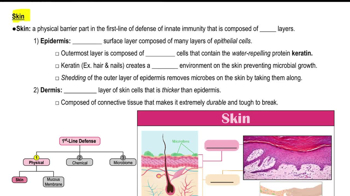
Physical Barriers in First-Line Defenses: Skin

Scabies and Its Clinical Presentation

Scabies is caused by the mite Sarcoptes scabiei, which burrows into the skin causing intense itching and inflammatory lesions. Diagnosis is confirmed by identifying the mite or its eggs in skin scrapings. Understanding the pathogenesis and symptoms aids in recognizing this common parasitic skin disease.
Recommended video:
Guided course
04:11
Free Antigens vs. Presented Antigens on APCs

Treatment of Arthropod-Induced Skin Diseases

Treatment of scabies involves topical scabicides like permethrin or oral ivermectin to eliminate mites. If a six-legged arthropod (insect) is found, such as lice, treatment differs and includes pediculicides. Correct identification ensures appropriate therapy and prevents reinfestation.
Recommended video:
Guided course
03:19
Methods of Inducing Mutations