
Ch. 24 - Microbial Diseases of the Respiratory System
Tortora - Microbiology: An Introduction 14th Edition
Tortora14th EditionMicrobiology: An IntroductionISBN: 9780138200398Not the one you use?Change textbook
Chapter 24, Problem 9

Identify the bacteria involved in respiratory infections using the following laboratory test results:
Gram-positive cocci
Catalase-positive: a. ____________________________________
Catalase-negative
Beta-hemolytic, bacitracin inhibition: b. ____________________________________
Alpha-hemolytic, optochin inhibition: c. ____________________________________
Gram-positive rods
Non-acid-fast: d. ____________________________________
Acid-fast: e. ____________________________________
Gram-negative cocci: f. ____________________________________
Gram-negative rods
Aerobes
Coccobacilli: g. ____________________________________
Rods
Grow on nutrient agar: h. ____________________________________
Require special media: i. ____________________________________
Facultative anaerobes
Coccobacilli: j. ____________________________________
Intracellular parasites
Form elementary bodies: k. ____________________________________
Do not form elementary bodies: l. ____________________________________
Wall-less: m. ____________________________________

Verified step by step guidance
1
Step 1: For Gram-positive cocci, first differentiate based on the catalase test. Catalase-positive Gram-positive cocci are typically Staphylococcus species, so for 'Catalase-positive', identify the genus Staphylococcus.
Step 2: For catalase-negative Gram-positive cocci, further classify based on hemolysis and antibiotic sensitivity. Beta-hemolytic and bacitracin-sensitive bacteria are usually Streptococcus pyogenes (Group A Streptococcus).
Step 3: For alpha-hemolytic and optochin-sensitive Gram-positive cocci, the typical identification is Streptococcus pneumoniae.
Step 4: For Gram-positive rods, distinguish between acid-fast and non-acid-fast. Non-acid-fast rods that are respiratory pathogens often include genera like Listeria or Bacillus, while acid-fast rods are characteristic of Mycobacterium species.
Step 5: For Gram-negative cocci, common respiratory pathogens include Neisseria species. For Gram-negative rods, differentiate aerobes by growth characteristics: coccobacilli that grow on nutrient agar might be Haemophilus influenzae, while those requiring special media could be Bordetella pertussis. Facultative anaerobic coccobacilli include Brucella. Intracellular parasites forming elementary bodies are Chlamydia species, while those not forming elementary bodies could be Rickettsia. Wall-less bacteria are Mycoplasma species.

Verified video answer for a similar problem:

This video solution was recommended by our tutors as helpful for the problem above.
Video duration:
2m
Was this helpful?

Key Concepts

Here are the essential concepts you must grasp in order to answer the question correctly.

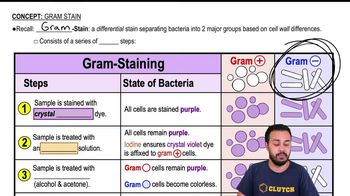
Gram Staining and Morphology

Gram staining differentiates bacteria into Gram-positive or Gram-negative based on cell wall structure, aiding identification. Morphology (cocci, rods, coccobacilli) further narrows down bacterial types. For example, Gram-positive cocci include Staphylococcus and Streptococcus, while Gram-negative cocci include Neisseria species.
Recommended video:

Biochemical and Hemolytic Tests

Catalase and hemolysis tests help distinguish bacteria by their enzyme activity and blood agar effects. Catalase-positive indicates presence of catalase enzyme (e.g., Staphylococcus), while catalase-negative includes Streptococcus. Hemolysis patterns (alpha, beta) and antibiotic sensitivity (bacitracin, optochin) further identify species causing respiratory infections.
Recommended video:
Guided course
06:59
The Ames Test

Special Growth Requirements and Intracellular Characteristics

Some bacteria require special media or conditions (e.g., Mycobacterium needs acid-fast staining and special media). Intracellular parasites like Chlamydia form elementary bodies, while others do not. Wall-less bacteria (e.g., Mycoplasma) lack a cell wall, affecting staining and antibiotic susceptibility.
Recommended video:
Guided course
04:16
Temperature Requirements for Microbial Growth