Ch. 26 - Microbial Diseases of the Urinary and Reproductive Systems
Tortora - Microbiology: An Introduction 14th Edition
Tortora14th EditionMicrobiology: An IntroductionISBN: 9780138200398Not the one you use?Change textbook
Chapter 26, Problem 5

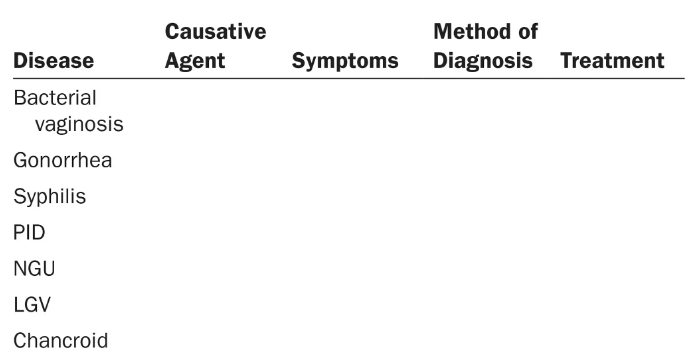
Complete the following table

Verified step by step guidance
1
Step 1: Identify the causative agent for each disease listed. For example, Bacterial vaginosis is caused by an imbalance of normal vaginal flora, often involving Gardnerella vaginalis; Gonorrhea is caused by Neisseria gonorrhoeae; Syphilis by Treponema pallidum; PID (Pelvic Inflammatory Disease) is often polymicrobial but commonly involves Neisseria gonorrhoeae and Chlamydia trachomatis; NGU (Nongonococcal urethritis) is commonly caused by Chlamydia trachomatis; LGV (Lymphogranuloma venereum) is caused by specific serovars of Chlamydia trachomatis; and Chancroid is caused by Haemophilus ducreyi.
Step 2: List the common symptoms associated with each disease. For example, Bacterial vaginosis often presents with vaginal discharge and odor; Gonorrhea typically causes urethritis with purulent discharge; Syphilis has stages with different symptoms including chancres and rash; PID presents with pelvic pain and fever; NGU causes urethral discharge and dysuria; LGV causes painful lymphadenopathy; and Chancroid causes painful genital ulcers.
Step 3: Determine the method of diagnosis for each disease. This may include microscopic examination, culture, nucleic acid amplification tests (NAATs), serology, or clinical diagnosis based on symptoms. For example, Gonorrhea and NGU are often diagnosed by NAATs; Syphilis by serologic tests; Chancroid by culture or clinical presentation; Bacterial vaginosis by Amsel criteria or Gram stain; PID by clinical criteria and imaging; LGV by serology or PCR.
Step 4: Identify the standard treatment options for each disease. For example, Bacterial vaginosis is treated with metronidazole; Gonorrhea with ceftriaxone plus azithromycin; Syphilis with penicillin; PID with broad-spectrum antibiotics; NGU with doxycycline or azithromycin; LGV with doxycycline; and Chancroid with azithromycin or ceftriaxone.
Step 5: Organize all the information into the table format, filling each column (Causative Agent, Symptoms, Method of Diagnosis, Treatment) corresponding to each disease. This structured approach helps in understanding and memorizing the key aspects of each disease.

Verified video answer for a similar problem:

This video solution was recommended by our tutors as helpful for the problem above.
Video duration:
4m
Was this helpful?

Key Concepts

Here are the essential concepts you must grasp in order to answer the question correctly.

Causative Agents of Sexually Transmitted Infections (STIs)

Understanding the specific microorganisms responsible for each STI is crucial. For example, bacterial vaginosis is caused by an imbalance of vaginal flora, gonorrhea by Neisseria gonorrhoeae, and syphilis by Treponema pallidum. Identifying the causative agent helps guide diagnosis and treatment.
Recommended video:

Symptoms and Clinical Presentation

Recognizing the typical symptoms associated with each disease aids in clinical diagnosis. Symptoms like vaginal discharge, genital ulcers, or pelvic pain vary among infections such as PID (Pelvic Inflammatory Disease) or chancroid, and help differentiate between similar conditions.
Recommended video:
Guided course
04:11
Free Antigens vs. Presented Antigens on APCs

Diagnostic Methods and Treatment Approaches

Different STIs require specific diagnostic tests, such as microscopy, culture, serology, or molecular methods. Treatment usually involves targeted antibiotics or other medications depending on the pathogen. Knowing these methods ensures accurate diagnosis and effective management.
Recommended video:
Guided course
06:29
Scientific Method