Ch. 28 - Applied and Industrial Microbiology
Tortora - Microbiology: An Introduction 14th Edition
Tortora14th EditionMicrobiology: An IntroductionISBN: 9780138200398Not the one you use?Change textbook
Chapter 28, Problem 10

Which of the following reactions is an oxidation carried out by A. ferrooxidans?
a. Fe²⁺ → Fe³⁺
b. Fe³⁺ → Fe²⁺
c. CuS→ CuSO₄
d. Fe⁰ → Cu⁰
e. None of the above

Verified step by step guidance
1
Step 1: Understand the concept of oxidation in microbiology. Oxidation is the loss of electrons by a molecule, atom, or ion. In chemical terms, this usually corresponds to an increase in oxidation state.
Step 2: Identify the role of Acidithiobacillus ferrooxidans (A. ferrooxidans). This bacterium is known for oxidizing ferrous iron (Fe²⁺) to ferric iron (Fe³⁺), which means it facilitates the reaction where Fe²⁺ loses an electron to become Fe³⁺.
Step 3: Analyze each reaction option to determine which involves oxidation (loss of electrons):
- a. Fe²⁺ → Fe³⁺: Fe²⁺ is oxidized to Fe³⁺ (loss of one electron).
- b. Fe³⁺ → Fe²⁺: Fe³⁺ is reduced to Fe²⁺ (gain of one electron), so this is not oxidation.
- c. CuS → CuSO₄: This is a chemical transformation involving copper sulfide to copper sulfate, which may involve oxidation but is not the classic reaction carried out by A. ferrooxidans.
- d. Fe⁰ → Cu⁰: This suggests elemental iron converting to elemental copper, which is not a typical oxidation reaction by A. ferrooxidans.
Step 4: Conclude that the oxidation reaction carried out by A. ferrooxidans is the conversion of Fe²⁺ to Fe³⁺, corresponding to option a.

Verified video answer for a similar problem:

This video solution was recommended by our tutors as helpful for the problem above.
Video duration:
2m
Was this helpful?

Key Concepts

Here are the essential concepts you must grasp in order to answer the question correctly.

Oxidation and Reduction Reactions

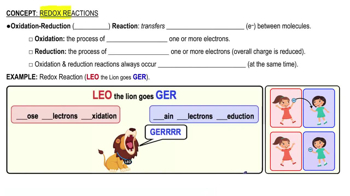
Oxidation involves the loss of electrons, while reduction involves the gain of electrons. In redox reactions, one substance is oxidized and another is reduced. Identifying which species loses electrons helps determine the oxidation process.
Recommended video:
Guided course
04:47
Redox Reactions

Role of Acidithiobacillus ferrooxidans in Iron Oxidation

A. ferrooxidans is a chemolithoautotrophic bacterium that oxidizes ferrous iron (Fe²⁺) to ferric iron (Fe³⁺) as an energy source. This oxidation reaction is central to its metabolism and environmental role in bioleaching and acid mine drainage.
Recommended video:
Guided course
04:38
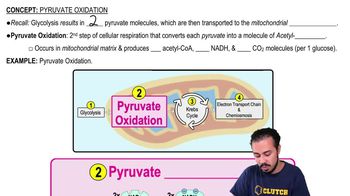
Pyruvate Oxidation

Electron Transfer in Metal Ion Transformations

Metal ions can undergo redox changes by gaining or losing electrons, altering their oxidation states. For example, Fe²⁺ oxidizes to Fe³⁺ by losing an electron, while Fe³⁺ reduces to Fe²⁺ by gaining an electron. Understanding these changes is key to identifying oxidation reactions.
Recommended video:
Guided course
03:06
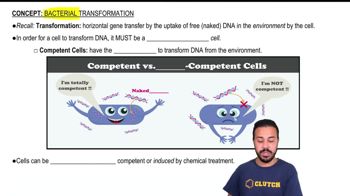
Bacterial Transformation