Ch. 5 - Microbial Metabolism
Tortora - Microbiology: An Introduction 14th Edition
Tortora14th EditionMicrobiology: An IntroductionISBN: 9780138200398Not the one you use?Change textbook
Chapter 5, Problem 5

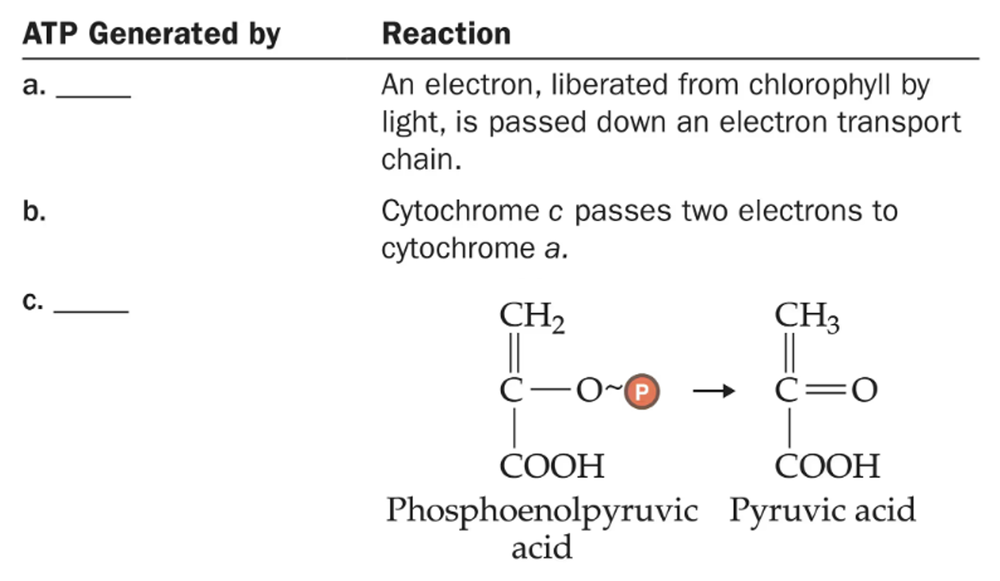
There are three mechanisms for the phosphorylation of ADP to produce ATP. Write the name of the mechanism that describes each of the reactions in the following table.
Table showing three ATP generation reactions, including electron transport chain steps and a phosphoenolpyruvic acid to pyruvic acid conversion.

Verified step by step guidance
1
Step 1: Understand the three main mechanisms of ATP synthesis in microbiology: substrate-level phosphorylation, oxidative phosphorylation, and photophosphorylation.
Step 2: Identify the context of each reaction in the table (e.g., whether it occurs during glycolysis, the electron transport chain, or photosynthesis) to determine which mechanism applies.
Step 3: For reactions where ATP is formed directly by transferring a phosphate group from a phosphorylated intermediate to ADP, classify these as substrate-level phosphorylation.
Step 4: For reactions where ATP is produced using energy derived from the electron transport chain and a proton gradient, classify these as oxidative phosphorylation.
Step 5: For reactions where light energy drives the formation of ATP via a proton gradient in photosynthetic organisms, classify these as photophosphorylation.

Verified video answer for a similar problem:

This video solution was recommended by our tutors as helpful for the problem above.
Video duration:
2m
Was this helpful?

Key Concepts

Here are the essential concepts you must grasp in order to answer the question correctly.

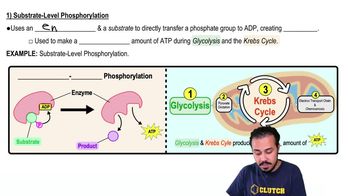
Substrate-Level Phosphorylation

This mechanism involves the direct transfer of a phosphate group from a phosphorylated intermediate to ADP, forming ATP. It occurs during glycolysis and the Krebs cycle and does not require oxygen or an electron transport chain.
Recommended video:
Guided course
03:00
Substrate-Level Phosphorylation

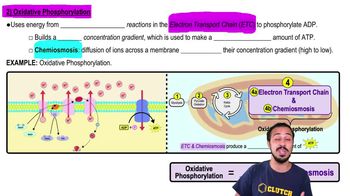
Oxidative Phosphorylation

Oxidative phosphorylation uses energy released by electrons transferred through the electron transport chain to pump protons and create a proton gradient. ATP synthase then uses this gradient to convert ADP to ATP, primarily occurring in the mitochondria.
Recommended video:
Guided course
06:27
Oxidative Phosphorylation

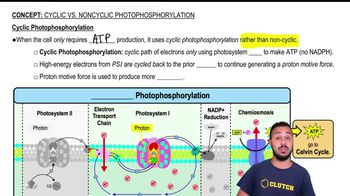
Photophosphorylation

Photophosphorylation occurs in photosynthetic organisms where light energy drives the electron transport chain, creating a proton gradient across the thylakoid membrane. ATP synthase uses this gradient to phosphorylate ADP to ATP during photosynthesis.
Recommended video:
Guided course
04:36
Cyclic Photophosphorylation
Related Practice
Textbook Question

Which of the following compounds has the greatest amount of energy for a cell?

a. CO2

b. ATP

c. glucose

d. O2

e. lactic acid

1023
views

Textbook Question

An enzyme and substrate are combined. The rate of reaction begins as shown in the following graph. To complete the graph, show the effect of increasing substrate concentration on a constant enzyme concentration. Show the effect of increasing temperature.

1507
views
Textbook Question

All of the energy-producing biochemical reactions that occur in cells, such as photophosphorylation and glycolysis, are ________ reactions.

1645
views
Textbook Question

Define oxidation-reduction, and differentiate the following terms:

a. Aerobic and anaerobic respiration

b. Respiration and fermentation

c. Cyclic and noncyclic photophosphorylation

1530
views
Textbook Question

Which of the following is the best definition of cellular respiration?

a. A sequence of redox reactions with O2 as the final electron acceptor

b. A sequence of redox reactions with the final electron acceptor from the environment

c. A method of generating ATP

d. The complete oxidation of glucose to CO2 and H2O

e. A series of reactions in which pyruvic acid is oxidized to CO2 and H2O

1481
views
Textbook Question

Which of the following is the best definition of the Krebs cycle?

a. The oxidation of pyruvic acid

b. The way cells produce CO2

c. A series of chemical reactions in which NADH is produced from the oxidation of pyruvic acid

d. A method of producing ATP by phosphorylating ADP

e. A series of chemical reactions in which ATP is produced from the oxidation of pyruvic acid

1451
views