Ch. 5 - Microbial Metabolism
Tortora - Microbiology: An Introduction 14th Edition
Tortora14th EditionMicrobiology: An IntroductionISBN: 9780138200398Not the one you use?Change textbook
Chapter 5, Problem 2

Which of the following reactions produces the most molecules of ATP during aerobic metabolism?
a. Glucose → Glucose 6-phosphate
b. Phosphoenolpyruvic acid → Pyruvic acid
c. Glucose → Pyruvic acid
d. Acetyl CoA → CO2 + H2O
e. Succinic acid → Fumaric acid

Verified step by step guidance
1
Step 1: Understand the context of aerobic metabolism and ATP production. Aerobic metabolism involves the complete oxidation of glucose to CO₂ and H₂O, generating ATP through glycolysis, the Krebs cycle, and oxidative phosphorylation.
Step 2: Analyze each reaction option to identify where ATP is produced or consumed. For example, phosphorylation of glucose to glucose 6-phosphate (option a) consumes ATP, while conversion of phosphoenolpyruvic acid to pyruvic acid (option b) produces ATP via substrate-level phosphorylation.
Step 3: Consider the overall ATP yield from each step or pathway segment. The conversion of glucose to pyruvic acid (option c) includes glycolysis, which produces a net gain of ATP molecules, while the conversion of acetyl CoA to CO₂ and H₂O (option d) represents the Krebs cycle and oxidative phosphorylation, which generate a large amount of ATP.
Step 4: Recall that the Krebs cycle and oxidative phosphorylation (option d) produce the most ATP molecules per molecule of substrate compared to glycolysis or individual substrate-level phosphorylation steps.
Step 5: Conclude that the reaction producing the most ATP molecules during aerobic metabolism is the one involving acetyl CoA being fully oxidized to CO₂ and H₂O, as this process drives the electron transport chain and oxidative phosphorylation, yielding the highest ATP output.

Verified video answer for a similar problem:

This video solution was recommended by our tutors as helpful for the problem above.
Video duration:
1m
Was this helpful?

Key Concepts

Here are the essential concepts you must grasp in order to answer the question correctly.

Aerobic Metabolism and ATP Production

Aerobic metabolism refers to the process by which cells convert glucose and other substrates into energy using oxygen. It involves glycolysis, the Krebs cycle, and oxidative phosphorylation, producing ATP as the main energy currency. Understanding which step yields the most ATP requires knowledge of these pathways and their energy outputs.
Recommended video:

Glycolysis and ATP Yield

Glycolysis is the breakdown of glucose into pyruvic acid, producing a net gain of 2 ATP molecules per glucose. Key reactions include glucose phosphorylation and conversion of phosphoenolpyruvate to pyruvate, with substrate-level phosphorylation generating ATP directly in these steps.
Recommended video:

Krebs Cycle and Electron Transport Chain

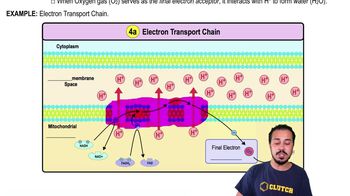
The Krebs cycle oxidizes acetyl CoA to CO₂, generating NADH and FADH₂, which donate electrons to the electron transport chain. This process produces the majority of ATP during aerobic respiration through oxidative phosphorylation, making reactions in the Krebs cycle critical for maximal ATP yield.
Recommended video:
Guided course
07:41
Electron Transport Chain
Related Practice
Textbook Question

Which of the following compounds has the greatest amount of energy for a cell?

a. CO2

b. ATP

c. glucose

d. O2

e. lactic acid

1023
views

Textbook Question

An enzyme and substrate are combined. The rate of reaction begins as shown in the following graph. To complete the graph, show the effect of increasing substrate concentration on a constant enzyme concentration. Show the effect of increasing temperature.

1507
views
Textbook Question

Using the following diagrams, show each of the following:

a. where the substrate will bind

b. where the competitive inhibitor will bind

c. where the noncompetitive inhibitor will bind

d. which of the four elements could be the inhibitor in feedback inhibition

e. What effect will the reactions in (a), (b), and (c) have?

1491
views
Textbook Question

Which of the following processes does not generate ATP?

a. Photophosphorylation

b. The Calvin-Benson cycle

c. Oxidative phosphorylation

d. Substrate-level phosphorylation

e. All of the above generate ATP

1279
views
Textbook Question

Use the following diagrams (a), (b), and (c) for the question.

<IMAGE>


Name pathways diagrammed in parts (a), (b), and (c) of the figure.

a. Show where glycerol is catabolized and where fatty acids are catabolized.

b. Show where glutamic acid (an amino acid) is catabolized:

<IMAGE>

c. Show how these pathways are related.

d. Where is ATP required in pathways (a) and (b)?

e. Where is CO₂ released in pathways (b) and (c)?

f. Show where a long-chain hydrocarbon such as petroleum is catabolized.

g. Where is NADH (or FADH₂ or NADPH) used and produced in these pathways?

h. Identify four places where anabolic and catabolic pathways are integrated.

1284
views
Textbook Question

Which substance in the following reaction is being reduced?

a. Acetaldehyde

b. NADH

c. Ethanol

d. NAD+

1339
views