Ch. 4 - Functional Anatomy of Prokaryotic and Eukaryotic Cells
Tortora - Microbiology: An Introduction 14th Edition
Tortora14th EditionMicrobiology: An IntroductionISBN: 9780138200398Not the one you use?Change textbook
Chapter 4, Problem 6

Which of the following is false about fimbriae?
a. They are composed of protein.
b. They may be used for attachment.
c. They are found on gram-negative cells.
d. They are composed of pilin.
e. They may be used for motility.

Verified step by step guidance
1
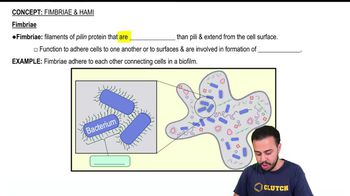
Step 1: Understand what fimbriae are. Fimbriae are hair-like appendages found on the surface of many bacteria, primarily involved in attachment to surfaces or other cells.
Step 2: Analyze each statement about fimbriae: (a) They are composed of protein. This is true because fimbriae are made of protein subunits.
Step 3: (b) They may be used for attachment. This is true since fimbriae help bacteria adhere to host cells or surfaces.
Step 4: (c) They are found on gram-negative cells. This is generally true as fimbriae are commonly found on gram-negative bacteria.
Step 5: (d) They are composed of pilin. This is true because pilin is the protein subunit that makes up fimbriae. (e) They may be used for motility. This is false because fimbriae are not involved in motility; that function is typically associated with flagella.

Verified video answer for a similar problem:

This video solution was recommended by our tutors as helpful for the problem above.
Video duration:
2m
Was this helpful?

Key Concepts

Here are the essential concepts you must grasp in order to answer the question correctly.

Structure and Composition of Fimbriae

Fimbriae are thin, hair-like appendages on the surface of many bacteria, primarily composed of the protein pilin. They differ from flagella in size and function, being shorter and more numerous, and their protein composition allows them to mediate specific interactions with surfaces or host cells.
Recommended video:
Guided course
01:52
Fimbriae & Hami

Function of Fimbriae in Attachment

Fimbriae primarily function to help bacteria adhere to surfaces, including host tissues, which is crucial for colonization and infection. This attachment ability distinguishes fimbriae from other appendages like flagella, which are mainly involved in movement.
Recommended video:
Guided course
01:52
Fimbriae & Hami

Distribution of Fimbriae in Bacteria

Fimbriae are commonly found on gram-negative bacteria, where they play a key role in pathogenicity. While some gram-positive bacteria may have similar structures, fimbriae are most characteristic and well-studied in gram-negative species.
Recommended video:
Guided course
01:52
Fimbriae & Hami
Related Practice
Textbook Question

Compare and contrast the following:

a. Simple diffusion and facilitated diffusion

b. Active transport and facilitated diffusion

c. Active transport and group translocation

1392
views

Textbook Question

Answer the following questions using the diagrams provided, which represent cross sections of bacterial cell walls.

a. Which diagram represents a gram-positive bacterium? How can you tell?

b. Explain how the Gram stain works to distinguish these two types of cell walls.

c. Why does penicillin have no effect on most gram-negative cells?

d. How do essential molecules enter cells through each wall?

e. Which cell wall is toxic to humans?

1339
views
Textbook Question

Which of the following statements best describes what happens to a cell exposed to polymyxins that destroy phospholipids?

a. In an isotonic solution, nothing will happen.

b. In a hypotonic solution, the cell will lyse.

c. Water will move into the cell.

d. Intracellular contents will leak from the cell.

e. Any of the above might happen.

1392
views
Textbook Question

Which of the following pairs is mismatched?

a. Metachromatic granules—stored phosphates

b. Polysaccharide granules—stored starch

c. Lipid inclusions—poly-β-hydroxybutyric acid

d. Sulfur granules—energy reserve

e. Ribosomes—protein storage

1676
views
Textbook Question

Why is an endospore called a resting structure? Of what advantage is an endospore to a bacterial cell?

1828
views
Textbook Question

Which of the following pairs is mismatched?

a. Glycocalyx—adherence

b. Pili—reproduction

c. Cell wall—toxin

d. Cell wall—protection

e. Plasma membrane—transport

1924
views