Ch. 7 - The Control of Microbial Growth
Tortora - Microbiology: An Introduction 14th Edition
Tortora14th EditionMicrobiology: An IntroductionISBN: 9780138200398Not the one you use?Change textbook
Chapter 7, Problem 3

Thermal death point is not considered an accurate measure of the effectiveness of heat sterilization. List three factors that can alter thermal death point.

Verified step by step guidance
1
Understand that the thermal death point (TDP) is defined as the lowest temperature at which all microorganisms in a liquid culture are killed in 10 minutes. It is a specific measure but can be influenced by various factors.
Identify that one factor altering TDP is the type of microorganism, as different species and strains have varying heat resistances due to their structural and physiological differences.
Recognize that the composition of the medium or environment where the microorganisms are present affects TDP; for example, the presence of organic matter, fats, or proteins can protect microbes from heat.
Consider the pH of the environment, since acidic or alkaline conditions can influence microbial heat sensitivity and thus change the thermal death point.
Note that the initial number of microorganisms (microbial load) also impacts TDP because a higher number of cells may require longer or higher heat exposure to achieve complete sterilization.

Verified video answer for a similar problem:

This video solution was recommended by our tutors as helpful for the problem above.
Video duration:
1m
Was this helpful?

Key Concepts

Here are the essential concepts you must grasp in order to answer the question correctly.

Thermal Death Point (TDP)

Thermal Death Point is the lowest temperature at which all microorganisms in a liquid culture are killed in 10 minutes. It is used to assess heat sterilization but can vary depending on conditions, making it an inconsistent measure of sterilization effectiveness.
Recommended video:
Guided course
04:07
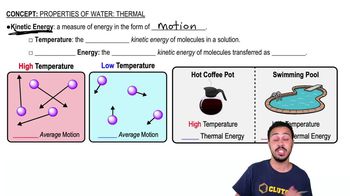
Properties of Water- Thermal

Microbial Resistance and Population Characteristics

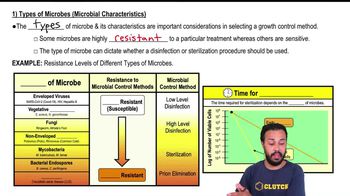
Different microorganisms have varying heat resistance, influenced by species, spore formation, and population size. Larger or more resistant populations require higher temperatures or longer exposure times to achieve sterilization.
Recommended video:
Guided course
07:24
Types of Microbes (Microbial Characteristics)

Environmental and Physical Factors Affecting Heat Sterilization

Factors such as pH, presence of organic matter, moisture content, and the medium's composition can alter heat transfer and microbial survival. These variables impact the thermal death point by protecting microbes or affecting heat penetration.
Recommended video:
Guided course
03:48
Environmental Factors Affecting Enzyme Activity