Ch. 8 - Microbial Genetics
Tortora - Microbiology: An Introduction 14th Edition
Tortora14th EditionMicrobiology: An IntroductionISBN: 9780138200398Not the one you use?Change textbook
Chapter 8, Problem 4

Bacteria can acquire antibiotic resistance by all of the following except
a. mutation.
b. insertion of transposons.
c. conjugation.
d. snRNPs.
e. transformation.

Verified step by step guidance
1
Step 1: Understand the mechanisms by which bacteria acquire antibiotic resistance. These include mutation, insertion of transposons, conjugation, and transformation.
Step 2: Review each option to determine if it is a known mechanism for acquiring antibiotic resistance: mutation (a genetic change), insertion of transposons (mobile genetic elements), conjugation (transfer of plasmids between bacteria), and transformation (uptake of free DNA from the environment).
Step 3: Identify what snRNPs are. Small nuclear ribonucleoproteins (snRNPs) are involved in RNA splicing in eukaryotic cells and are not related to bacterial antibiotic resistance mechanisms.
Step 4: Conclude that the option which does not contribute to antibiotic resistance in bacteria is the one involving snRNPs.
Step 5: Summarize that the correct answer is the option that does not fit with known bacterial resistance acquisition methods, which is snRNPs.

Verified video answer for a similar problem:

This video solution was recommended by our tutors as helpful for the problem above.
Video duration:
3m
Was this helpful?

Key Concepts

Here are the essential concepts you must grasp in order to answer the question correctly.

Mechanisms of Antibiotic Resistance Acquisition

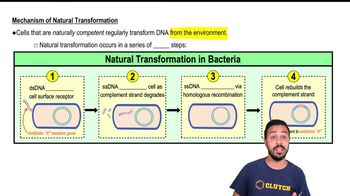
Bacteria can gain antibiotic resistance through genetic changes such as mutations, horizontal gene transfer via conjugation, transformation, and transposon insertion. These mechanisms enable bacteria to survive antibiotic exposure by altering target sites, producing enzymes, or reducing drug uptake.
Recommended video:
Guided course
03:49
Mechanism of Natural Transformation

Horizontal Gene Transfer in Bacteria

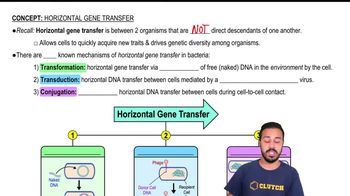
Horizontal gene transfer allows bacteria to exchange genetic material, spreading resistance genes rapidly. Key methods include conjugation (direct cell-to-cell transfer), transformation (uptake of free DNA), and transduction (via bacteriophages). These processes contribute significantly to antibiotic resistance dissemination.
Recommended video:
Guided course
04:42
Horizontal Gene Transfer

Role of snRNPs in Cells

Small nuclear ribonucleoproteins (snRNPs) are involved in RNA splicing within eukaryotic cells and are not related to bacterial antibiotic resistance. They function in processing pre-mRNA, making them irrelevant to bacterial gene transfer or mutation mechanisms.
Recommended video:
Guided course
03:53
Regulatory T Cells
Related Practice
Textbook Question

Match the following examples of mutagens.

1602
views

Textbook Question

The following is a code for a strand of DNA.

a. Using the genetic code provided in Figure 8.8, fill in the blanks to complete the segment of DNA shown.

b. Fill in the blanks to complete the sequence of amino acids coded for by this strand of DNA.

c. Write the code for the complementary strand of DNA completed in part (a).

d. What would be the effect if C were substituted for T at base 10?

e. What would be the effect if A were substituted for G at base 11?

f. What would be the effect if G were substituted for T at base 14?

g. What would be the effect if C were inserted between bases 9 and 10?

h. How would UV radiation affect this strand of DNA?

i. Identify a nonsense sequence in this strand of DNA.

1491
views
Textbook Question

Feedback inhibition differs from repression because feedback inhibition

a. Is less precise.

b. Is slower acting.

c. Stops the action of preexisting enzymes.

d. Stops the synthesis of new enzymes.

e. All of the above

1003
views
Textbook Question

Suppose you inoculate three flasks of minimal salts broth with E. coli. Flask A contains glucose. Flask B contains glucose and lactose. Flask C contains lactose. After a few hours of incubation, you test the flasks for the presence of ß-galactosidase. Which flask(s) do you predict will have this enzyme?

a. A

b. B

c. C

d. A and B

e. B and C

1524
views
Textbook Question

Identify and mark each of the following on the portion of DNA undergoing replication: replication fork, DNA polymerase, RNA primer, parent strands, leading strand, lagging strand, the direction of replication on each strand, and the 5′ end of each strand.

1482
views
Textbook Question

Plasmids differ from transposons in that plasmids

a. become inserted into chromosomes.

b. are self-replicated outside the chromosome.

c. move from chromosome to chromosome.

d. carry genes for antibiotic resistance.

e. none of the above

1457
views