
Ch. 8 - Microbial Genetics
Tortora - Microbiology: An Introduction 14th Edition
Tortora14th EditionMicrobiology: An IntroductionISBN: 9780138200398Not the one you use?Change textbook
Chapter 8, Problem 7

Use the following choices to answer the question:
a. Catabolite repression
b. DNA polymerase
c. Induction
d. Repression
e. Translation


Mechanism by which the presence of glucose inhibits the lac operon.

Verified step by step guidance
1
Identify the key concept in the question: it asks for the mechanism by which glucose presence inhibits the lac operon.
Recall that the lac operon is a set of genes involved in lactose metabolism, and its expression is regulated depending on the availability of glucose and lactose.
Understand that when glucose is present, the cell prefers to use it over lactose, so it suppresses the lac operon to conserve energy.
Recognize that this suppression mechanism is called catabolite repression, where glucose presence leads to decreased levels of cyclic AMP (cAMP), reducing activation of the lac operon.
Match the correct term from the given choices to this mechanism, which is 'catabolite repression'.

Verified video answer for a similar problem:

This video solution was recommended by our tutors as helpful for the problem above.
Video duration:
4m
Was this helpful?

Key Concepts

Here are the essential concepts you must grasp in order to answer the question correctly.

Catabolite Repression

Catabolite repression is a regulatory mechanism in bacteria where the presence of a preferred carbon source, like glucose, inhibits the expression of genes involved in the metabolism of alternative sugars. In the lac operon, glucose lowers cAMP levels, preventing activation of the CAP protein, thus repressing lac operon transcription.
Recommended video:
Guided course
03:42
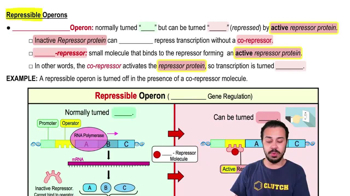
Repressible Operons

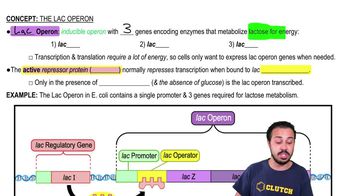
Lac Operon Regulation

The lac operon controls the metabolism of lactose in E. coli and is regulated by both induction and repression mechanisms. When glucose is absent and lactose is present, the operon is induced to produce enzymes for lactose utilization; glucose presence inhibits this process through catabolite repression.
Recommended video:
Guided course
07:06
The Lac Operon

cAMP and CAP Protein Interaction

Cyclic AMP (cAMP) binds to the catabolite activator protein (CAP) to form a complex that enhances RNA polymerase binding to the lac operon promoter. Glucose reduces intracellular cAMP levels, preventing CAP binding and thus inhibiting transcription of the lac operon.
Recommended video:
Related Practice
Textbook Question

Identify when (before transcription, after transcription but before translation, after translation) each of the following regulatory mechanisms functions.

a. ATP combines with an enzyme, altering its shape.

b. A short RNA is synthesized that is complementary to mRNA.

c. Methylation of DNA occurs.

d. An inducer combines with a repressor.

1290
views
Textbook Question

Two offspring cells are most likely to inherit which one of the following from the parent cell?

a. A change in a nucleotide in mRNA

b. A change in a nucleotide in tRNA

c. A change in a nucleotide in rRNA

d. A change in a nucleotide in DNA

e. A change in a protein

1497
views
Textbook Question

Use the following choices to answer the question:

a. Catabolite repression

b. DNA polymerase

c. Induction

d. Repression

e. Translation


The mechanism by which lactose controls the lac operon.

815
views
Textbook Question

Which sequence is the best target for damage by UV radiation: AGGCAA, CTTTGA, or GUAAAU? Why aren’t all bacteria killed when they are exposed to sunlight?

1621
views
Textbook Question

You are provided with cultures with the following characteristics:

Culture 1: F+, genotype A+B+C+

Culture 2: F ̄, genotype A ̄B ̄C ̄

a. Indicate the possible genotypes of a recombinant cell resulting from the conjugation of cultures 1 and 2.

b. Indicate the possible genotypes of a recombinant cell resulting from conjugation of the two cultures after the F+ has become an Hfr cell.

1425
views
Textbook Question

Plasmids differ from transposons in that plasmids

a. become inserted into chromosomes.

b. are self-replicated outside the chromosome.

c. move from chromosome to chromosome.

d. carry genes for antibiotic resistance.

e. none of the above

1457
views