Skip to main content
Microeconomics
My Course
Learn
Exam Prep
AI Tutor
Study Guides
Flashcards
Explore
Try the app
My Course
Learn
Exam Prep
AI Tutor
Study Guides
Flashcards
Explore
Try the app
Back
Characteristics of Monopoly quiz #1
You can tap to flip the card.
Which best describes the availability of substitutes in a monopoly?
You can tap to flip the card.
👆
Which best describes the availability of substitutes in a monopoly?
A monopoly offers unique goods with no close substitutes.
Track progress
Control buttons has been changed to "navigation" mode.
1/37
Related flashcards
Related practice
Recommended videos
Characteristics of Monopoly quiz #2
Characteristics of Monopoly
38 Terms
Characteristics of Monopoly quiz #3
Characteristics of Monopoly
11 Terms
Characteristics of Monopoly definitions
Characteristics of Monopoly
15 Terms
Characteristics of Monopoly
12. Monopoly
10 problems
Topic
Monopoly Revenue
12. Monopoly
9 problems
Topic
12. Monopoly
9 topics
13 problems
Chapter
Guided course
06:29
Monopoly Barriers to Entry
3390
views
40
rank
Guided course
02:48
Characteristics of Monopoly
3969
views
64
rank
Guided course
04:17
Monopoly Demand Curve
2880
views
20
rank
1
comments
Terms in this set (37)
Hide definitions
Which best describes the availability of substitutes in a monopoly?
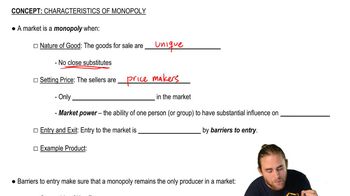
A monopoly offers unique goods with no close substitutes.
What is true about the relationship between a monopoly and its competition in a market?
A monopoly faces no competition because it is the sole producer in the market.
What is a natural monopoly?
A natural monopoly occurs when economies of scale make it most efficient for a single firm to supply the entire market.
What is true of a monopoly?
A monopoly is a price maker with substantial market power.
What causes a natural monopoly to arise?
A natural monopoly arises due to large economies of scale and high fixed costs.
Which type of industry has a limited number of competing firms?
An oligopoly has a limited number of competing firms.
What qualities would ideally suit a monopolistic firm with regard to barriers to entry?
High barriers to entry such as ownership of key resources, government regulation, and economies of scale.
Why is a monopolist considered a price maker?
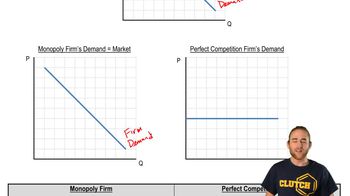
A monopolist is the sole producer and faces the entire market demand curve.
What is an example of a monopoly?
A local electricity utility company.
What are the main characteristics of a pure monopoly?
Single producer, unique product, price maker, and barriers to entry.
In monopolistic competition, how many firms are present?
There are many firms, each selling differentiated products.
What is a necessary characteristic of a monopoly?
A monopoly must have barriers to entry.
What is true about a monopolistically competitive firm?
It faces a downward-sloping demand curve and sells differentiated products.
What is the typical shape of a monopolist's total cost curve?
The total cost curve typically increases with output, reflecting high fixed costs and lower variable costs.
How does the monopoly determine the level of output that maximizes profit?
A monopoly maximizes profit where marginal revenue equals marginal cost.
How is a monopolist most accurately described?
A monopolist is the sole producer with significant control over price.
What is true about a firm operating under a monopoly?
The firm faces the entire market demand curve and can set prices.
What is a correct statement regarding monopolies?
Monopolies have market power and can restrict output to raise prices.
What scenario represents a monopoly?
A single firm supplies all electricity to a city.
What is true about a monopoly in terms of pricing?
A monopoly can set prices due to lack of competition.
Which term is not used by monopolists to determine how to maximize profit?
Supply curve is not used by monopolists to determine profit maximization.
What is true about the demand curve faced by a monopolist?
A monopolist faces a downward-sloping demand curve.
Which phrase would be most characteristic of pure monopoly?
Single seller with no close substitutes.
Netflix is an example of what type of market structure?
Netflix operates in a market with monopoly-like characteristics due to limited substitutes.
Would a monopolist still produce if they are getting zero profit?
A monopolist may continue to produce if covering variable costs, even with zero profit.
What kind of company could be considered a monopoly?
A company with exclusive rights to a patented product.
What is a benefit of monopolies relative to perfectly competitive markets?
Monopolies may achieve economies of scale, lowering average costs.
What is an essential characteristic of a monopoly?
Barriers to entry.
What is true about a firm under monopoly?
The firm can influence the market price.
Which statement describes a monopoly?
A monopoly is a market with one producer and no close substitutes.
Which type of free market has no competition?
A monopoly has no competition.
Which statement concerning monopolists and a product's price is true?
Monopolists set prices above marginal cost.
What is always true for a firm with monopsony power?
It is the sole buyer in the market.
What is an example of a price-discriminating monopoly?
A movie theater charging different prices for children and adults.
How is a monopolist most accurately described?
A monopolist is the only seller in the market with control over price.
Which type of firm would likely pose the least competitive threat?
A firm with exclusive control over a key resource.
For a monopoly firm, what is the relationship between price and marginal revenue?
Price is greater than marginal revenue.
 BackBack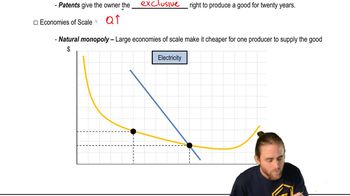
 06:29
06:29