Skip to main content
Microeconomics
My Course
Learn
Exam Prep
AI Tutor
Study Guides
Flashcards
Explore
Try the app
My Course
Learn
Exam Prep
AI Tutor
Study Guides
Flashcards
Explore
Try the app
Back
Characteristics of Monopoly quiz #2
You can tap to flip the card.
What are potential barriers to entry that could lead to a monopoly market?
You can tap to flip the card.
👆
What are potential barriers to entry that could lead to a monopoly market?
Ownership of key resources, government regulation, economies of scale.
Track progress
Control buttons has been changed to "navigation" mode.
1/38
Related flashcards
Related practice
Recommended videos
Characteristics of Monopoly quiz #1
Characteristics of Monopoly
37 Terms
Characteristics of Monopoly quiz #3
Characteristics of Monopoly
11 Terms
Characteristics of Monopoly definitions
Characteristics of Monopoly
15 Terms
Characteristics of Monopoly
12. Monopoly
10 problems
Topic
Monopoly Revenue
12. Monopoly
9 problems
Topic
12. Monopoly
9 topics
13 problems
Chapter
Guided course
06:29
Monopoly Barriers to Entry
3390
views
40
rank
Guided course
02:48
Characteristics of Monopoly
3969
views
64
rank
Guided course
04:17
Monopoly Demand Curve
2880
views
20
rank
1
comments
Terms in this set (38)
Hide definitions
What are potential barriers to entry that could lead to a monopoly market?
Ownership of key resources, government regulation, economies of scale.
What is a characteristic of a natural monopoly?
High fixed costs and economies of scale.
How does a monopolist typically adjust price to sell more units?
A monopolist lowers price to sell more units.
Monopolists are criticized because they are inefficient. What is meant by this statement?
Monopolists restrict output and charge higher prices, leading to deadweight loss.
Which market structure is defined by a single producer?
Monopoly.
In a pure monopoly, which two terms are synonymous?
Firm and industry.
What is a potential barrier to entry into a monopoly market?
Government-issued patents.
What did monopolies threaten?
Monopolies threaten competition and consumer choice.
What pricing behavior does a perfect price discriminating monopolist exhibit?
It charges each consumer the maximum they are willing to pay.
What phrases describe a monopoly market?
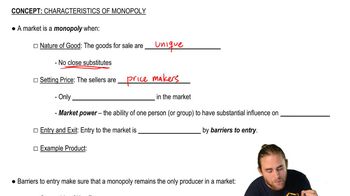
Single seller, unique product, barriers to entry.
A monopolist is able to maximize its profits by
Producing where marginal revenue equals marginal cost.
A monopolistically competitive firm may earn abnormally high profits in the
Short run.
A monopolist maximizes profits by
Setting output where marginal revenue equals marginal cost.
By charging consumers the highest price they are willing and able to pay, the pure monopoly:
Engages in perfect price discrimination.
Why can a professional sports team be considered a monopoly?
It is the sole provider of a unique product in a specific location.
What is an example of a price-discriminating monopoly?
Airlines charging different fares for the same flight.
The MR curve of a perfectly competitive firm is horizontal. The MR curve of a monopoly firm is:
Downward sloping.
What is a non price discriminating monopoly?
A monopoly that charges the same price to all consumers.
The additional revenue a monopolist receives from selling an additional unit of output is
Marginal revenue.
What can cause a monopoly to lose economic profit?
Rising costs or falling demand.
The lack of competition within a monopoly means that
The monopolist can set prices above competitive levels.
A firm that holds a monopoly position in the marketplace is
A price maker with market power.
Indicate the point where a monopoly will set its output.
Where marginal revenue equals marginal cost.
Where does a monopoly set its price on a graph?
At the price corresponding to the profit-maximizing output on the demand curve.
A monopoly is a market that has
One producer and no close substitutes.
What is a source of monopoly power?
Ownership of key resources.
Which supplier is most likely to be a monopolist?
A local water utility.
What is an example of monopolistic competition?
Restaurants offering different cuisines in a city.
Monopolies are socially inefficient because the price they charge is
Higher than marginal cost, reducing consumer surplus.
What characteristic is not true of a monopoly?
Many sellers.
One defining characteristic of pure monopoly is that the
Firm is the sole producer in the market.
In economics, a firm that faces no competitors is referred to as _________________.
A monopoly.
There are many differences between a market served by a monopoly and a market served by perfect competition. Name one.
A monopoly sets prices, while perfect competition has price takers.
Market segregation must exist in order for a monopolist to
Engage in price discrimination.
A monopolist does not have a supply curve because:
It sets both price and quantity, not responding to market price.
For a monopolistic firm, the demand for its product is
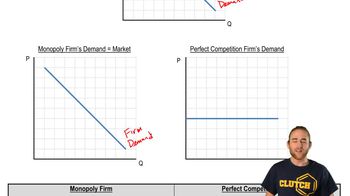
The market demand curve, which is downward sloping.
A government-created monopoly arises when
The government grants exclusive rights, such as patents.
Monopoly firms face
Downward-sloping demand curves.
 BackBack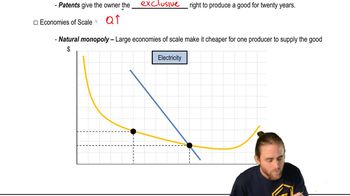
 06:29
06:29