Skip to main content
Microeconomics
My Course
Learn
Exam Prep
AI Tutor
Study Guides
Flashcards
Explore
Try the app
My Course
Learn
Exam Prep
AI Tutor
Study Guides
Flashcards
Explore
Try the app
Back
Marginal Analysis quiz #1
You can tap to flip the card.
What is the best definition of marginal cost?
You can tap to flip the card.
👆
What is the best definition of marginal cost?
Marginal cost is the additional cost incurred from producing one more unit of a good or service.
Track progress
Control buttons has been changed to "navigation" mode.
1/40
Related flashcards
Related practice
Recommended videos
Marginal Analysis quiz #2
Marginal Analysis
40 Terms
Marginal Analysis quiz #3
Marginal Analysis
40 Terms
Marginal Analysis quiz #4
Marginal Analysis
25 Terms
Marginal Analysis
0. Basic Principles of Economics
9 problems
Topic
Allocative Efficiency, Productive Efficiency, and Equality
0. Basic Principles of Economics
10 problems
Topic
0. Basic Principles of Economics
13 topics
14 problems
Chapter
Guided course
09:36
Marginal Analysis
10268
views
288
rank
Terms in this set (40)
Hide definitions
What is the best definition of marginal cost?
Marginal cost is the additional cost incurred from producing one more unit of a good or service.
What is the best definition of marginal revenue?
Marginal revenue is the additional revenue gained from selling one more unit of a good or service.
What is the best definition of marginal benefit?
Marginal benefit is the additional satisfaction or utility received from consuming one more unit of a good or service.
Which statement best describes marginal tax rates?
Marginal tax rates refer to the rate of tax applied to each additional dollar of income.
Why would an already-successful business owner conduct a marginal cost analysis for their product?
To determine if producing additional units will increase profits by comparing the extra costs and benefits.
All else being equal, what does marginal analysis help determine?
It helps determine the optimal level of production or consumption by comparing additional costs and benefits.
Why is marginal product an important concept for business owners to understand?
It shows how much additional output is produced by adding one more unit of input, helping optimize resource allocation.
What does increasing marginal opportunity costs mean?
It means that producing each additional unit of a good requires giving up increasingly more of another good.
Which is the first step in marginal analysis?
Identify the additional costs and benefits of one more unit of an activity.
What does a high marginal propensity to consume imply?
People spend a large portion of any additional income they receive.
Which statement best illustrates the concept of diminishing marginal utility?
Each additional slice of pizza provides less satisfaction than the previous one.
What best describes a marginal investor?
A marginal investor is one who makes decisions based on the additional benefit and cost of investing one more unit.
What type of cost can be saved by not producing the last unit?
The marginal cost associated with that unit.
What is marginal revenue?
It is the extra revenue from selling one additional unit of output.
When is marginal cost at its minimum?
Marginal cost is at its minimum when increasing production no longer decreases the cost of each additional unit.
What typically happens to marginal utility as more of a good or service is consumed in a given period of time?
Marginal utility typically decreases with each additional unit consumed.
Which description best captures the idea of marginal thinking?
Marginal thinking involves considering the additional costs and benefits of a small change in activity.
Which best expresses the law of diminishing marginal utility?
As more units of a good are consumed, the additional satisfaction from each unit decreases.
What is an example of how marginal thinking works?
Deciding whether to eat one more slice of pizza by comparing its extra benefit and cost.
If marginal cost exceeds average total cost in the short run, what does this indicate?
Average total cost is rising.
How is marginal analysis or decision-making best described?
Comparing the additional benefits and costs of a decision.
What happens to marginal cost if a business’s average total cost is decreasing?
Marginal cost is less than average total cost.
What is the marginal revenue received from the 11th unit?
It is the increase in total revenue from selling the 11th unit.
Refer to table 13-9. What is the marginal product of the third worker?
It is the additional output produced by hiring the third worker.
Refer to table 14-4. What is the marginal revenue from selling the 3rd unit?
It is the increase in total revenue from selling the third unit.
Refer to table 13-2. What is the marginal product of the fourth worker?
It is the additional output produced by hiring the fourth worker.
Refer to table 14-4. What is the marginal revenue from selling the 4th unit?
It is the increase in total revenue from selling the fourth unit.
Which situation is consistent with the law of diminishing marginal utility?
Getting less satisfaction from each additional slice of pizza eaten.
What is true about the marginal productivity of any resource?
It typically decreases as more of the resource is used, due to diminishing returns.
Which example was used to explain marginal benefit and marginal cost?
Eating slices of pizza.
What does the marginal propensity to consume measure?
It measures the fraction of additional income that is spent on consumption.
Consider the following chart. What is the marginal product of labor (MPL) of the seventh worker?
It is the increase in output from hiring the seventh worker.
Refer to the table below. What is the marginal cost of producing the 200th pizza?
It is the increase in total cost from producing the 200th pizza.
Where does the marginal cost (MC) curve intersect the average variable cost (AVC) curve?
At the minimum point of the AVC curve.
Consider the following chart. What is the marginal product of labor (MPL) of the fifth worker?
It is the increase in output from hiring the fifth worker.
What is the relationship between variable costs and output?
Variable costs increase as output increases.
What is the marginal revenue (MR) of the inverse linear demand function?
It is the derivative of total revenue with respect to quantity, reflecting the change in revenue from selling one more unit.
What most likely will happen if the pie maker continues to make additional pies?
Marginal cost will eventually exceed marginal benefit, leading to overproduction.
Which economic principle pertains to how a change in a property affects its value as a whole?
Marginal analysis.
Which scenario best illustrates the law of diminishing marginal utility?
A person enjoys each additional slice of pizza less than the previous one.
 BackBack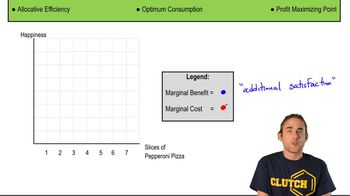
 09:36
09:36