 Back
BackMicroeconomics Key Concepts
 14:23
14:23
Terms in this set (28)
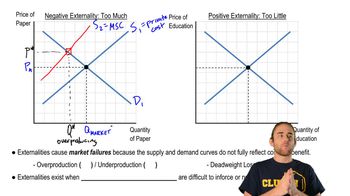
A positive externality occurs when a third party benefits from a transaction they are not involved in, leading to underproduction from a social perspective.
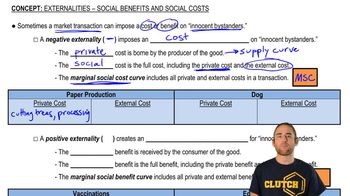
A negative externality occurs when a third party suffers a cost from a transaction they are not involved in, causing overproduction relative to the social optimum.
Deadweight loss is the loss of economic efficiency when the equilibrium outcome is not socially optimal due to externalities.
Private cost is the cost borne by producers, while social cost includes private cost plus external costs to society.
Price elasticity types: price elasticity of demand, price elasticity of supply, income elasticity of demand, cross-price elasticity of demand, and elasticity of supply.
Price elasticity of demand = \(\frac{\%\text{ change in quantity demanded}}{\%\text{ change in price}}\).
Determinants include availability of substitutes, necessity vs luxury, time horizon, and proportion of income spent on the good.
Income elasticity of demand measures how quantity demanded changes as consumer income changes.
Cross-price elasticity measures how quantity demanded of one good changes in response to the price change of another good.
Comparative advantage is when a producer can produce a good at a lower opportunity cost than another.
Gains from trade arise when countries specialize according to comparative advantage and trade, increasing overall welfare.
Tariffs reduce trade volume, cause deadweight loss, and generally decrease overall economic welfare.
Utility is satisfaction from consumption; marginal utility is the additional satisfaction from consuming one more unit.
The law of diminishing marginal utility states that as consumption increases, marginal utility decreases.
Consumers maximize utility by allocating spending so that marginal utility per dollar is equal across all goods.
A budget constraint represents all combinations of goods a consumer can afford given income and prices.
Indifference curves show combinations of goods providing the same utility to a consumer.
Consumer equilibrium occurs where the budget line is tangent to an indifference curve, maximizing utility given the budget.
Income effect is change in consumption due to purchasing power change; substitution effect is change due to relative price change.
Explicit costs are direct monetary payments; implicit costs are opportunity costs of using owned resources.
The law of diminishing returns states that adding more of one input, holding others fixed, eventually yields smaller output increases.
Short run has at least one fixed input; long run all inputs are variable.
TC = FC + VC; FC do not vary with output; VC vary with output level.
ATC = TC/output, AVC = VC/output, AFC = FC/output.
Marginal cost is the additional cost of producing one more unit of output.
Marginal product is the additional output from using one more unit of input.
Economies of scale occur when long-run average costs decrease as output increases.
Isoquants show input combinations producing the same output; isocosts show input combinations with the same total cost.