Which molecule acts as a precursor for vitamin D synthesis in the body?
Cholesterol acts as a precursor for vitamin D synthesis in the body, which is converted to vitamin D3 when the skin is exposed to sunlight.
Which vitamins are classified as fat-soluble vitamins?
The fat-soluble vitamins are vitamins A, D, E, and K.
Which vitamin is not classified as a fat-soluble vitamin?
Any vitamin other than A, D, E, or K is not a fat-soluble vitamin; for example, vitamin C and the B vitamins are water-soluble.
What is the main function of vitamin K in the body?
The main function of vitamin K is to enable blood clotting (coagulation).
Which vitamin is synthesized in the skin upon exposure to sunlight?
Vitamin D is synthesized in the skin when it is exposed to sunlight.
What skin function is necessary for the synthesis of vitamin D from sunlight?
The conversion of a cholesterol precursor in the skin to vitamin D3 upon exposure to sunlight is necessary for vitamin D synthesis.
What is the primary function of vitamin D in the body?
Vitamin D is vital for immune function and bone health, primarily by regulating calcium and phosphorus absorption.
Which vitamin is essential for maintaining epithelial tissues?
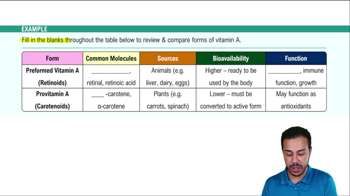
Vitamin A is essential for maintaining epithelial tissues.
What is a key difference between the absorption of fat-soluble and water-soluble vitamins?
Fat-soluble vitamins require dietary fat and are absorbed via micelles and chylomicrons, while water-soluble vitamins are absorbed directly into the bloodstream.
Where are fat-soluble vitamins primarily stored in the body?
Fat-soluble vitamins are primarily stored in the liver, muscles, and fatty tissues.
What is a potential risk associated with the storage of fat-soluble vitamins?
Because fat-soluble vitamins are stored in the body, they are more prone to toxicity if consumed in excess.
Which vitamin is known as the 'sunshine vitamin' and why?
Vitamin D is known as the 'sunshine vitamin' because it is synthesized in the skin upon exposure to sunlight.
What is the main dietary source of vitamin K1?
Vitamin K1 (phylloquinone) is primarily found in green leafy vegetables.
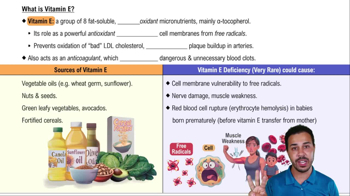
How does vitamin E function in the body?
Vitamin E functions as a powerful antioxidant, protecting cell membranes from free radicals and preventing the oxidation of LDL cholesterol.
 Back
Back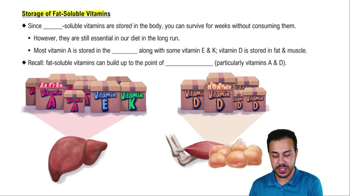
 01:33
01:33