What is the definition of a mineral in the context of nutrition?
A mineral is an essential inorganic micronutrient, which is a chemical element found on the periodic table and required in the diet for various bodily functions.
What are the five characteristics that define a mineral?
A mineral is naturally occurring, inorganic, solid, has a definite chemical composition, and possesses an ordered atomic arrangement.
What is the difference between major minerals and trace minerals?
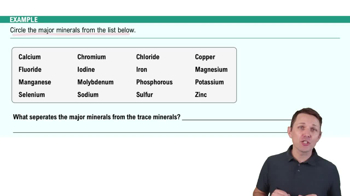
Major minerals are needed in amounts greater than 100 milligrams per day, while trace minerals are required in amounts less than 100 milligrams per day.
Which minerals are classified as major minerals?
Major minerals include sodium, potassium, calcium, phosphorus, chloride, magnesium, and sulfur.
Which minerals are classified as trace minerals?
Trace minerals include iron, copper, fluoride, iodide (iodine), zinc, selenium, chromium, manganese, and molybdenum.
What is a trace mineral?
A trace mineral is an essential inorganic nutrient required by the body in amounts less than 100 milligrams per day.
Is sugar considered a mineral?
No, sugar is not a mineral because it is an organic compound and minerals are inorganic.
Is plastic considered a mineral?
No, plastic is not a mineral because it is a synthetic organic material and minerals are naturally occurring inorganic substances.
Can a mineral be a liquid?
No, minerals are defined as solid substances with an ordered atomic arrangement.
What is the arrangement of atoms in a mineral?
Minerals have an ordered atomic arrangement, meaning their atoms are organized in a specific, repeating pattern.
Which phrase does not describe a mineral?
A phrase that does not describe a mineral is 'organic compound,' since minerals are inorganic.
In general, daily mineral requirements are correlated with what factor?
Daily mineral requirements are correlated with whether the mineral is classified as a major or trace mineral, based on the amount needed by the body.
What mineral is the major component of rock salt?
Sodium is the major mineral component of rock salt.
Which substance is not a mineral: sugar, sodium, calcium, or iron?
Sugar is not a mineral; sodium, calcium, and iron are minerals.
Which mineral is classified as a trace mineral: iron, sodium, calcium, or phosphorus?
Iron is a trace mineral; sodium, calcium, and phosphorus are major minerals.
What are some key functions of minerals in the human body?
Minerals serve structural roles in bones, act as enzyme cofactors, and maintain water balance as electrolytes, which are essential for nerve and muscle function.
 Back
Back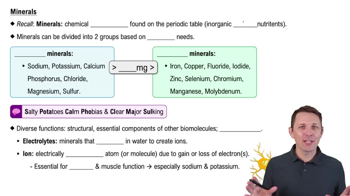
 05:33
05:33