Back

Introduction to Vitamins quiz #1

Control buttons has been changed to "navigation" mode.
1/10
  • What are the key characteristics that define a vitamin?

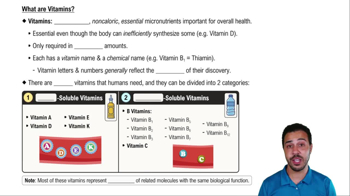
    Vitamins are essential organic micronutrients required in small amounts, are non-caloric (do not provide energy or calories), and play crucial roles in maintaining health. They must be obtained from the diet because the body cannot synthesize enough of them.
  • How many calories per gram do vitamins provide?

    Vitamins provide zero calories per gram; they are non-caloric and do not directly supply energy to the body.
  • What is the main structural difference between vitamins and minerals?

    Vitamins are organic molecules containing carbon-hydrogen bonds, while minerals are inorganic and do not contain carbon-hydrogen bonds. This distinction affects their classification as micronutrients.
  • Why are some vitamin letters and numbers missing from the list of known vitamins?

    Some vitamin letters and numbers were retired because certain molecules were reclassified after being found not to be vitamins. This led to gaps and inconsistencies in the vitamin naming system.
  • How are vitamins typically named, and what does their naming convention reflect?

    Vitamins are named using letters and sometimes numbers, which generally reflect the order of their discovery. This system can result in gaps due to reclassification of some compounds.
  • What is the difference between provitamins and preformed vitamins in terms of usability by the body?

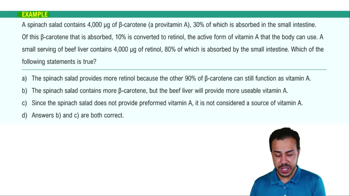
    Provitamins are inactive precursors that must be converted into active forms before use, while preformed vitamins are already in active forms and can be used immediately. This affects how quickly and efficiently the body can utilize them.
  • Which vitamins represent individual molecules rather than groups of related molecules?

    Only vitamin B7 and vitamin C represent individual molecules. The other vitamins are groups of related molecules with the same biological function.
  • What does bioavailability mean in the context of vitamins?

    Bioavailability refers to the percentage of a consumed vitamin that is actually absorbed and available for use in the body. It is often expressed as a percentage and varies depending on the vitamin source and form.
  • Why are plant-based, fat-soluble, and provitamin sources generally less bioavailable?

    These sources are less bioavailable because the vitamins are either in inactive forms, harder to absorb, or require conversion before use. Animal-based, water-soluble, and preformed vitamins are typically more readily absorbed.
  • How do antioxidants protect cells from damage caused by free radicals?

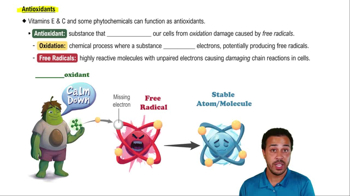
    Antioxidants donate electrons to free radicals, stabilizing them and preventing damaging chain reactions in cells. This helps protect cell membranes, proteins, and DNA from oxidative damage.