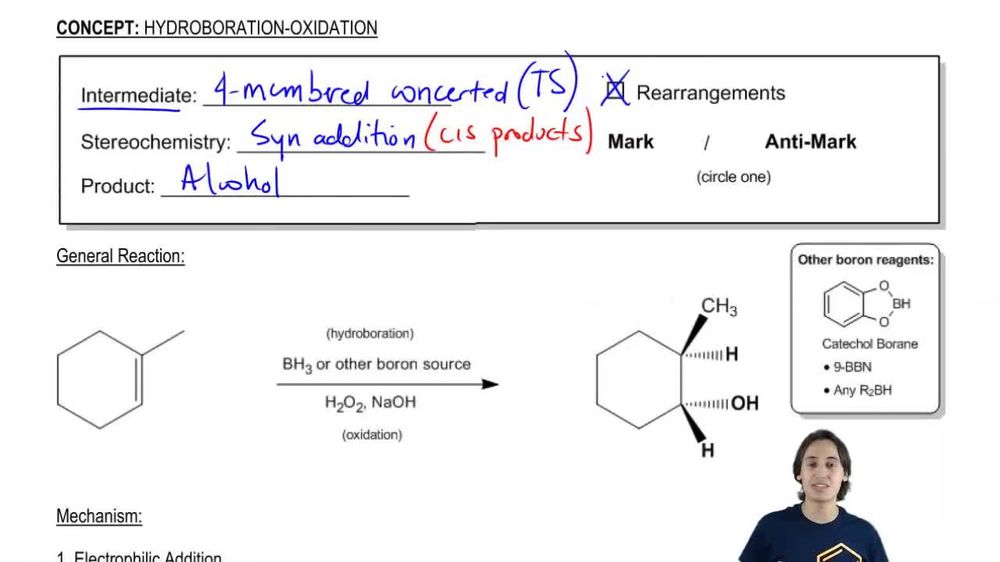
Which is more highly regioselective: reaction of an alkene with BH3 or with 9-BBN?
Verified step by step guidance
1
Understand the concept of regioselectivity: Regioselectivity refers to the preference of a chemical reaction to produce one structural isomer over another when multiple outcomes are possible. In the context of hydroboration, regioselectivity determines which carbon in the alkene will bond to the boron atom.
Recall the hydroboration mechanism: In the hydroboration of an alkene, the boron atom adds to the less substituted carbon (anti-Markovnikov addition), while the hydrogen adds to the more substituted carbon. This is due to steric and electronic factors.
Compare BH3 and 9-BBN: BH3 (borane) is a smaller, less sterically hindered molecule, while 9-BBN (9-borabicyclo[3.3.1]nonane) is a bulky boron reagent. The bulkiness of 9-BBN increases its steric hindrance, making it more selective in targeting the less substituted carbon of the alkene.
Explain why 9-BBN is more regioselective: The increased steric hindrance of 9-BBN forces it to approach the alkene in a more controlled manner, favoring the addition to the less substituted carbon. This makes 9-BBN more highly regioselective compared to BH3.
Conclude the comparison: While both BH3 and 9-BBN follow the same anti-Markovnikov addition pattern, 9-BBN exhibits greater regioselectivity due to its bulkier structure, which limits alternative reaction pathways and enhances selectivity for the less substituted carbon.
Verified video answer for a similar problem:
This video solution was recommended by our tutors as helpful for the problem above
Video duration:
3m
Play a video:
0 Comments
Key Concepts
Here are the essential concepts you must grasp in order to answer the question correctly.
Regioselectivity
Regioselectivity refers to the preference of a chemical reaction to yield one structural isomer over others when multiple isomers are possible. In the context of alkene reactions, it indicates which carbon atom of the alkene is more likely to bond with a reagent, leading to the formation of a specific product. Understanding regioselectivity is crucial for predicting the outcome of reactions involving alkenes.
Hydroboration is a chemical reaction that involves the addition of borane (BH3) or its derivatives to alkenes, resulting in the formation of organoboranes. This reaction is characterized by its anti-Markovnikov selectivity, where the boron atom attaches to the less substituted carbon of the alkene. The regioselectivity of hydroboration is influenced by the sterics and electronics of the alkene and the boron reagent used.
9-BBN (9-borabicyclo[3.3.1]nonane) is a bulky boron reagent used in hydroboration reactions. Its structure provides unique steric properties that enhance regioselectivity, often favoring the formation of less substituted products. When comparing 9-BBN to BH3, the bulkiness of 9-BBN typically leads to higher regioselectivity in reactions with alkenes, making it a valuable reagent in synthetic organic chemistry.

 3:27 minutes
 Verified step by step guidance
 05:09
05:09