

Sometimes chemists need the unnatural D enantiomer of an amino acid, often as part of a drug or an insecticide. Most L-amino acids are isolated from proteins, but the D-amino acids are rarely found in natural proteins. D-amino acids can be synthesized from the corresponding L-amino acids. The following synthetic scheme is one of the possible methods. (a) Draw the structures of intermediates 1 and 2 in this scheme. (b) How do we know that the product is entirely the unnatural D configuration?
Verified step by step guidance
1
Step 1: Analyze the reaction scheme provided. The starting material is an L-amino acid with the general structure NH₂-CHR-COOH, where the amino group is in the L-configuration. The first reaction involves NaNO₂ and HCl, which converts the amino group into a diazonium salt intermediate (Intermediate 1). This step replaces the NH₂ group with a diazonium group (-N₂⁺).
Step 2: The second reaction involves NaN₃ (sodium azide), which reacts with the diazonium salt (Intermediate 1) to form Intermediate 2. In this step, the diazonium group (-N₂⁺) is replaced by an azide group (-N₃). This intermediate is crucial for the stereochemical inversion in the next step.
Step 3: The final reaction involves hydrogenation (H₂/Pd catalyst), which reduces the azide group (-N₃) in Intermediate 2 to an amino group (-NH₂). During this reduction, the stereochemistry at the chiral center is inverted, resulting in the D-configuration of the amino acid.
Step 4: To confirm that the product is entirely in the unnatural D-configuration, the stereochemical inversion during the hydrogenation step is key. The inversion occurs because the azide intermediate allows for a backside attack during the reduction process, flipping the configuration from L to D.
Step 5: The synthetic scheme ensures that the product is entirely in the D-configuration due to the stereochemical control in the reduction step. This is verified by analyzing the stereochemistry of the final product using techniques such as optical rotation or chiral chromatography.
Verified video answer for a similar problem:
This video solution was recommended by our tutors as helpful for the problem above
Video duration:
5m
Play a video:
0 Comments
Key Concepts
Here are the essential concepts you must grasp in order to answer the question correctly.
Enantiomers and Chirality
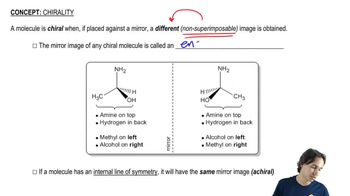
Enantiomers are a pair of molecules that are non-superimposable mirror images of each other, often due to the presence of a chiral center, typically a carbon atom bonded to four different groups. Chirality is a fundamental concept in organic chemistry, particularly in the study of amino acids and pharmaceuticals, as the biological activity of molecules can differ significantly between enantiomers.
D-amino acids can be synthesized from their corresponding L-amino acids through various chemical reactions, such as racemization or specific enzymatic processes. Understanding the synthetic pathways and mechanisms involved is crucial for chemists to produce the desired enantiomer for applications in drug development and other fields.
Synthesis of Amino Acids: Strecker Synthesis Example 1
Determining Configuration
To confirm that a product is entirely in the unnatural D configuration, chemists often use techniques such as optical rotation measurements or chiral chromatography. These methods allow for the analysis of the optical activity of the compound, which is directly related to its stereochemistry, thus providing evidence of the enantiomeric purity of the synthesized product.