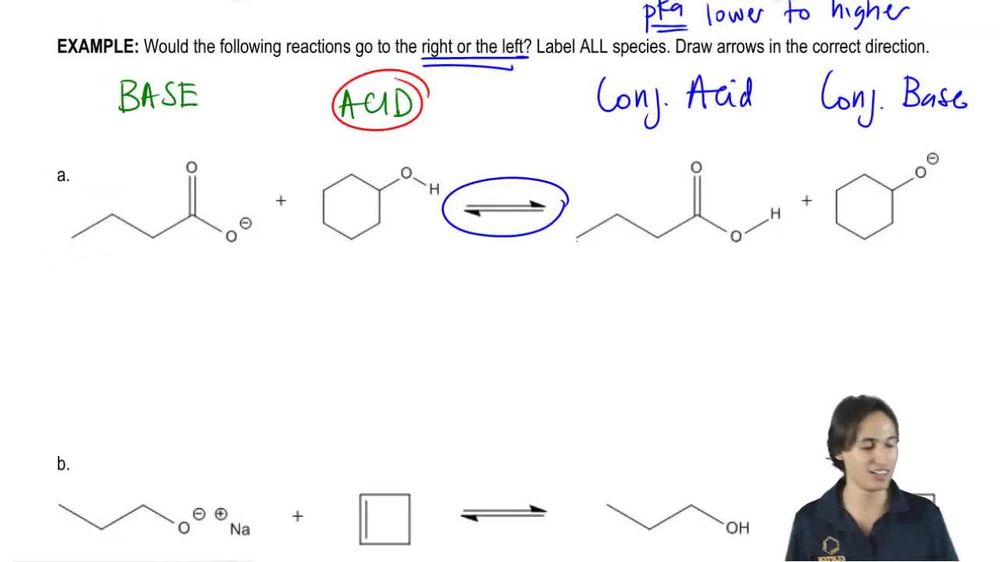
From which of the following compounds can HO− remove a proton in a reaction that favors product formation?
Verified step by step guidance
1
Step 1: Understand the concept of acidity and basicity. Hydroxide ion (HO⁻) acts as a base and can remove a proton (H⁺) from a compound if the compound has an acidic proton. The reaction will favor product formation if the resulting conjugate base is more stable than the original base.
Step 2: Evaluate the acidity of the compounds provided. Look for factors that increase acidity, such as electronegativity of the atom bonded to the proton, resonance stabilization of the conjugate base, and inductive effects from electronegative groups.
Step 3: Compare the pKa values of the compounds. A lower pKa value indicates a stronger acid, meaning the compound is more likely to donate a proton to HO⁻. If the pKa of the compound is significantly lower than the pKa of water (15.7), the reaction is likely to favor product formation.
Step 4: Analyze the stability of the conjugate base formed after the proton is removed. Stability can be enhanced by resonance, inductive effects, or the presence of electronegative atoms. If the conjugate base is stable, the reaction will favor product formation.
Step 5: Determine which compound has the most acidic proton based on the above factors. The compound with the most acidic proton will be the one from which HO⁻ can remove a proton in a reaction that favors product formation.
Verified video answer for a similar problem:
This video solution was recommended by our tutors as helpful for the problem above
Video duration:
5m
Play a video:
0 Comments
Key Concepts
Here are the essential concepts you must grasp in order to answer the question correctly.
Acidity and Basicity
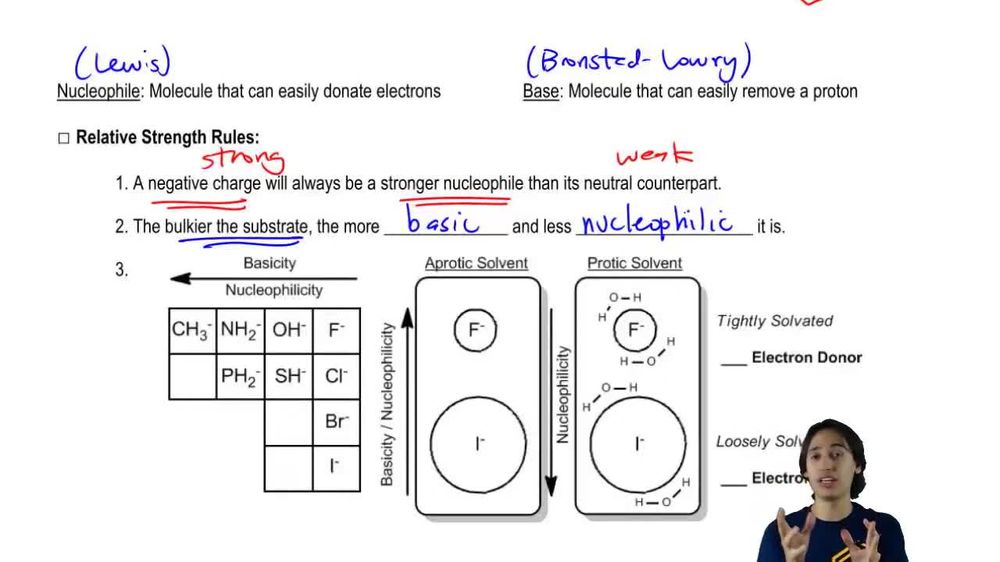
Acidity refers to the tendency of a compound to donate protons (H+ ions), while basicity is the ability to accept protons. In organic chemistry, the strength of an acid is often measured by its pKa value; lower pKa values indicate stronger acids. Understanding the relative acidity of compounds is crucial for predicting which can be deprotonated by hydroxide ions (HO−) in a reaction.
Understanding the difference between basicity and nucleophilicity.
Equilibrium and Reaction Favorability
Chemical reactions reach a state of equilibrium where the rate of the forward reaction equals the rate of the reverse reaction. The position of equilibrium is influenced by the stability of the products and reactants. A reaction favors product formation when the products are more stable than the reactants, often determined by factors such as bond strength and sterics.
Proton transfer reactions involve the transfer of a proton from an acid to a base. In the context of the question, HO− acts as a base that can remove a proton from an acidic compound. The ability of HO− to effectively remove a proton depends on the acidity of the compound in question and the stability of the resulting conjugate base.