Using pKₐ values, calculate the equilibrium constants for the following acid–base reactions. (b)
Verified step by step guidance
1
Identify the acids and bases in the reaction. Determine which species is the acid and which is the conjugate acid, as well as the base and its conjugate base.
Write the general relationship between the equilibrium constant (K_eq) and the pKₐ values of the acids involved in the reaction. The formula is: .
Look up the pKₐ values for the acids on both the reactant and product sides of the reaction. These values are typically found in a pKₐ table.
Substitute the pKₐ values into the formula from step 2. Ensure that the correct pKₐ values are used for the acid on the reactant side and the acid on the product side.
Simplify the expression to calculate the equilibrium constant (K_eq). This will give you the ratio of the concentrations of products to reactants at equilibrium.
Verified video answer for a similar problem:
This video solution was recommended by our tutors as helpful for the problem above
Video duration:
4m
Play a video:
0 Comments
Key Concepts
Here are the essential concepts you must grasp in order to answer the question correctly.
pKₐ and its significance
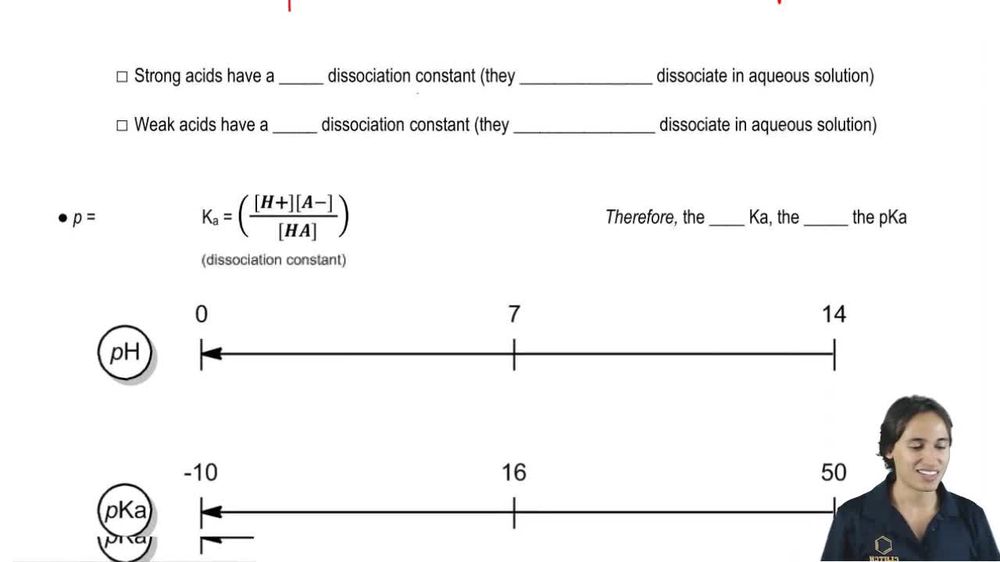
pKₐ is a measure of the strength of an acid in solution, defined as the negative logarithm of the acid dissociation constant (Kₐ). A lower pKₐ value indicates a stronger acid, as it dissociates more completely in water. Understanding pKₐ values is essential for predicting the direction of acid-base reactions and calculating equilibrium constants.
The equilibrium constant (K) quantifies the ratio of the concentrations of products to reactants at equilibrium for a given reaction. For acid-base reactions, K can be derived from the pKₐ values of the acids and bases involved. This relationship allows chemists to determine the extent to which a reaction favors products or reactants under specific conditions.
The relationship between equilibrium constant and pKa.
Henderson-Hasselbalch equation
The Henderson-Hasselbalch equation relates pH, pKₐ, and the ratio of the concentrations of the deprotonated and protonated forms of a weak acid or base. It is useful for calculating the pH of buffer solutions and understanding how changes in pKₐ affect the equilibrium position of acid-base reactions. This equation is fundamental in predicting the behavior of acids and bases in biological and chemical systems.