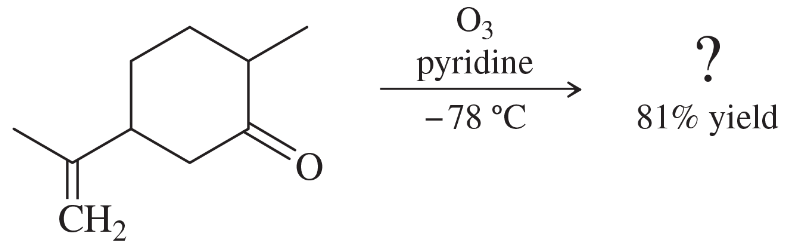
Professor Patrick Dussault (University of Nebraska at Lincoln) has developed an alternative to the standard two-step ozonolysis procedure requiring reduction of the ozonide in a second step. He uses 2 to 3 equivalents of pyridine, a mildly basic organic solvent, in a one-step process (Organic Letters, 2012, 14, 2242). Show the products you expect from the following examples. (c) (d)
Verified step by step guidance
1
Step 1: Understand the reaction mechanism. Ozonolysis is a reaction where an alkene reacts with ozone (O₃) to form an ozonide intermediate, which is then reduced to yield carbonyl compounds (aldehydes or ketones). In this alternative method, pyridine is used as a reducing agent in a one-step process.
Step 2: Analyze the structure of the alkene in the given examples (c and d). Identify the double bond(s) in the molecule, as these are the sites where ozonolysis will occur.
Step 3: Break the double bond(s) in the alkene symmetrically. Replace each carbon-carbon double bond with two carbonyl groups (C=O). For each carbon in the double bond, determine whether it will form an aldehyde or a ketone based on the substituents attached to it.
Step 4: Consider the role of pyridine. Pyridine is a mild base and helps stabilize the reaction environment, ensuring that the ozonide intermediate is reduced directly to the carbonyl products without requiring a second step.
Step 5: Draw the final products for each example (c and d) by replacing the double bonds with the appropriate carbonyl groups. Ensure that the connectivity of the molecule is preserved and that the products are consistent with the ozonolysis mechanism.
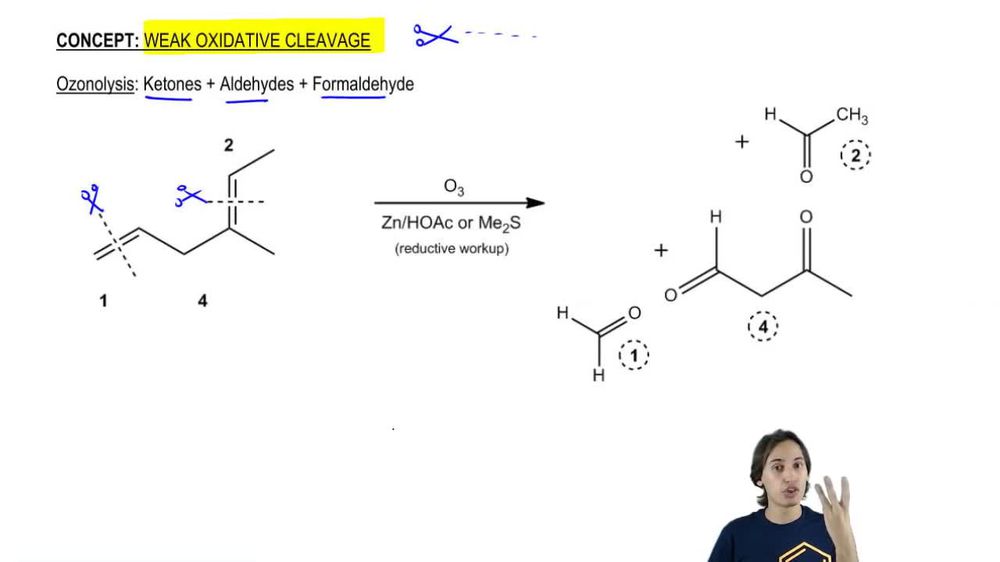
Verified video answer for a similar problem:
This video solution was recommended by our tutors as helpful for the problem above
Video duration:
3m
Play a video:
0 Comments
Key Concepts
Here are the essential concepts you must grasp in order to answer the question correctly.
Ozonolysis
Ozonolysis is a reaction involving the cleavage of alkenes or alkynes using ozone (O3) to form carbonyl compounds, typically aldehydes or ketones. In the standard procedure, the reaction occurs in two steps: first, ozone adds to the double bond to form an ozonide, which is then reduced in a second step, often using a reducing agent like zinc or dimethyl sulfide. Understanding this process is crucial for predicting the products of ozonolysis reactions.
Pyridine is a basic, aromatic organic compound that is often used as a solvent in organic reactions due to its ability to stabilize reactive intermediates. In the context of ozonolysis, pyridine can facilitate the reaction by acting as a nucleophile, helping to convert the ozonide into carbonyl products in a one-step process. Its mild basicity allows it to participate without overly aggressive reactivity, making it suitable for delicate transformations.
A reaction mechanism describes the step-by-step sequence of elementary reactions by which overall chemical change occurs. In ozonolysis, understanding the mechanism is essential to predict the structure of the products formed. The mechanism involves the formation of a cyclic ozonide intermediate, which can rearrange or react with the solvent (in this case, pyridine) to yield the final carbonyl compounds, highlighting the importance of both the starting materials and the reaction conditions.

 3:11 minutes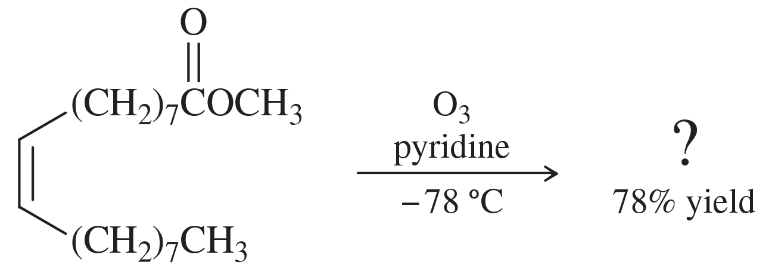
 Verified step by step guidance
 06:30
06:30