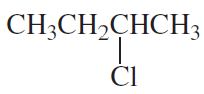
Give two names for each of the following alkyl halides and indicate whether each is primary, secondary, or tertiary: a.
Verified step by step guidance
1
Step 1: Identify the parent chain in the given alkyl halide. The parent chain is the longest continuous chain of carbon atoms that includes the carbon atom bonded to the halogen. This will help determine the base name of the compound.
Step 2: Number the parent chain starting from the end closest to the halogen atom. This ensures that the halogen gets the lowest possible number in the name.
Step 3: Identify and name any substituents (alkyl groups) attached to the parent chain. Assign a number to each substituent based on its position on the parent chain.
Step 4: Combine the substituent names, their positions, and the parent chain name to form the IUPAC name. For the common name, name the alkyl group (as a single substituent) followed by the halide (e.g., methyl chloride).
Step 5: Determine whether the alkyl halide is primary, secondary, or tertiary. This classification depends on the carbon atom bonded to the halogen: primary (1°) if the carbon is attached to one other carbon, secondary (2°) if attached to two carbons, and tertiary (3°) if attached to three carbons.
Verified video answer for a similar problem:
This video solution was recommended by our tutors as helpful for the problem above
Video duration:
5m
Play a video:
0 Comments
Key Concepts
Here are the essential concepts you must grasp in order to answer the question correctly.
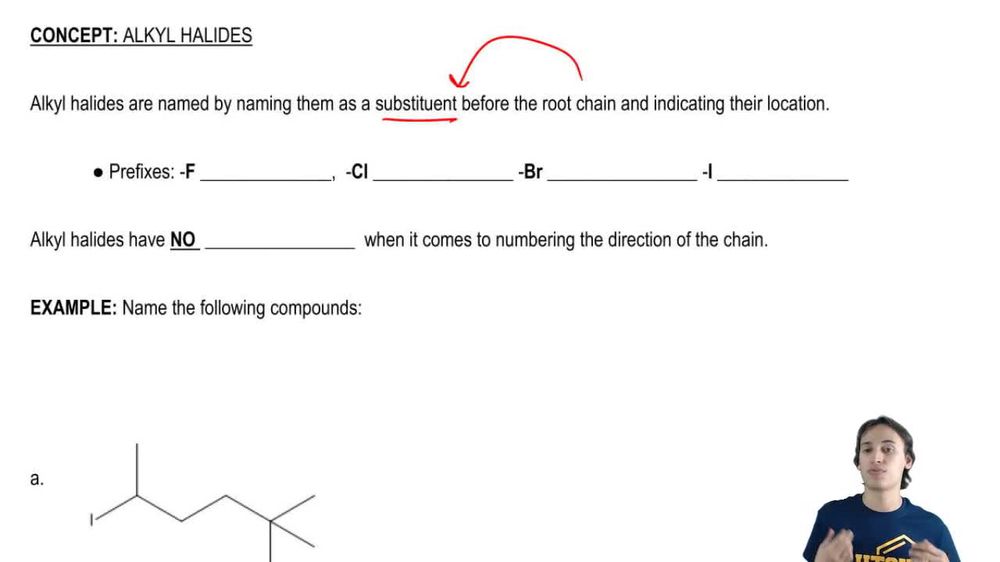
Alkyl Halides
Alkyl halides are organic compounds derived from alkanes that contain one or more halogen atoms (F, Cl, Br, I) attached to a carbon atom. They are classified based on the degree of substitution of the carbon atom bonded to the halogen: primary (1°) if the carbon is attached to one other carbon, secondary (2°) if attached to two, and tertiary (3°) if attached to three. Understanding this classification is essential for determining the reactivity and properties of these compounds.
The classification of alkyl halides as primary, secondary, or tertiary is based on the number of carbon atoms bonded to the carbon that carries the halogen. A primary alkyl halide has the halogen attached to a carbon that is connected to only one other carbon, while a secondary has two, and a tertiary has three. This classification affects the compound's reactivity in nucleophilic substitution and elimination reactions, which are fundamental concepts in organic chemistry.
Nomenclature in organic chemistry refers to the systematic naming of chemical compounds based on established rules. For alkyl halides, the names are derived from the parent alkane, with the halogen substituent indicated as a prefix (e.g., bromo-, chloro-). Understanding how to correctly name these compounds is crucial for clear communication in chemistry and for identifying the structure and classification of the alkyl halides in question.