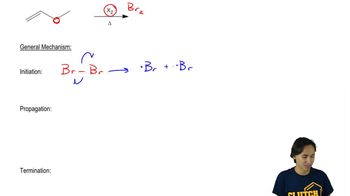
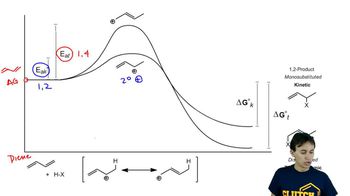
The fact that allylic halogenation results in formation of the most stable alkene suggests that it is under thermodynamic control. Thus, the second propagation step must be reversible. Suggest an arrow-pushing mechanism by which the less stable allylic halide might equilibrate to the more stable allylic halide.
Verified step by step guidance
1
Begin by identifying the allylic halide structure. Allylic halides have a halogen atom attached to a carbon atom that is adjacent to a carbon-carbon double bond.
Recognize that the reaction is under thermodynamic control, meaning the most stable product is favored. This implies that the reaction can equilibrate between different allylic halides.
Consider the mechanism of allylic rearrangement. The key step involves the reversible formation of a π-allyl radical or cation intermediate, which allows for the migration of the halide.
Use arrow-pushing to illustrate the formation of the π-allyl intermediate. Start by showing the homolytic cleavage of the C-X bond, where X is the halogen, to form a radical or cation at the allylic position.
Show the rearrangement of the π-allyl intermediate to form the more stable allylic halide. This involves the movement of the double bond and the reformation of the C-X bond at a different position, resulting in the more stable alkene configuration.
Verified video answer for a similar problem:
This video solution was recommended by our tutors as helpful for the problem above
Video duration:
5m
Play a video:
0 Comments
Key Concepts
Here are the essential concepts you must grasp in order to answer the question correctly.
Allylic Halogenation
Allylic halogenation is a reaction where a halogen atom is introduced at the allylic position of an alkene, which is the carbon atom adjacent to a double bond. This reaction often involves radical intermediates and is significant because it can lead to the formation of more stable alkenes through rearrangement or resonance stabilization.
Thermodynamic control in a chemical reaction refers to conditions where the product distribution is determined by the relative stability of the products. Under these conditions, the reaction is reversible, and the most stable product predominates, as it is the lowest energy state. This contrasts with kinetic control, where the fastest-forming product is favored.
Arrow-pushing is a technique used in organic chemistry to illustrate the movement of electrons during chemical reactions. It involves using curved arrows to show how electron pairs move from nucleophiles to electrophiles, helping to visualize the step-by-step process of bond formation and breaking. In the context of allylic halogenation, it helps explain how less stable intermediates can rearrange to form more stable products.