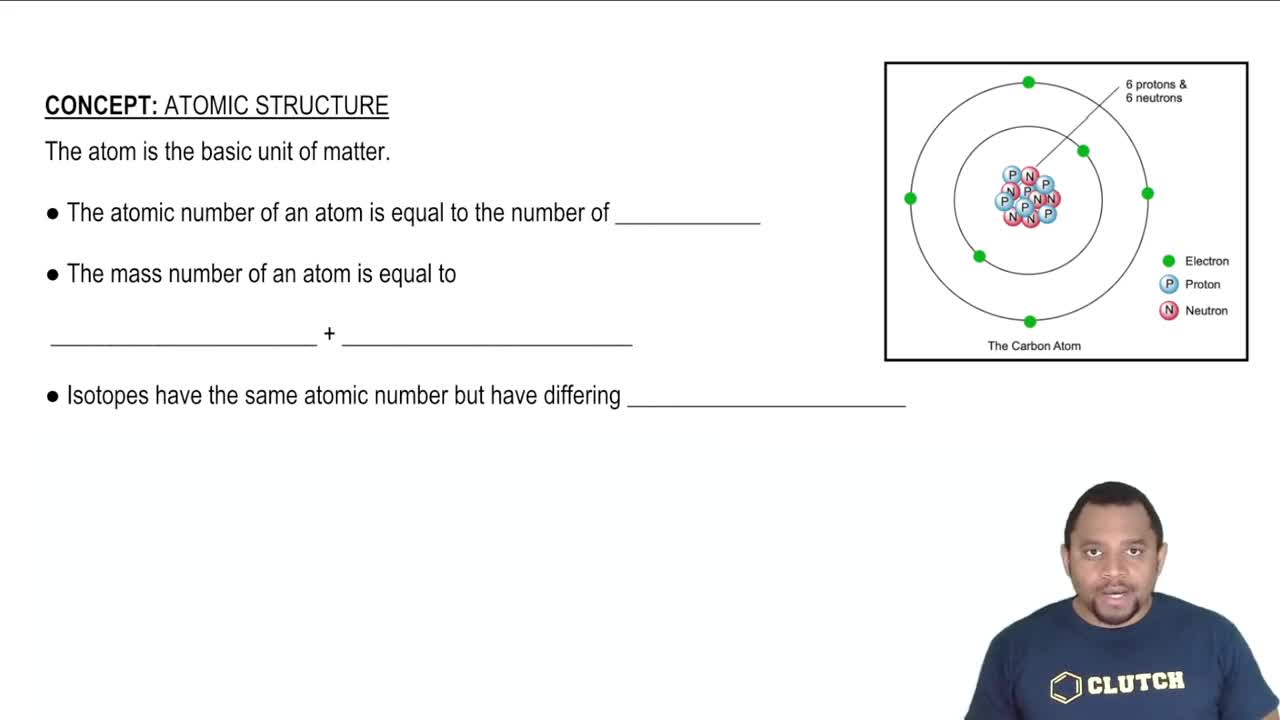
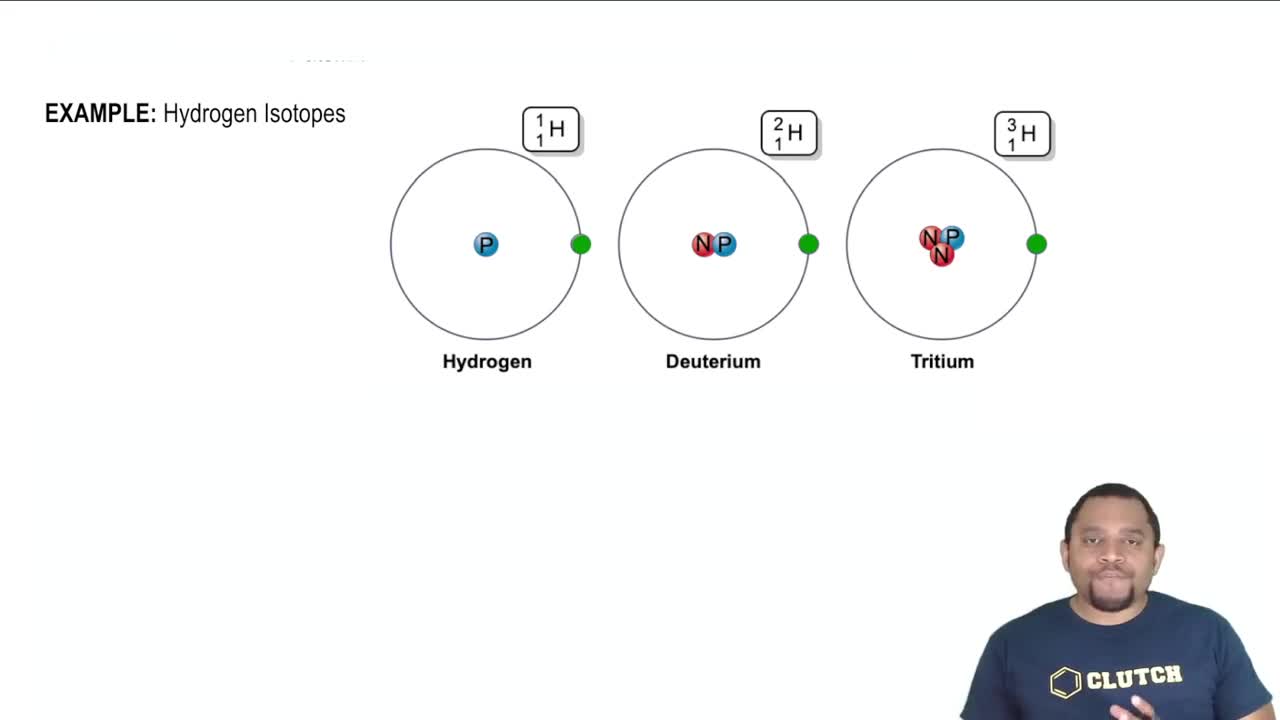
Oxygen has three isotopes, 16O, 17O, and 18O. The atomic number of oxygen is 8. How many protons and neutrons does each of the isotopes have?
Verified step by step guidance
1
Step 1: Recall that the atomic number of an element represents the number of protons in its nucleus. For oxygen, the atomic number is 8, so all isotopes of oxygen have 8 protons.
Step 2: Understand that the mass number of an isotope is the sum of its protons and neutrons. For example, the mass number of O16 is 16, O17 is 17, and O18 is 18.
Step 3: To calculate the number of neutrons in each isotope, subtract the atomic number (number of protons) from the mass number. Use the formula: , where is the number of neutrons, is the mass number, and is the atomic number.
Step 4: For O16, calculate the neutrons as . For O17, calculate the neutrons as . For O18, calculate the neutrons as .
Step 5: Summarize the results: All isotopes of oxygen have 8 protons. O16 has 8 neutrons, O17 has 9 neutrons, and O18 has 10 neutrons.
Verified video answer for a similar problem:
This video solution was recommended by our tutors as helpful for the problem above
Video duration:
3m
Play a video:
0 Comments
Key Concepts
Here are the essential concepts you must grasp in order to answer the question correctly.
Isotopes
Isotopes are variants of a chemical element that have the same number of protons but different numbers of neutrons. This results in different atomic masses for the isotopes. For example, oxygen has three isotopes: O-16, O-17, and O-18, which differ in their neutron count while maintaining the same atomic number.
The atomic number of an element is defined as the number of protons found in the nucleus of its atoms. For oxygen, the atomic number is 8, meaning every oxygen atom has 8 protons. This number also determines the element's identity and its position in the periodic table.
The difference between atomic numbers and atomic mass.
Neutron Count
The neutron count in an atom can be calculated by subtracting the atomic number from the atomic mass number (the total number of protons and neutrons). For the isotopes of oxygen, O-16 has 8 neutrons, O-17 has 9 neutrons, and O-18 has 10 neutrons, reflecting their differing atomic masses.

 3:24 minutes
 Verified step by step guidance
 03:06
03:06