Using the bond-dissociation energies in Table 5.6 (see Section 5.3.1), estimate the equilibrium constant of the following reaction at 298 K.
Verified step by step guidance
1
Step 1: Identify the bonds broken and formed in the reaction. In the reactants, the bonds broken are one Cl-Cl bond and one C-H bond in the alkene. In the products, the bonds formed are one C-Cl bond and one H-Cl bond.
Step 2: Use the bond-dissociation energies (BDEs) from Table 5.6 to calculate the energy change for the reaction. The energy change is calculated as the sum of the BDEs of bonds broken minus the sum of the BDEs of bonds formed. Represent this calculation as ΔH = Σ(BDE_broken) - Σ(BDE_formed).
Step 3: Relate the enthalpy change (ΔH) to the equilibrium constant (K) using the Gibbs free energy equation: ΔG = ΔH - TΔS. Assume ΔS (entropy change) is negligible if not provided, and approximate ΔG ≈ ΔH at 298 K.
Step 4: Use the relationship between Gibbs free energy and the equilibrium constant: ΔG = -RT ln(K), where R is the gas constant (8.314 J/mol·K) and T is the temperature in Kelvin (298 K). Rearrange to solve for K: K = e^(-ΔG/RT).
Step 5: Substitute the calculated ΔH value into the equation for ΔG and then into the equation for K. This will provide the equilibrium constant for the reaction at 298 K.
Verified video answer for a similar problem:
This video solution was recommended by our tutors as helpful for the problem above
Play a video:
0 Comments
Key Concepts
Here are the essential concepts you must grasp in order to answer the question correctly.
Bond Dissociation Energy
Bond dissociation energy (BDE) is the energy required to break a specific bond in a molecule, resulting in the formation of two radicals. It is a crucial concept in thermodynamics and kinetics, as it helps predict the stability of molecules and the feasibility of chemical reactions. Higher BDE values indicate stronger bonds, which can influence the equilibrium position of a reaction.
How to calculate enthalpy using bond dissociation energies.
Equilibrium Constant (K)
The equilibrium constant (K) is a numerical value that expresses the ratio of the concentrations of products to reactants at equilibrium for a given reaction at a specific temperature. It provides insight into the extent of a reaction and whether it favors products or reactants. The equilibrium constant can be calculated using the standard Gibbs free energy change or through bond dissociation energies.
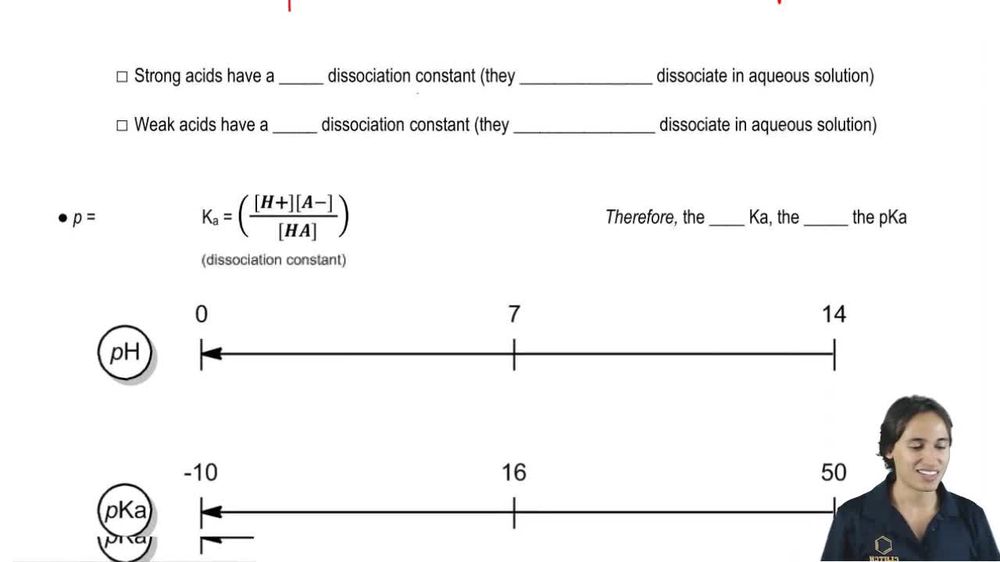
The relationship between equilibrium constant and pKa.
Thermodynamic Relationships
Thermodynamic relationships, particularly the connection between bond energies and Gibbs free energy, are essential for estimating equilibrium constants. The change in Gibbs free energy (ΔG) for a reaction can be derived from the difference in bond dissociation energies of the reactants and products. Understanding these relationships allows chemists to predict reaction spontaneity and equilibrium positions.


 Verified step by step guidance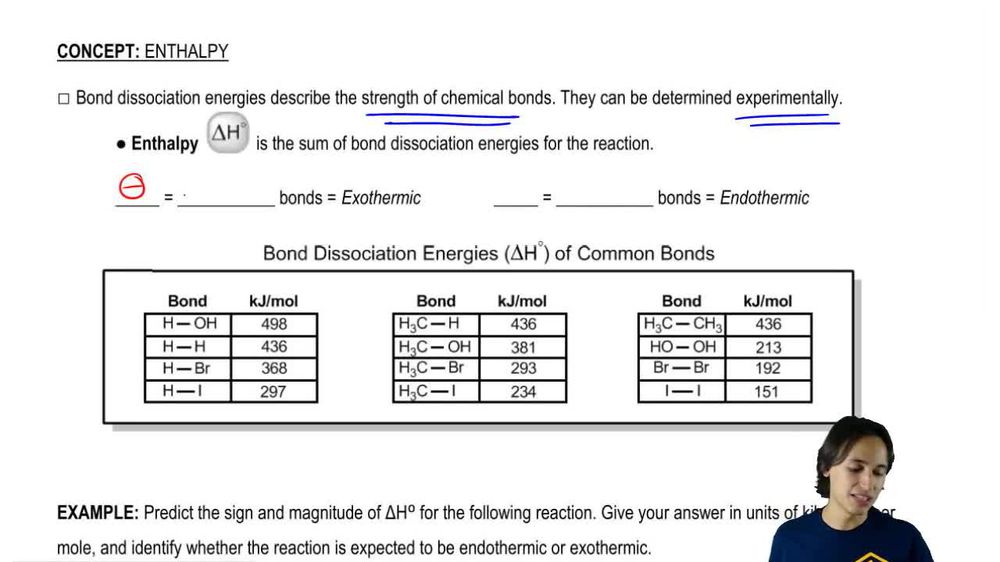
 04:09
04:09