Why does cis-2-butene have a higher boiling point than trans-2-butene?
Verified step by step guidance
1
Understand the structural difference between cis-2-butene and trans-2-butene. Cis-2-butene has both methyl groups on the same side of the double bond, while trans-2-butene has the methyl groups on opposite sides of the double bond.
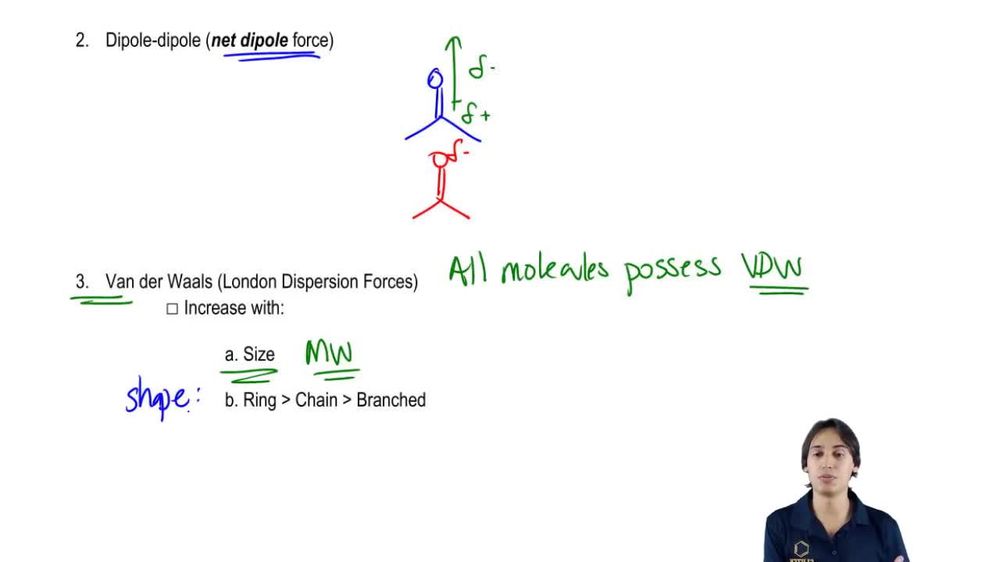
Recognize that the spatial arrangement of the methyl groups in cis-2-butene creates a dipole moment. The molecule is slightly polar because the electron density is unevenly distributed due to the methyl groups being on the same side.
Compare this to trans-2-butene, which is nonpolar. In trans-2-butene, the methyl groups are on opposite sides, canceling out any dipole moment and resulting in a more symmetrical molecule.
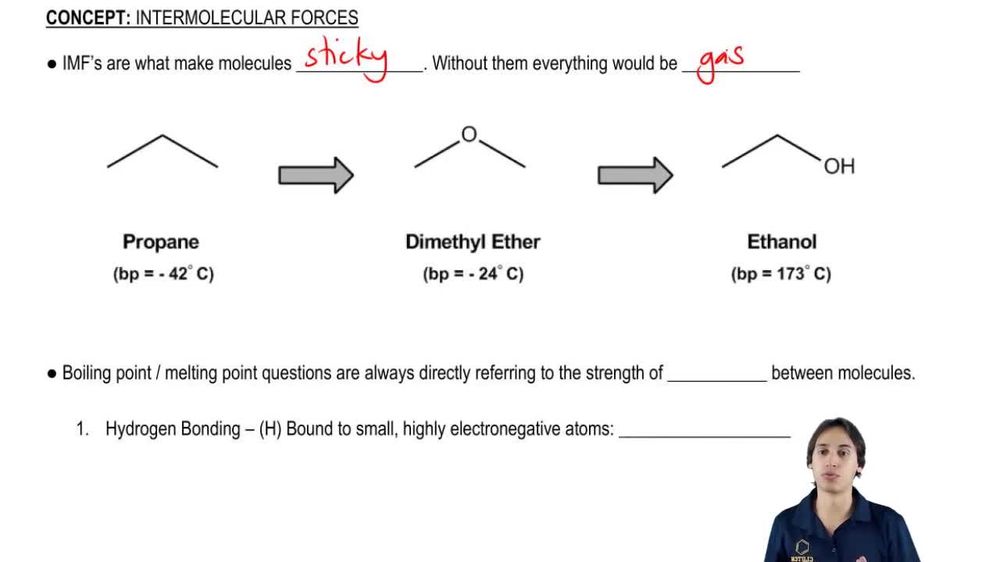
Understand that intermolecular forces play a key role in boiling points. Cis-2-butene, being slightly polar, experiences stronger dipole-dipole interactions compared to trans-2-butene, which only experiences weaker London dispersion forces.
Conclude that the stronger intermolecular forces in cis-2-butene require more energy to overcome during boiling, leading to a higher boiling point compared to trans-2-butene.
Verified video answer for a similar problem:
This video solution was recommended by our tutors as helpful for the problem above
Video duration:
6m
Play a video:
0 Comments
Key Concepts
Here are the essential concepts you must grasp in order to answer the question correctly.
Cis-Trans Isomerism
Cis-trans isomerism, also known as geometric isomerism, occurs in compounds with restricted rotation around a double bond. In cis isomers, substituents are on the same side of the double bond, while in trans isomers, they are on opposite sides. This spatial arrangement affects the physical properties of the molecules, including boiling points.
The boiling point of a substance is influenced by its intermolecular forces, which include hydrogen bonding, dipole-dipole interactions, and London dispersion forces. Cis-2-butene is more polar than trans-2-butene due to its molecular geometry, leading to stronger dipole-dipole interactions. This increased polarity results in a higher boiling point for cis-2-butene.
Boiling point trends in organic compounds are often determined by molecular weight, structure, and intermolecular forces. Generally, compounds with stronger intermolecular forces have higher boiling points. In the case of cis-2-butene versus trans-2-butene, the stronger dipole-dipole interactions in the cis form contribute to its higher boiling point compared to the trans form.

 6:04 minutes
 Verified step by step guidance
 00:44
00:44