Draw the two chair conformations of each compound, and label the substituents as axial and equatorial. In each case, determine which conformation is more stable. e. cis-1-ethyl-4-methylcyclohexane f. trans-1-ethyl-4-methylcyclohexane
Verified step by step guidance
1
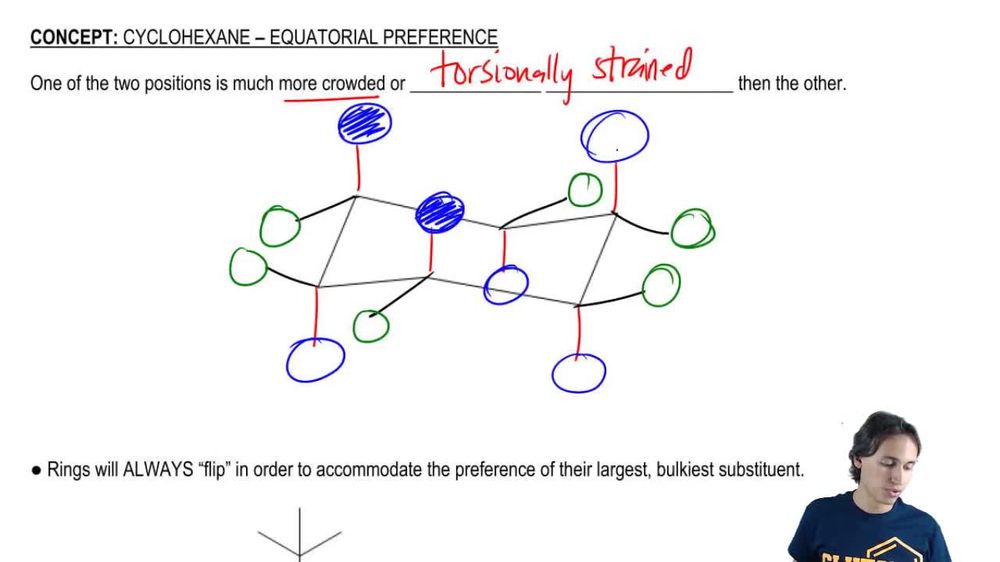
Begin by understanding the structure of cyclohexane and its chair conformations. Cyclohexane can adopt two chair conformations that are interconvertible. Each carbon atom in the chair conformation has two types of positions for substituents: axial (pointing up or down, perpendicular to the ring) and equatorial (pointing outwards, around the equator of the ring).
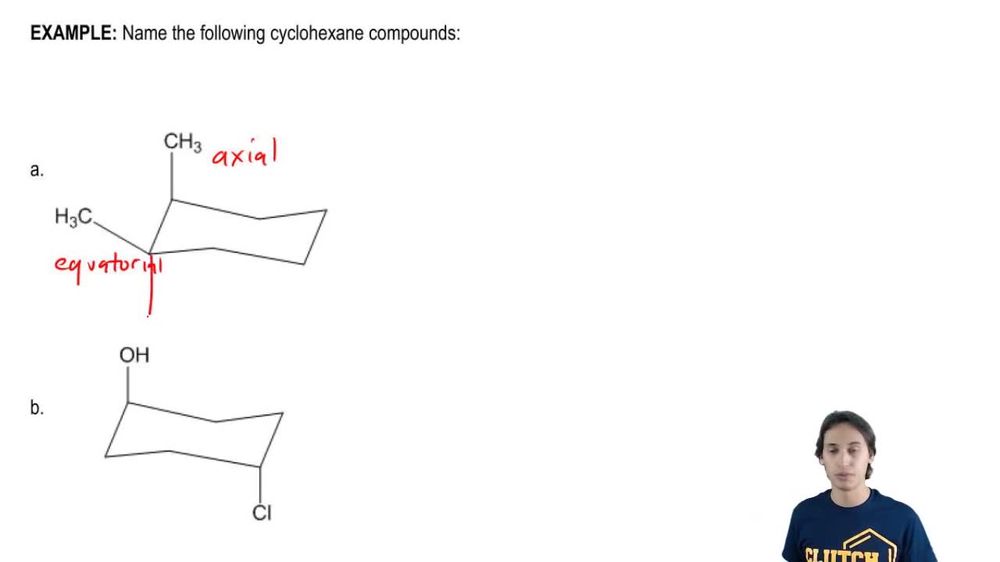
For cis-1-ethyl-4-methylcyclohexane, identify the positions of the substituents. 'Cis' indicates that both substituents are on the same side of the cyclohexane ring. Draw the first chair conformation with the ethyl group at the 1-position and the methyl group at the 4-position, both in axial positions. Then, draw the second chair conformation with both substituents in equatorial positions.
Label the substituents in each conformation as axial or equatorial. In the first conformation, both ethyl and methyl groups are axial. In the second conformation, both are equatorial.
Determine the more stable conformation for cis-1-ethyl-4-methylcyclohexane. Generally, equatorial positions are favored for larger groups due to less steric hindrance. Therefore, the conformation with both substituents in equatorial positions is more stable.
For trans-1-ethyl-4-methylcyclohexane, 'trans' indicates that the substituents are on opposite sides of the ring. Draw the first chair conformation with the ethyl group axial at the 1-position and the methyl group equatorial at the 4-position. Then, draw the second chair conformation with the ethyl group equatorial at the 1-position and the methyl group axial at the 4-position. Label the substituents and determine the more stable conformation, which typically has the larger group (ethyl) in the equatorial position.
Verified video answer for a similar problem:
This video solution was recommended by our tutors as helpful for the problem above
Video duration:
9m
Play a video:
0 Comments
Key Concepts
Here are the essential concepts you must grasp in order to answer the question correctly.
Chair Conformation
Chair conformation is a three-dimensional shape that cyclohexane adopts to minimize steric strain and torsional strain. It resembles a chair, with alternating carbon atoms positioned above and below the plane. This conformation is crucial for understanding the spatial arrangement of substituents and their interactions in cyclohexane derivatives.
In the chair conformation of cyclohexane, substituents can occupy either axial or equatorial positions. Axial positions are perpendicular to the ring plane, while equatorial positions are roughly parallel. Equatorial positions are generally more stable due to reduced steric hindrance, making it important to identify these positions when assessing the stability of different conformations.
Cis and trans isomerism refers to the relative orientation of substituents around a cyclohexane ring. In cis isomers, substituents are on the same side of the ring, while in trans isomers, they are on opposite sides. This distinction affects the stability and spatial arrangement of the chair conformations, influencing which conformation is more stable for a given compound.

 9:42 minutes
 Verified step by step guidance
 03:29
03:29