Explain why the chemical shift of the OH proton of a carboxylic acid is at a higher frequency than the chemical shift of an OH proton of an alcohol.
Verified step by step guidance
1
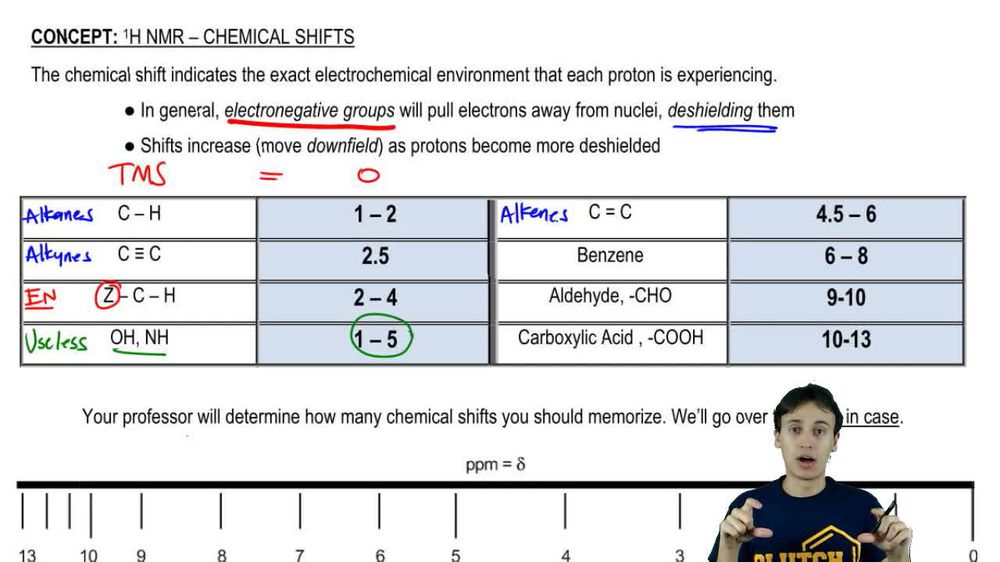
The chemical shift in NMR spectroscopy is influenced by the electronic environment around a nucleus. In this case, we are comparing the OH proton of a carboxylic acid and the OH proton of an alcohol.
In a carboxylic acid, the OH group is directly attached to a carbonyl group (C=O). The carbonyl group is highly electronegative due to the oxygen atom, which withdraws electron density from the OH group through both inductive and resonance effects.
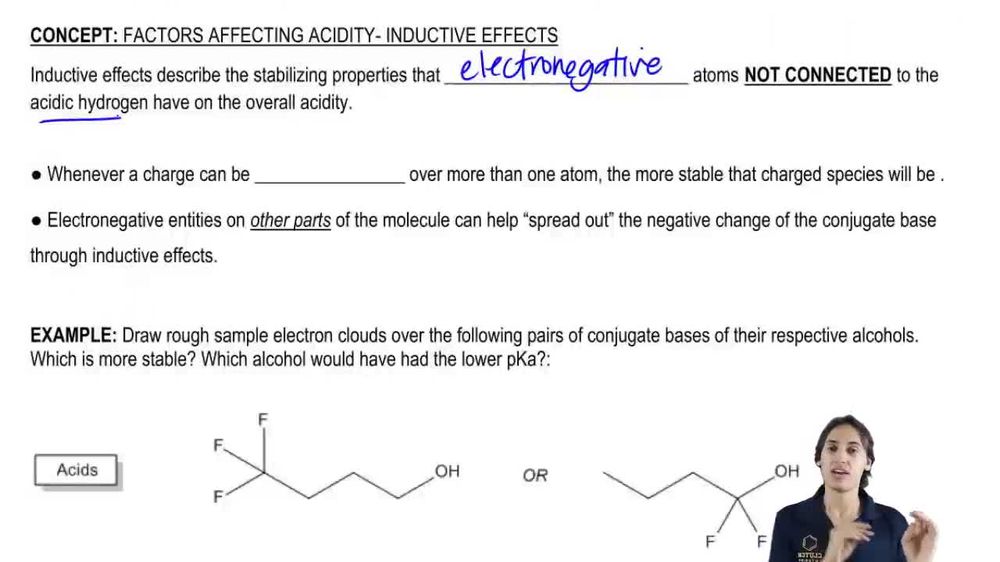
The inductive effect occurs because the electronegative oxygen atom in the carbonyl group pulls electron density away from the OH proton, deshielding it. This deshielding causes the OH proton to resonate at a higher frequency (downfield) in the NMR spectrum.
Additionally, the resonance effect in a carboxylic acid allows the lone pair of electrons on the OH oxygen to delocalize into the carbonyl group. This further enhances the deshielding of the OH proton, contributing to its higher chemical shift.
In contrast, in an alcohol, the OH group is not adjacent to a carbonyl group. The absence of strong electron-withdrawing effects means the OH proton in an alcohol is less deshielded and resonates at a lower frequency (upfield) compared to the OH proton in a carboxylic acid.
Verified video answer for a similar problem:
This video solution was recommended by our tutors as helpful for the problem above
Video duration:
4m
Play a video:
0 Comments
Key Concepts
Here are the essential concepts you must grasp in order to answer the question correctly.
Chemical Shift
Chemical shift refers to the resonant frequency of a nucleus relative to a standard in a magnetic field, typically measured in parts per million (ppm). It provides insight into the electronic environment surrounding the nucleus, influenced by factors such as electronegativity and hybridization. In NMR spectroscopy, different functional groups exhibit distinct chemical shifts, allowing for the identification of molecular structures.
Hydrogen bonding is a type of dipole-dipole interaction that occurs when a hydrogen atom covalently bonded to an electronegative atom interacts with another electronegative atom. In carboxylic acids, the presence of both a hydroxyl (-OH) and a carbonyl (C=O) group allows for strong intramolecular hydrogen bonding, which stabilizes the structure and affects the chemical environment of the OH proton, leading to a higher chemical shift compared to alcohols.
Electronegativity is the tendency of an atom to attract electrons towards itself, influencing the distribution of electron density in a molecule. In carboxylic acids, the electronegative oxygen atoms in the carbonyl group exert an inductive effect, pulling electron density away from the hydroxyl proton. This results in a deshielding effect, causing the OH proton in carboxylic acids to resonate at a higher frequency than that in alcohols, where such strong electron-withdrawing effects are absent.