Draw and name all stereoisomers of 3-chlorohepta-2,4-diene b. using the E-Z nomenclature.
Verified step by step guidance
1
Identify the structure of 3-chlorohepta-2,4-diene. The compound is a heptadiene, meaning it has a seven-carbon chain with two double bonds located at the 2nd and 4th positions. The chlorine atom is attached to the 3rd carbon.
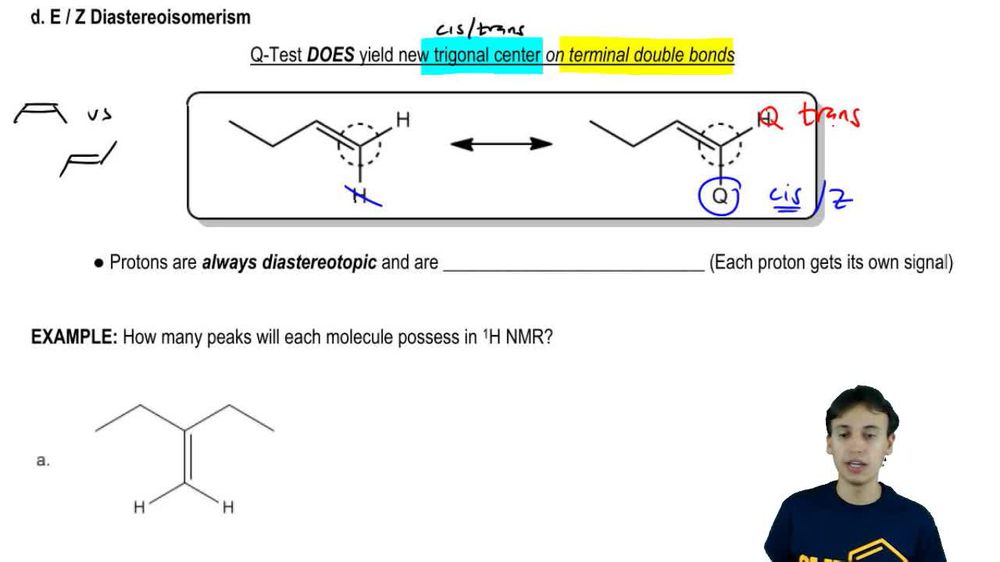
Determine the possible stereoisomers. Since there are two double bonds, each can have E/Z isomerism. The stereochemistry at each double bond needs to be considered separately.
For the double bond at the 2nd position, assign priorities to the substituents on each carbon of the double bond using the Cahn-Ingold-Prelog priority rules. Compare the groups attached to the carbons involved in the double bond to determine if the configuration is E (opposite sides) or Z (same side).
Repeat the priority assignment for the double bond at the 4th position. Again, use the Cahn-Ingold-Prelog priority rules to determine the E or Z configuration for this double bond.
Combine the configurations of both double bonds to name each stereoisomer. For example, if the first double bond is E and the second is Z, the compound would be named (2E,4Z)-3-chlorohepta-2,4-diene. Repeat this process to identify and name all possible stereoisomers.
Verified video answer for a similar problem:
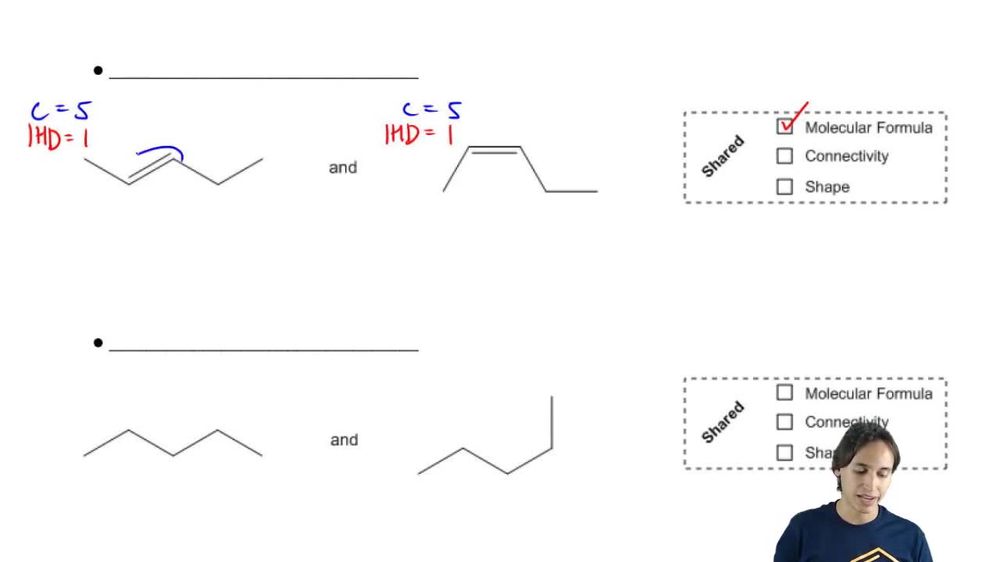
This video solution was recommended by our tutors as helpful for the problem above
Video duration:
5m
Play a video:
0 Comments
Key Concepts
Here are the essential concepts you must grasp in order to answer the question correctly.
Stereoisomers
Stereoisomers are molecules with the same molecular formula and sequence of bonded atoms, but they differ in the three-dimensional orientations of their atoms in space. In the context of alkenes, stereoisomers can be classified as cis-trans or E-Z isomers, depending on the substituents around the double bond. Understanding stereoisomers is crucial for identifying and naming different forms of a compound.
The E-Z nomenclature is a system used to describe the stereochemistry of double bonds in alkenes. 'E' (from the German 'entgegen') indicates that the highest priority substituents on each carbon of the double bond are on opposite sides, while 'Z' (from 'zusammen') indicates they are on the same side. Priority is determined using the Cahn-Ingold-Prelog priority rules, which consider atomic number and connectivity.
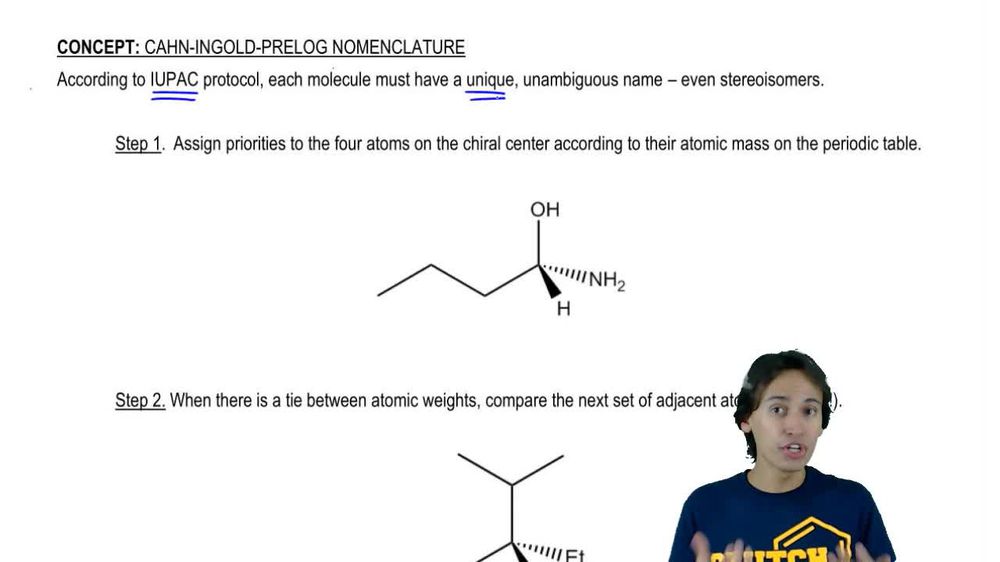
The Cahn-Ingold-Prelog (CIP) priority rules are used to assign priority to substituents attached to a stereocenter or double bond. The rules state that the atom with the higher atomic number receives higher priority. If two atoms are the same, the next set of atoms along the chain is considered. These rules are essential for correctly applying the E-Z nomenclature to alkenes.