Using the BDEs in Table 4-2 (page 167), (c) Suggest two reasons why iodine does not react well with methane.
Verified step by step guidance
1
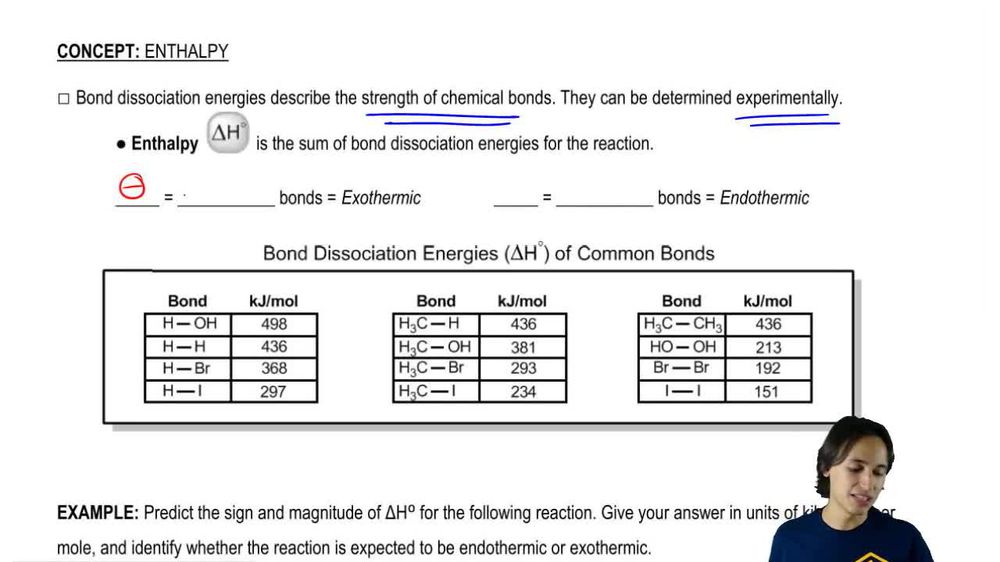
Step 1: Analyze the bond dissociation enthalpy (BDE) values for the bonds involved in the reaction. From the table, the bond dissociation enthalpy for the C-H bond in methane (CH₃-H) is 439 kJ/mol, and the bond dissociation enthalpy for the I-I bond in iodine is 149 kJ/mol.
Step 2: Compare the bond dissociation enthalpy of iodine (I-I) with other halogens like chlorine (Cl-Cl, 240 kJ/mol) and bromine (Br-Br, 190 kJ/mol). The lower BDE of iodine indicates that the I-I bond is weaker and less stable, making it less reactive.
Step 3: Consider the bond formation between iodine and hydrogen (H-I). The bond dissociation enthalpy for H-I is 298 kJ/mol, which is significantly lower than H-Cl (432 kJ/mol) and H-Br (366 kJ/mol). This suggests that the H-I bond is weaker and less favorable to form.
Step 4: Evaluate the steric and electronic factors. Iodine is a larger atom compared to other halogens, which can lead to steric hindrance and slower reaction rates. Additionally, iodine's lower electronegativity compared to chlorine and bromine reduces its ability to polarize the C-H bond in methane, making the reaction less efficient.
Step 5: Conclude that iodine does not react well with methane due to its weak bond dissociation enthalpy (both I-I and H-I bonds) and steric/electronic factors that hinder effective interaction with methane's C-H bond.
Verified video answer for a similar problem:
This video solution was recommended by our tutors as helpful for the problem above
Video duration:
10m
Play a video:
0 Comments
Key Concepts
Here are the essential concepts you must grasp in order to answer the question correctly.
Bond Dissociation Energy (BDE)
Bond Dissociation Energy (BDE) refers to the energy required to break a specific bond in a molecule, resulting in the formation of free radicals. It is a crucial concept in understanding the stability of chemical bonds and the reactivity of different molecules. Higher BDE values indicate stronger bonds that are less likely to break, which can influence the likelihood of a reaction occurring.
How to calculate enthalpy using bond dissociation energies.
Reactivity of Halogens
The reactivity of halogens, such as iodine, is influenced by their electronegativity and the strength of their bonds with hydrogen or carbon. Iodine is less reactive compared to other halogens like chlorine or bromine due to its larger atomic size and lower electronegativity, which results in weaker bonds with hydrogen. This reduced reactivity affects its ability to engage in reactions with hydrocarbons like methane.
Hydrocarbons, such as methane, are generally stable due to their strong C-H bonds and low reactivity under standard conditions. The stability of methane makes it less likely to react with less reactive halogens like iodine, as the energy required to break the C-H bonds is not compensated by the energy released during the formation of new bonds with iodine. This stability is a key factor in understanding why iodine does not react well with methane.