Show how you would use the Williamson ether synthesis to prepare the following ethers. You may use any alcohols or phenols as your organic starting materials. (d) ethyl n-propyl ether (two ways) (e) benzyl tert-butyl ether (benzyl = Ph–CH2–)
Verified step by step guidance
1
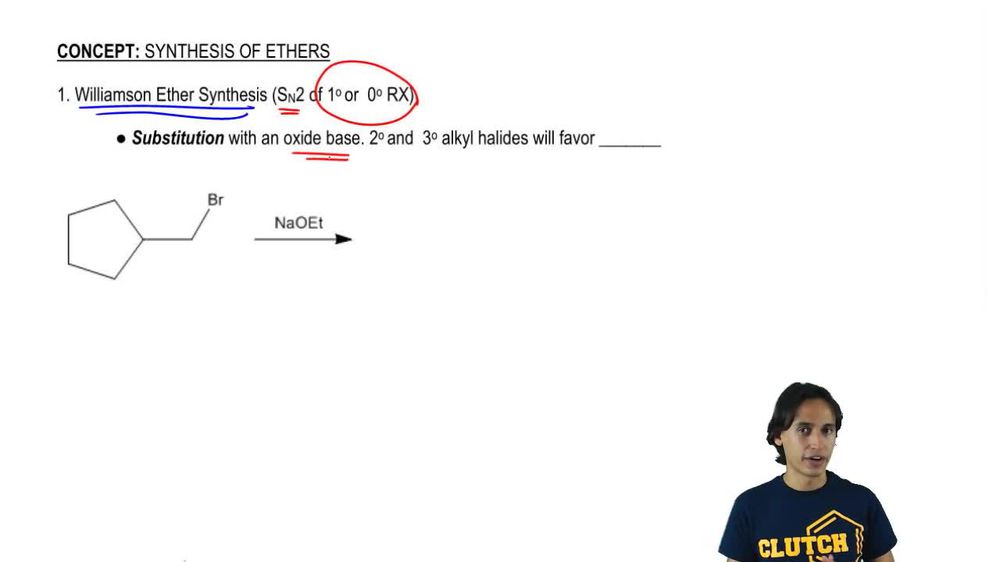
The Williamson ether synthesis involves the reaction of an alkoxide ion (RO⁻) with a primary alkyl halide (R'X) to form an ether (R-O-R'). The reaction proceeds via an SN2 mechanism, so the alkyl halide should ideally be primary to avoid steric hindrance.
For part (d), ethyl n-propyl ether (CH3CH2-O-CH2CH2CH3):
1. First method: Use ethanol (CH3CH2OH) as the alcohol. Deprotonate ethanol with a strong base (e.g., NaH or Na metal) to form the ethoxide ion (CH3CH2O⁻). Then, react the ethoxide ion with 1-bromopropane (CH3CH2CH2Br) or 1-chloropropane to form ethyl n-propyl ether.
2. Second method: Use 1-propanol (CH3CH2CH2OH) as the alcohol. Deprotonate 1-propanol with a strong base to form the propoxide ion (CH3CH2CH2O⁻). Then, react the propoxide ion with ethyl bromide (CH3CH2Br) or ethyl chloride to form ethyl n-propyl ether.
For part (e), benzyl tert-butyl ether (Ph-CH2-O-C(CH3)3):
1. Use benzyl alcohol (Ph-CH2OH) as the alcohol. Deprotonate benzyl alcohol with a strong base to form the benzyl alkoxide ion (Ph-CH2O⁻). Then, react the benzyl alkoxide ion with tert-butyl bromide (C(CH3)3Br) or tert-butyl chloride to form benzyl tert-butyl ether.
2. Alternatively, use tert-butanol (C(CH3)3OH) as the alcohol. Deprotonate tert-butanol with a strong base to form the tert-butoxide ion (C(CH3)3O⁻). Then, react the tert-butoxide ion with benzyl bromide (Ph-CH2Br) or benzyl chloride to form benzyl tert-butyl ether.
Verified video answer for a similar problem:
This video solution was recommended by our tutors as helpful for the problem above
Video duration:
4m
Play a video:
0 Comments
Key Concepts
Here are the essential concepts you must grasp in order to answer the question correctly.
Williamson Ether Synthesis
The Williamson ether synthesis is a method for producing ethers through the reaction of an alkoxide ion with a primary alkyl halide. This reaction typically involves the nucleophilic substitution mechanism (SN2), where the alkoxide acts as a nucleophile, attacking the electrophilic carbon of the alkyl halide, resulting in the formation of an ether. This method is particularly effective for synthesizing simple ethers and requires careful selection of starting materials to avoid side reactions.
Nucleophilic substitution reactions are fundamental reactions in organic chemistry where a nucleophile replaces a leaving group in a molecule. In the context of the Williamson ether synthesis, the alkoxide ion serves as the nucleophile, while the alkyl halide provides the leaving group. Understanding the mechanisms of SN2 and SN1 reactions is crucial, as the choice of substrate (primary, secondary, or tertiary) influences the reaction pathway and the efficiency of ether formation.
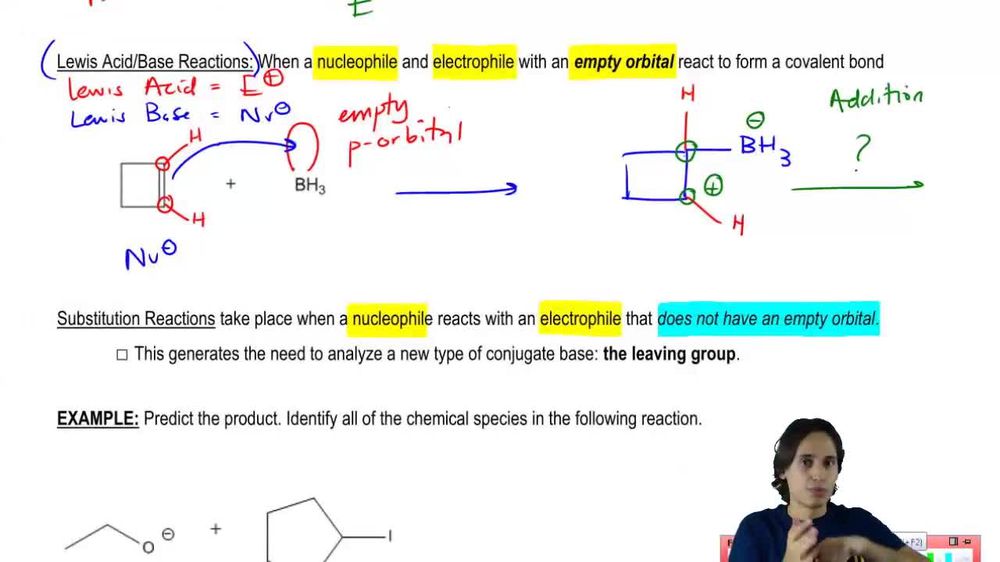
Nucleophiles and Electrophiles can react in Substitution Reactions.
Reactivity of Alcohols and Phenols
Alcohols and phenols can be converted into alkoxide ions, which are essential for the Williamson ether synthesis. The reactivity of these compounds varies; for instance, primary alcohols are more readily converted to alkoxides and are preferred for SN2 reactions. Phenols, while less nucleophilic than alkoxides, can also participate in ether synthesis when treated with strong bases. Understanding the properties and reactivity of these starting materials is vital for designing effective synthetic routes to ethers.

 4:06 minutes
 Verified step by step guidance
 03:50
03:50