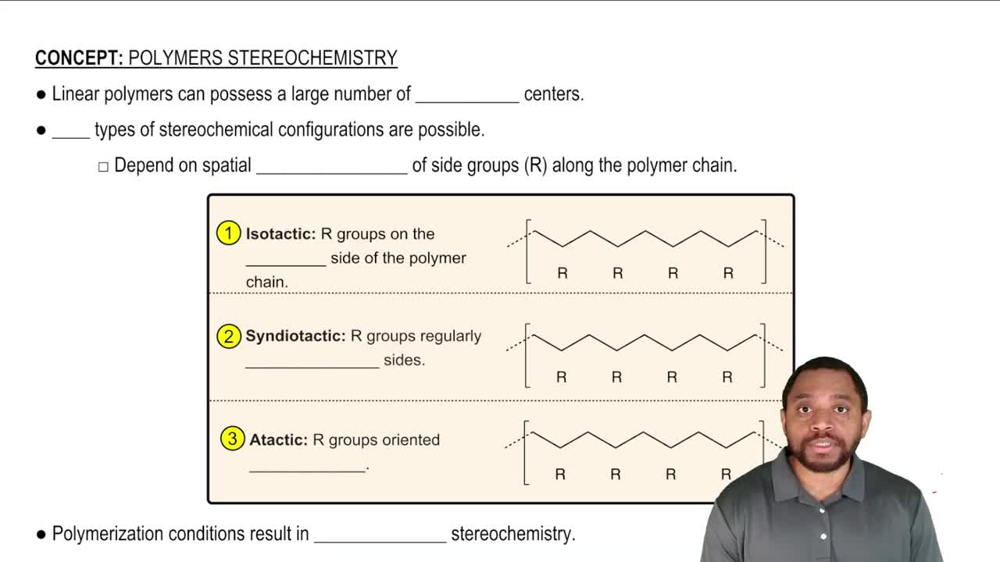
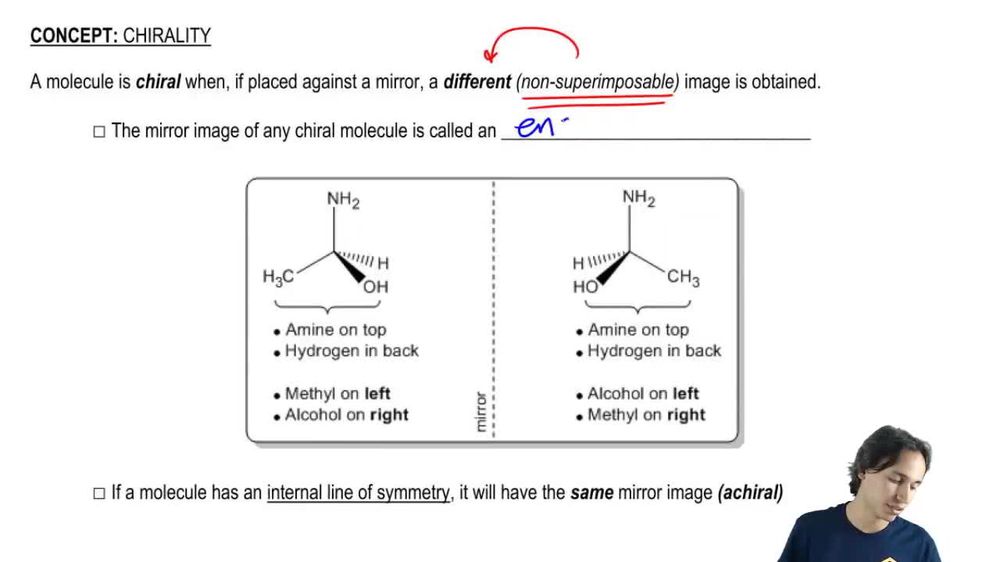
3,4-Dimethylpent-1-ene has the formula CH2=CH—CH(CH3)—CH(CH3)2. When pure (R)-3,4-dimethylpent-1-ene is treated with hydrogen over a platinum catalyst, the product is (S)-2,3-dimethylpentane. a. Draw the equation for this reaction. Show the stereochemistry of the reactant and the product. b. Has the chiral center retained its configuration during this hydrogenation, or has it been inverted?
Verified step by step guidance
1
Step 1: Analyze the given reactant, (R)-3,4-dimethylpent-1-ene (CH2=CH—CH(CH3)—CH(CH3)2). This molecule contains a double bond at the 1-position and a chiral center at the 3-position. The stereochemistry of the chiral center is specified as (R).
Step 2: Understand the reaction conditions. The molecule is treated with hydrogen gas (H2) in the presence of a platinum catalyst. This is a typical catalytic hydrogenation reaction, which converts alkenes into alkanes by adding hydrogen atoms across the double bond.
Step 3: Predict the product. The double bond in the reactant will be reduced, resulting in a saturated hydrocarbon. The product is specified as (S)-2,3-dimethylpentane, indicating that the chiral center at the 3-position has undergone inversion of configuration from (R) to (S).
Step 4: Draw the reaction mechanism. The hydrogenation process involves syn addition of hydrogen atoms to the double bond. This addition does not directly affect the stereochemistry of the chiral center, but the inversion occurs due to the specific spatial arrangement during the reaction.
Step 5: Conclude whether the chiral center retains its configuration or is inverted. Based on the given information, the chiral center at the 3-position has been inverted from (R) to (S) during the hydrogenation process.
Verified video answer for a similar problem:
This video solution was recommended by our tutors as helpful for the problem above
Video duration:
11m
Play a video:
0 Comments
Key Concepts
Here are the essential concepts you must grasp in order to answer the question correctly.
Hydrogenation
Hydrogenation is a chemical reaction that involves the addition of hydrogen (H2) to an unsaturated compound, typically an alkene or alkyne, in the presence of a catalyst, such as platinum or palladium. This process converts double or triple bonds into single bonds, resulting in a saturated compound. In this case, the hydrogenation of (R)-3,4-dimethylpent-1-ene leads to the formation of (S)-2,3-dimethylpentane.
Stereochemistry is the study of the spatial arrangement of atoms in molecules and how this affects their chemical behavior. In the context of this question, it is crucial to understand the stereochemical configuration of the reactant and product. The (R) and (S) designations refer to the specific three-dimensional arrangement of substituents around the chiral centers, which can influence the properties and reactivity of the molecules.
Chirality refers to the property of a molecule that makes it non-superimposable on its mirror image, often due to the presence of chiral centers. In this reaction, it is important to determine whether the chiral center in (R)-3,4-dimethylpent-1-ene retains its configuration or undergoes inversion during hydrogenation. The outcome of this reaction can affect the optical activity of the product, (S)-2,3-dimethylpentane, indicating a change in chirality.

 11:17 minutes
 Verified step by step guidance
 00:48
00:48