Which ion in each of the following pairs is more stable? b.
Verified step by step guidance
1
Step 1: Analyze the structures of the two ions. The first ion is a cycloheptatrienyl cation (left structure), and the second ion is a cycloheptatrienyl anion (right structure). Both structures have conjugated π-systems.
Step 2: Determine the aromaticity of each ion. Aromatic compounds follow Huckel's rule, which states that a molecule is aromatic if it has (4n + 2) π-electrons, where n is an integer.
Step 3: For the cycloheptatrienyl cation, count the π-electrons. The cation has 6 π-electrons (from the three double bonds), which satisfies Huckel's rule (4n + 2, where n = 1). This makes the cation aromatic and highly stable.
Step 4: For the cycloheptatrienyl anion, count the π-electrons. The anion has 8 π-electrons (from the three double bonds and the lone pair on the negatively charged carbon). This does not satisfy Huckel's rule, making the anion non-aromatic and less stable.
Step 5: Conclude that the cycloheptatrienyl cation is more stable than the cycloheptatrienyl anion due to its aromaticity, which provides extra stabilization through delocalization of π-electrons.
Verified video answer for a similar problem:
This video solution was recommended by our tutors as helpful for the problem above
Video duration:
3m
Play a video:
0 Comments
Key Concepts
Here are the essential concepts you must grasp in order to answer the question correctly.
Aromatic Stability
Aromatic compounds are particularly stable due to their cyclic structure and delocalized π electrons, which follow Hückel's rule (4n + 2 π electrons). This stability is a key factor when comparing the stability of ions derived from aromatic systems, as the presence of a charge can disrupt this delocalization.
The stability of charged species (cations and anions) is influenced by how well the charge can be distributed across the molecule. In the case of the provided structures, the negative charge on the anion can be stabilized by resonance, while the positive charge on the cation may be less effectively stabilized, affecting overall stability.
Resonance structures are different ways of drawing a molecule that illustrate the delocalization of electrons. For the ions in the question, the ability of the negative ion to delocalize its charge through resonance can enhance its stability compared to the positive ion, which may have fewer resonance contributors to stabilize the positive charge.

 3:02 minutes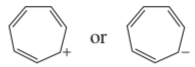
 Verified step by step guidance
 08:19
08:19