What orbitals contain the electrons represented as lone pairs in the structures of quinoline, indole, imidazole?
Verified step by step guidance
1
Step 1: Analyze the structures of quinoline, indole, and imidazole. Quinoline contains a nitrogen atom in a pyridine ring fused to a benzene ring. Indole contains a nitrogen atom in a pyrrole ring fused to a benzene ring. Imidazole contains two nitrogen atoms in a five-membered ring.
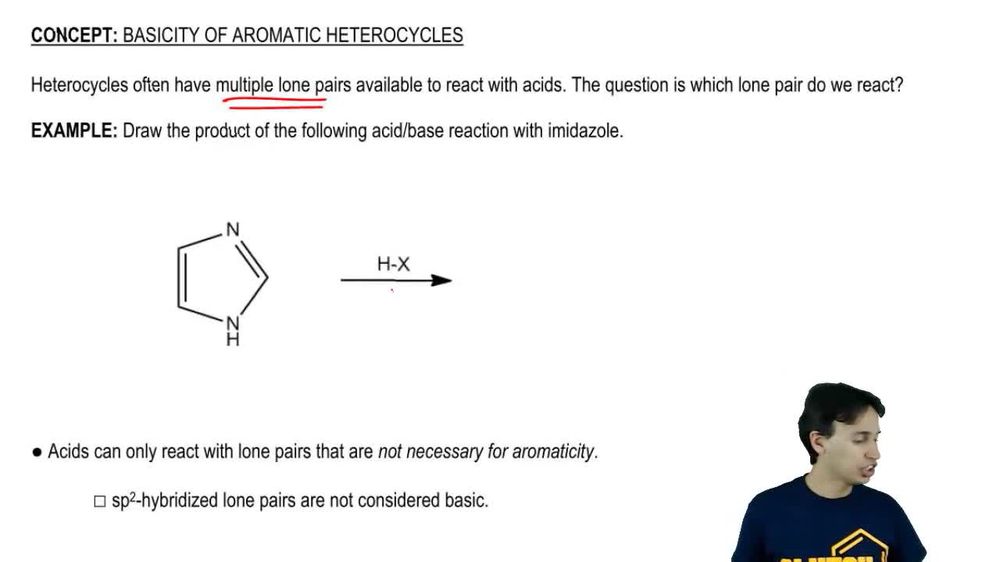
Step 2: Determine the hybridization of the nitrogen atoms in each structure. In quinoline, the nitrogen atom is sp2 hybridized because it is part of an aromatic system. In indole, the nitrogen atom is sp2 hybridized as it is part of the aromatic pyrrole ring. In imidazole, one nitrogen is sp2 hybridized (part of the aromatic system), and the other nitrogen is sp2 hybridized but has a lone pair not involved in aromaticity.
Step 3: Identify the orbitals containing the lone pairs. For sp2 hybridized nitrogen atoms, the lone pairs are located in sp2 orbitals. In quinoline, the lone pair on nitrogen resides in an sp2 orbital. In indole, the lone pair on nitrogen also resides in an sp2 orbital. In imidazole, the lone pair on the sp2 nitrogen not involved in aromaticity resides in an sp2 orbital.
Step 4: Consider the aromaticity of the systems. The lone pairs in quinoline and indole do not participate in aromaticity and remain localized in sp2 orbitals. In imidazole, one nitrogen contributes its lone pair to the aromatic π-system, while the other nitrogen's lone pair remains localized in an sp2 orbital.
Step 5: Summarize the findings. The lone pairs in quinoline, indole, and imidazole are located in sp2 orbitals. In imidazole, one nitrogen's lone pair contributes to aromaticity, while the other nitrogen's lone pair remains localized.
Verified video answer for a similar problem:
This video solution was recommended by our tutors as helpful for the problem above
Video duration:
10m
Play a video:
0 Comments
Key Concepts
Here are the essential concepts you must grasp in order to answer the question correctly.
Lone Pairs
Lone pairs are pairs of valence electrons that are not involved in bonding and are localized on a single atom. In organic molecules, they can influence reactivity, molecular geometry, and polarity. Understanding where these lone pairs are located in a molecule is crucial for predicting its chemical behavior and interactions.
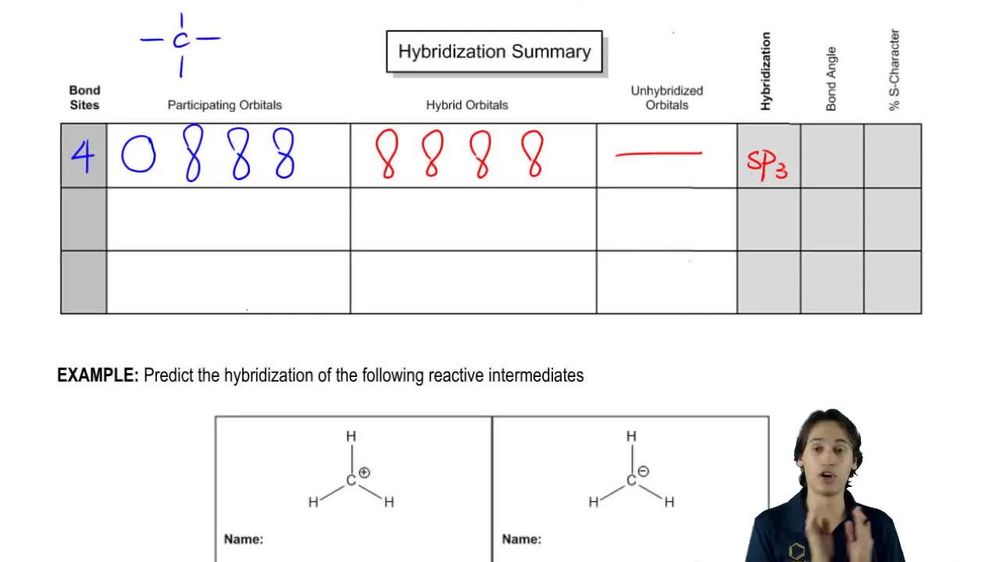
Hybridization is the concept of mixing atomic orbitals to form new hybrid orbitals that can accommodate bonding and lone pairs. In the context of quinoline, indole, and imidazole, recognizing the hybridization of nitrogen atoms helps identify the orbitals that contain lone pairs. For example, sp2 hybridization typically involves one lone pair in a trigonal planar arrangement.
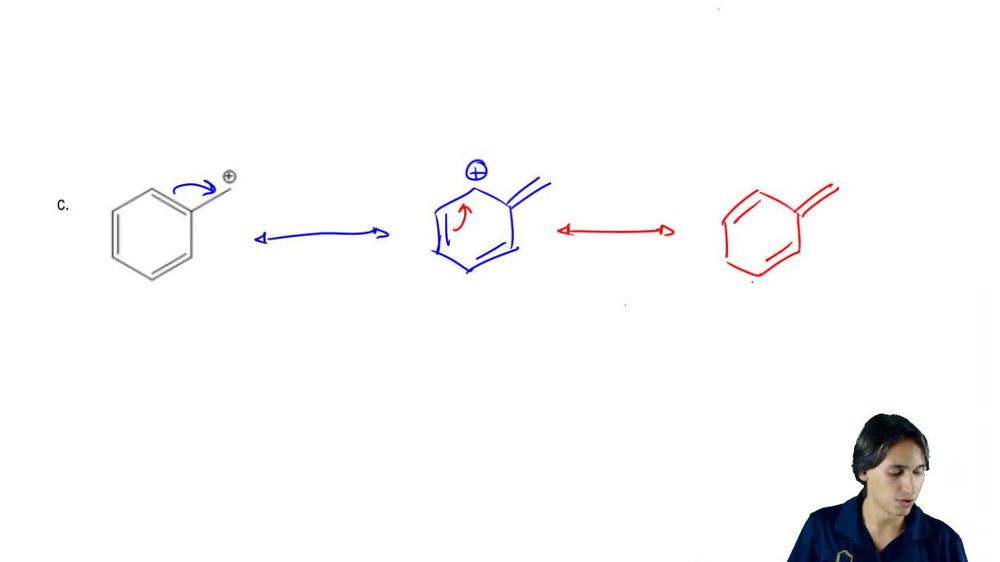
The molecular structure of compounds like quinoline, indole, and imidazole can exhibit resonance, where electrons are delocalized over multiple atoms. This delocalization affects the distribution of lone pairs and can stabilize the molecule. Understanding resonance structures is essential for determining the actual electron distribution and the role of lone pairs in these compounds.

 10:54 minutes
 Verified step by step guidance
 02:04
02:04