For the following acid–base pairs, (iv) calculate Keq; (e)
Verified step by step guidance
1
Step 1: Identify the acid and base on both sides of the equilibrium. In the given reaction, the acid on the left side is acetic acid (CH3COOH), and the base is ethanol (CH3CH2OH). On the right side, the conjugate base of acetic acid is acetate ion (CH3COO⁻), and the conjugate acid of ethanol is ethoxide ion (CH3CH2O⁻).
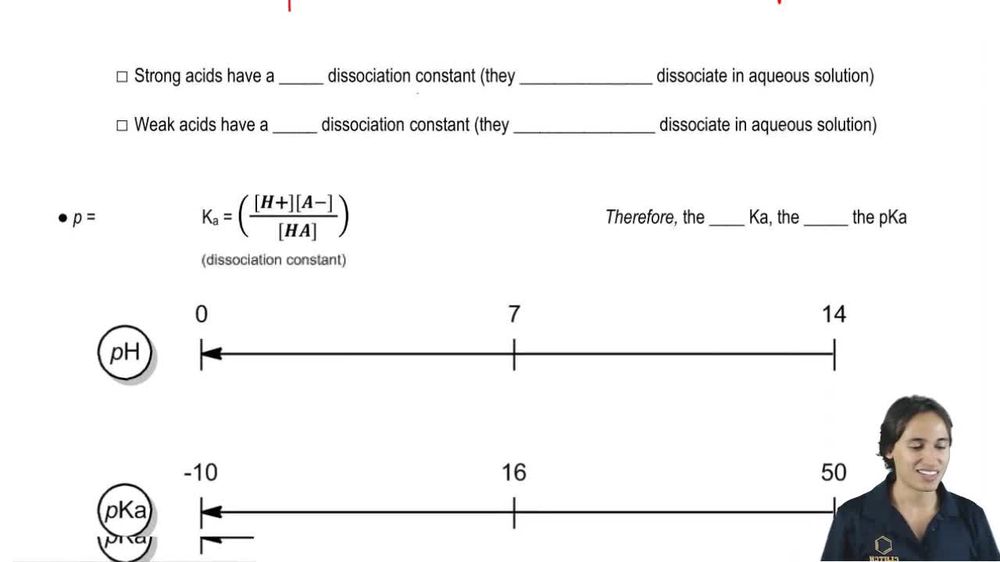
Step 2: Determine the pKa values of the acids involved. The pKa of acetic acid is approximately 4.76, and the pKa of ethanol is approximately 16. This information is crucial for calculating the equilibrium constant (Keq).
Step 3: Use the relationship between pKa values and Keq. The equilibrium constant for an acid-base reaction can be calculated using the formula: Keq = 10^(pKa(conjugate acid) - pKa(acid)).
Step 4: Substitute the pKa values into the formula. In this case, the conjugate acid is ethanol (pKa = 16), and the acid is acetic acid (pKa = 4.76). The formula becomes: Keq = 10^(16 - 4.76).
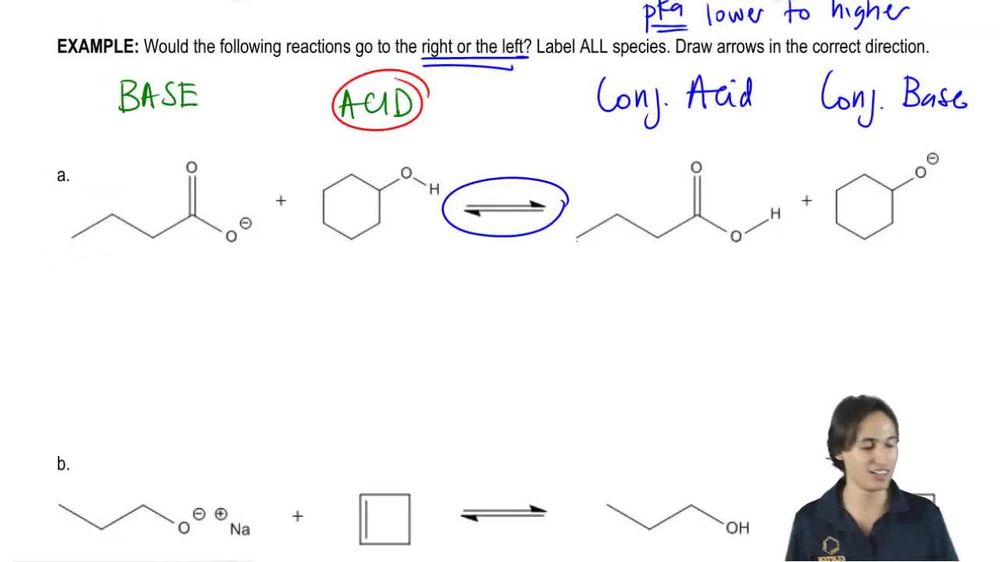
Step 5: Interpret the result. The calculated Keq will indicate the position of equilibrium. If Keq > 1, the equilibrium favors the products (right side). If Keq < 1, the equilibrium favors the reactants (left side).
Verified video answer for a similar problem:
This video solution was recommended by our tutors as helpful for the problem above
Video duration:
3m
Play a video:
0 Comments
Key Concepts
Here are the essential concepts you must grasp in order to answer the question correctly.
Acid-Base Equilibrium
Acid-base equilibrium refers to the state where the rates of the forward and reverse reactions of an acid and its conjugate base are equal. This equilibrium is characterized by the equilibrium constant (Keq), which quantifies the ratio of the concentrations of products to reactants at equilibrium. Understanding this concept is crucial for calculating Keq for given acid-base pairs.
The equilibrium constant (Keq) is a numerical value that expresses the ratio of the concentrations of products to reactants at equilibrium for a reversible reaction. For acid-base reactions, Keq can be calculated using the concentrations of the acid and its conjugate base. A higher Keq value indicates a stronger tendency for the reaction to favor products, while a lower value suggests a preference for reactants.
The relationship between equilibrium constant and pKa.
Conjugate Acid-Base Pairs
Conjugate acid-base pairs consist of two species that differ by the presence or absence of a proton (H+). In any acid-base reaction, the acid donates a proton to form its conjugate base, while the base accepts a proton to form its conjugate acid. Recognizing these pairs is essential for understanding the dynamics of acid-base reactions and for calculating the equilibrium constant.

 3:32 minutes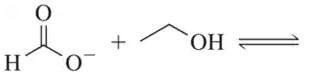
 Verified step by step guidance
 04:00
04:00