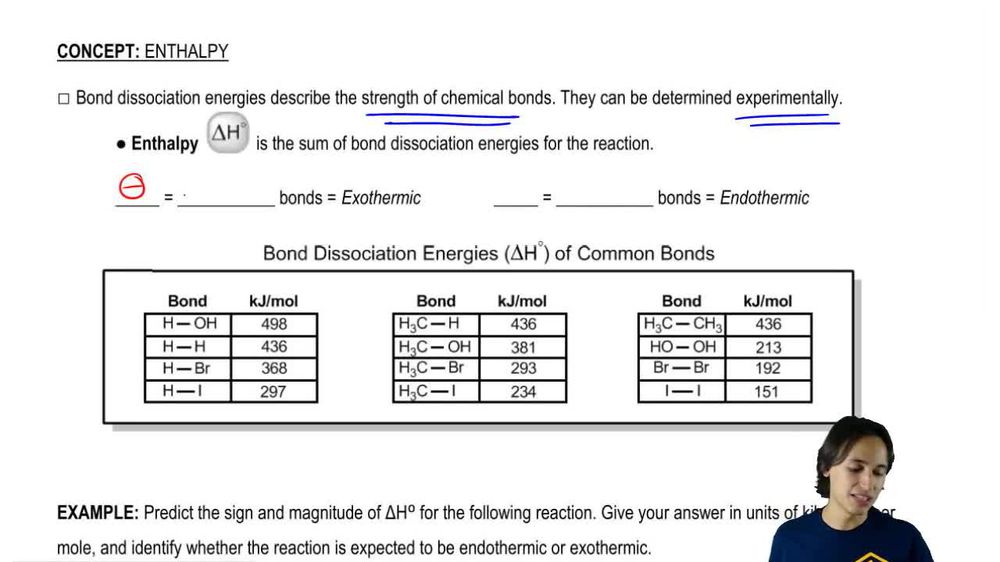
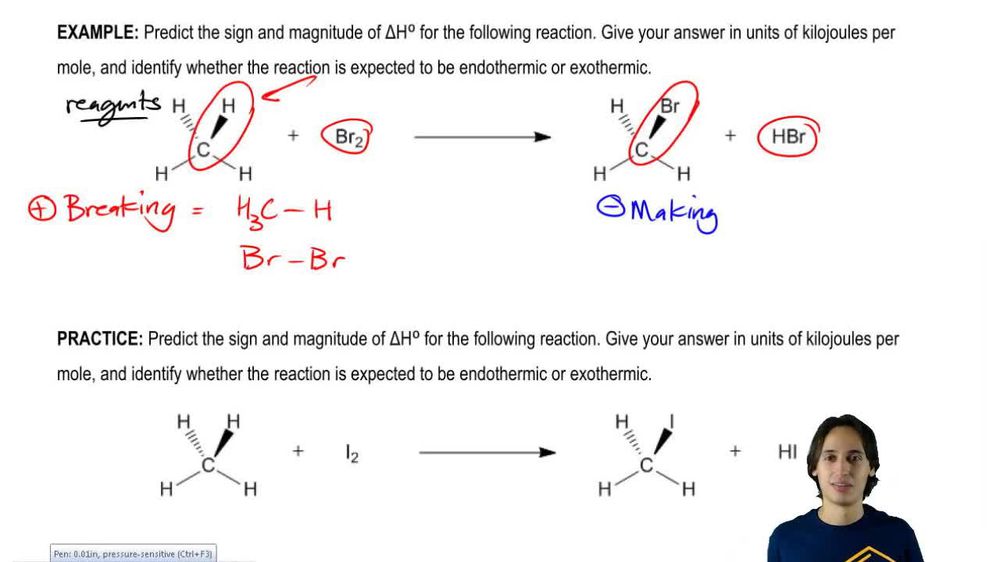
a. Propose a mechanism for the following reaction: b. Use the bond-dissociation enthalpies given in Table 4-2 (page 167) to calculate the value of ΔH° for each step shown in your mechanism. (The BDE for CH2=CHCH2―Br is about 280 kJ/mol, or 67 kcal/mol.) Calculate the overall value of ΔH° for the reaction. Are these values consistent with a rapid free-radical chain reaction?
Verified step by step guidance
1
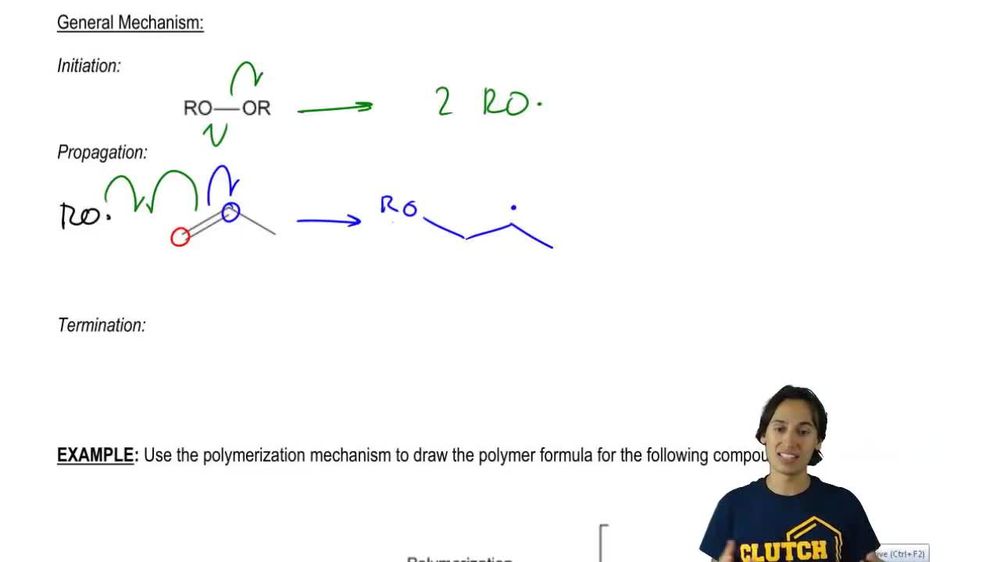
Step 1: Analyze the reaction mechanism. This reaction involves a free-radical chain mechanism initiated by light (hv). The bromine molecule (Br2) undergoes homolytic cleavage under light to form two bromine radicals. This is the initiation step.
Step 2: In the propagation step, one bromine radical reacts with the allylic hydrogen of H2C=CH—CH3, forming an allylic radical (H2C=CH—CH2•) and HBr. The bond-dissociation enthalpy (BDE) for breaking the allylic C—H bond is 372 kJ/mol (89 kcal/mol).
Step 3: The allylic radical (H2C=CH—CH2•) reacts with another Br2 molecule, forming the product H2C=CH—CH2Br and regenerating a bromine radical. The BDE for forming the C—Br bond in H2C=CH—CH2Br is approximately 280 kJ/mol (67 kcal/mol).
Step 4: Calculate ΔH° for each step using the bond-dissociation enthalpies provided. For the initiation step, breaking the Br—Br bond requires 190 kJ/mol (45 kcal/mol). For the propagation steps, subtract the energy released in bond formation from the energy required for bond breaking.
Step 5: Sum the ΔH° values for all steps to determine the overall ΔH° for the reaction. Compare the calculated ΔH° to the typical energy profile of a rapid free-radical chain reaction. If the overall ΔH° is negative and the steps are energetically favorable, the reaction is consistent with a rapid free-radical chain mechanism.
Verified video answer for a similar problem:
This video solution was recommended by our tutors as helpful for the problem above
Video duration:
10m
Play a video:
0 Comments
Key Concepts
Here are the essential concepts you must grasp in order to answer the question correctly.
Free Radical Mechanism
The free radical mechanism involves the formation of reactive species called free radicals, which are atoms or molecules with unpaired electrons. In this reaction, bromine (Br2) is homolytically cleaved under light (hv) to generate two bromine radicals. These radicals then react with the alkene, leading to the addition of bromine across the double bond and the formation of a bromoalkane.
Bond dissociation enthalpy (BDE) is the energy required to break a specific bond in a molecule, resulting in the formation of free radicals. In this context, BDE values are used to calculate the energy changes associated with each step of the reaction mechanism. By summing the BDEs of bonds broken and formed, one can determine the overall enthalpy change (ΔH°) for the reaction, which provides insight into its feasibility and kinetics.
How to calculate enthalpy using bond dissociation energies.
Enthalpy Change (ΔH°)
Enthalpy change (ΔH°) is a measure of the heat absorbed or released during a chemical reaction at constant pressure. It is calculated by considering the energy of bonds broken and formed during the reaction. A negative ΔH° indicates an exothermic reaction, while a positive value suggests an endothermic process. Understanding ΔH° is crucial for evaluating whether the reaction is energetically favorable and consistent with the characteristics of a rapid free-radical chain reaction.