Phosgene is the acid chloride of carbonic acid. Although phosgene was used as a war gas in World War I, it is now used as a reagent for the synthesis of many useful products. Phosgene reacts like other acid chlorides, but it can react twice. (b) Predict the products formed when phosgene reacts with 1 equivalent of methanol, followed by 1 equivalent of aniline.
Verified step by step guidance
1
Step 1: Understand the reactivity of phosgene. Phosgene (Cl2C=O) is an acid chloride and reacts with nucleophiles. It can undergo two successive nucleophilic acyl substitution reactions due to the presence of two chlorine atoms attached to the carbonyl carbon.
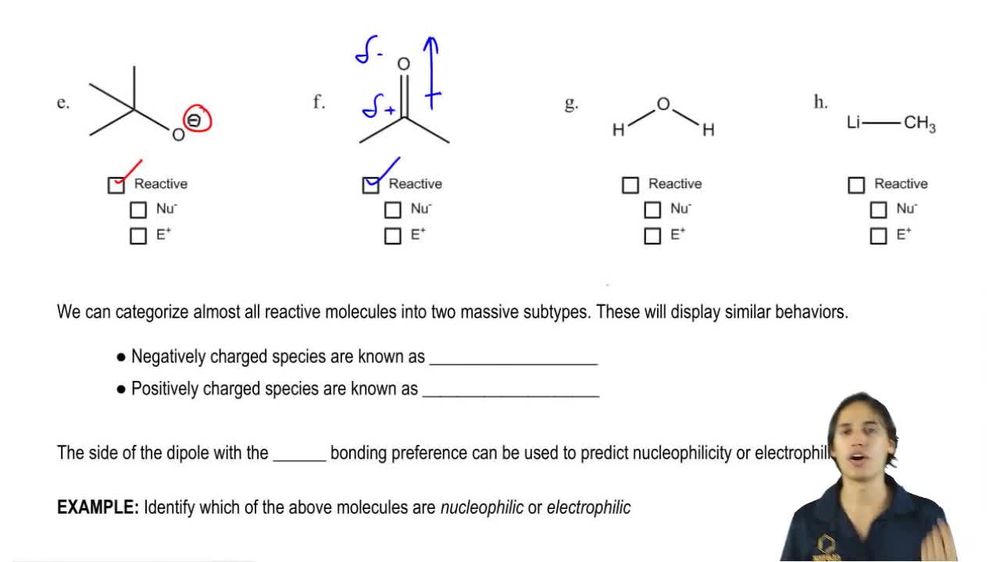
Step 2: Analyze the reaction with methanol. Methanol (CH3OH) acts as a nucleophile. The lone pair on the oxygen atom of methanol attacks the carbonyl carbon of phosgene, displacing one chloride ion (Cl-). This forms methyl chloroformate (CH3OCOCl).
Step 3: Examine the reaction with aniline. Aniline (C6H5NH2) is a nucleophile due to the lone pair on the nitrogen atom. Aniline reacts with methyl chloroformate, attacking the carbonyl carbon and displacing the remaining chloride ion (Cl-). This forms the final product, methyl N-phenyl carbamate (CH3OCO-NH-C6H5).
Step 4: Summarize the reaction mechanism. The reaction proceeds via two nucleophilic acyl substitution steps. In the first step, methanol replaces one chloride ion, forming methyl chloroformate. In the second step, aniline replaces the remaining chloride ion, forming methyl N-phenyl carbamate.
Step 5: Note the byproducts. Each substitution reaction releases a chloride ion (Cl-) as a byproduct. Therefore, two chloride ions are released in total during the reaction.
Verified video answer for a similar problem:
This video solution was recommended by our tutors as helpful for the problem above
Video duration:
3m
Play a video:
0 Comments
Key Concepts
Here are the essential concepts you must grasp in order to answer the question correctly.
Acid Chlorides
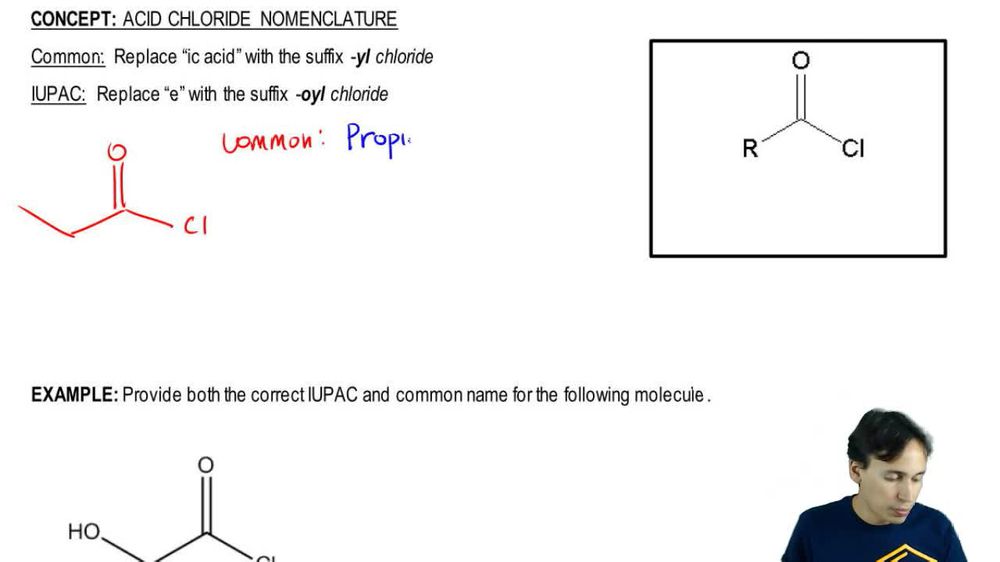
Acid chlorides are a class of organic compounds derived from carboxylic acids, where the hydroxyl group (-OH) is replaced by a chlorine atom. They are highly reactive due to the presence of the carbonyl group (C=O) and the electronegative chlorine, making them excellent electrophiles. This reactivity allows them to participate in nucleophilic acyl substitution reactions, where nucleophiles attack the carbonyl carbon, leading to the formation of various products.
Nucleophilic acyl substitution is a fundamental reaction in organic chemistry where a nucleophile attacks the electrophilic carbon of a carbonyl group in an acyl compound, such as an acid chloride. This reaction typically involves the replacement of a leaving group (like Cl) with the nucleophile. In the case of phosgene reacting with methanol and aniline, the nucleophiles will replace the chlorine atoms, resulting in the formation of esters and amides.
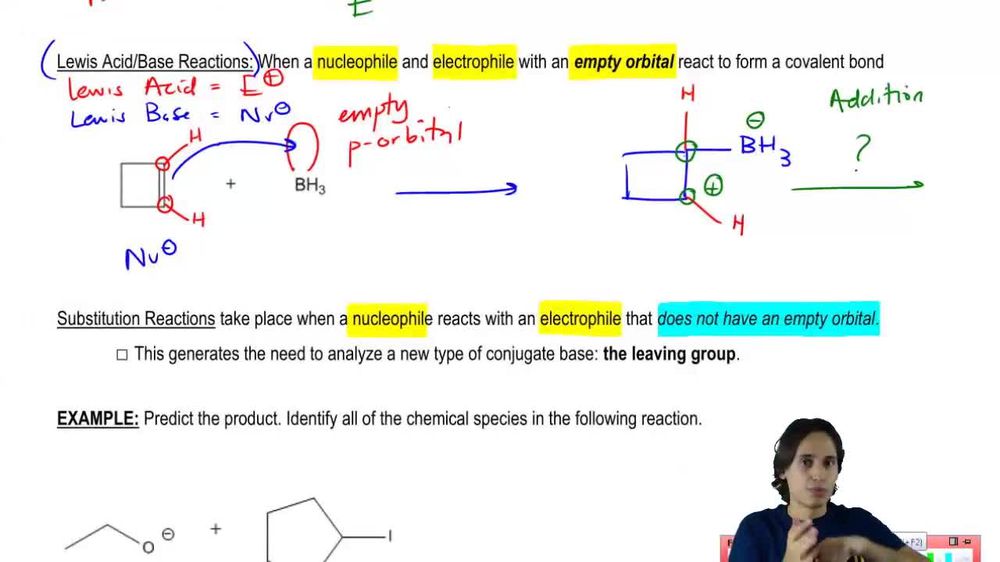
Nucleophiles and Electrophiles can react in Substitution Reactions.
Reactivity of Phosgene
Phosgene, as an acid chloride of carbonic acid, exhibits unique reactivity patterns due to its ability to undergo two nucleophilic substitutions. When it reacts with nucleophiles like methanol and aniline, it can form both an ester and an amide. Understanding this dual reactivity is crucial for predicting the products of the reaction, as it highlights the versatility of phosgene in synthetic organic chemistry.