Predict the major product(s) of the following elimination reactions, paying close attention to the stereochemical outcome of the reactions. (c)
Verified step by step guidance
1
Analyze the type of elimination reaction: Determine whether the reaction proceeds via an E1 or E2 mechanism. This depends on factors such as the strength of the base, the structure of the substrate (primary, secondary, or tertiary), and the reaction conditions (e.g., heat). For example, a strong base and a secondary or tertiary substrate often favor an E2 mechanism.
Identify the β-hydrogens: Locate the β-carbons (carbons adjacent to the carbon bearing the leaving group) and identify the β-hydrogens that can be eliminated. These hydrogens are crucial for forming the double bond in the elimination product.
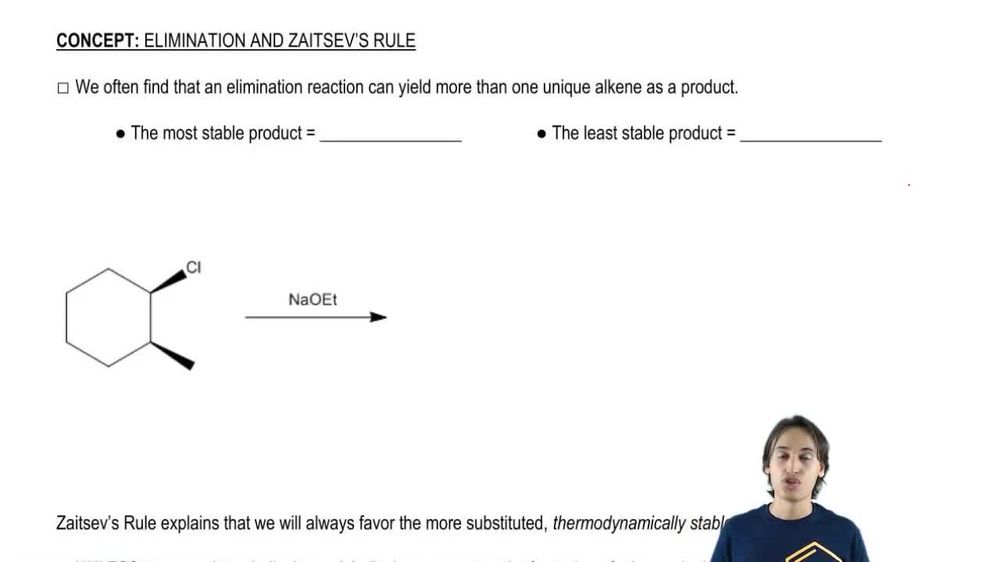
Consider Zaitsev's rule: Predict the major product based on Zaitsev's rule, which states that the more substituted alkene (the one with more alkyl groups attached to the double-bonded carbons) is typically the major product. However, if a bulky base is used, the less substituted alkene (Hofmann product) may dominate.
Evaluate stereochemistry: For an E2 reaction, the β-hydrogen and the leaving group must be anti-periplanar (in the same plane but opposite sides). Draw the Newman projection or use a chair conformation (if applicable) to ensure proper alignment for elimination. This step determines the stereochemical outcome of the product.
Draw the major product(s): Based on the above analysis, draw the structure of the major alkene product(s), ensuring that the stereochemistry and substitution pattern are consistent with the mechanism and rules applied.
Verified video answer for a similar problem:
This video solution was recommended by our tutors as helpful for the problem above
Video duration:
2m
Play a video:
0 Comments
Key Concepts
Here are the essential concepts you must grasp in order to answer the question correctly.
Elimination Reactions
Elimination reactions involve the removal of atoms or groups from a molecule, resulting in the formation of a double bond. The most common types are E1 and E2 mechanisms, where E1 is a two-step process involving carbocation formation, while E2 is a one-step concerted process. Understanding the mechanism is crucial for predicting the products and their stereochemistry.
Stereochemistry refers to the spatial arrangement of atoms in molecules and how this affects their chemical behavior. In elimination reactions, the stereochemical outcome can lead to different products, such as cis or trans isomers. Recognizing the stereochemical implications of the reaction mechanism is essential for predicting the major product.
Zaitsev's Rule states that in elimination reactions, the more substituted alkene is typically the major product. This principle helps predict the outcome of reactions by favoring the formation of more stable alkenes, which are generally more substituted. Understanding this rule aids in determining the preferred product in elimination scenarios.

 2:48 minutes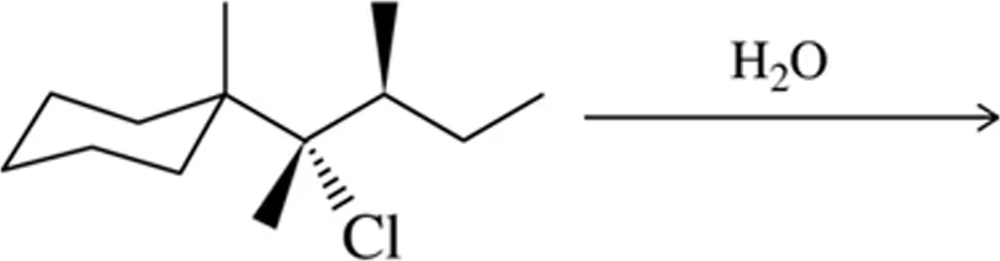
 Verified step by step guidance
 00:40
00:40