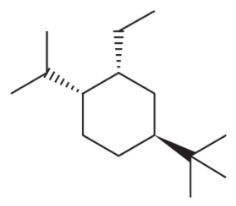
Draw the most stable chair conformation for the following trisubstituted cyclohexane.
Verified step by step guidance
1
Analyze the given cyclohexane structure and identify the substituents attached to the ring. In this case, there are three substituents: two isopropyl groups and one methyl group.
Determine the stereochemistry of each substituent based on the wedge (solid) and dash (dotted) bonds. Wedge bonds indicate substituents pointing out of the plane (up), while dash bonds indicate substituents pointing into the plane (down).
Draw the basic chair conformation of cyclohexane, which alternates between axial and equatorial positions for substituents. Axial positions are perpendicular to the plane of the ring, while equatorial positions are roughly parallel to the plane.
Place the substituents in the chair conformation based on their stereochemistry. Substituents in the 'up' position should be placed in equatorial or axial positions depending on stability, and substituents in the 'down' position should follow the same rule. Larger groups (like isopropyl) prefer equatorial positions to minimize steric hindrance.
Verify the stability of the conformation by ensuring that the largest substituents occupy equatorial positions, as this reduces steric strain and makes the conformation more stable.
Verified video answer for a similar problem:
This video solution was recommended by our tutors as helpful for the problem above
Play a video:
0 Comments
Key Concepts
Here are the essential concepts you must grasp in order to answer the question correctly.
Chair Conformation
The chair conformation is the most stable three-dimensional arrangement of cyclohexane, minimizing steric strain and torsional strain. In this conformation, the carbon atoms are arranged in a staggered manner, allowing for optimal bond angles and distances. Understanding this conformation is crucial for analyzing the stability of substituted cyclohexanes.
In cyclohexane derivatives, substituents can occupy axial or equatorial positions. Axial substituents are oriented perpendicular to the plane of the ring, while equatorial substituents extend outward, parallel to the ring. The equatorial position is generally more stable due to reduced steric hindrance, making it essential to determine the most favorable positioning for substituents in chair conformations.
Steric hindrance refers to the repulsion between atoms or groups that are in close proximity, which can destabilize a molecular conformation. In the context of cyclohexane, bulky substituents prefer equatorial positions to minimize interactions with other axial substituents or hydrogen atoms. Recognizing the impact of steric hindrance is vital for predicting the stability of different conformations.