From the IUPAC name, draw the corresponding structure. (a) (R)-6-iodo-3-isopropylnon-1-ene
Verified step by step guidance
1
Step 1: Break down the IUPAC name systematically. The name '(R)-6-iodo-3-isopropylnon-1-ene' indicates a molecule with a nonane backbone (9 carbon atoms) and specific substituents and stereochemistry.
Step 2: Identify the main chain. The 'non-1-ene' part specifies a 9-carbon chain with a double bond at the first carbon. Draw a straight chain of 9 carbons and place a double bond between C1 and C2.
Step 3: Add the substituents. The '6-iodo' indicates an iodine atom attached to the 6th carbon, and '3-isopropyl' indicates an isopropyl group attached to the 3rd carbon. Place these substituents accordingly on the main chain.
Step 4: Incorporate stereochemistry. The '(R)' designation specifies the absolute configuration at the chiral center. Determine the chiral center (C3, where the isopropyl group is attached) and assign the (R) configuration based on the Cahn-Ingold-Prelog priority rules.
Step 5: Verify the structure. Ensure the double bond, substituents, and stereochemistry are correctly placed and consistent with the IUPAC name. Double-check the connectivity and spatial arrangement of atoms.
Verified video answer for a similar problem:
This video solution was recommended by our tutors as helpful for the problem above
Video duration:
7m
Play a video:
0 Comments
Key Concepts
Here are the essential concepts you must grasp in order to answer the question correctly.
IUPAC Nomenclature
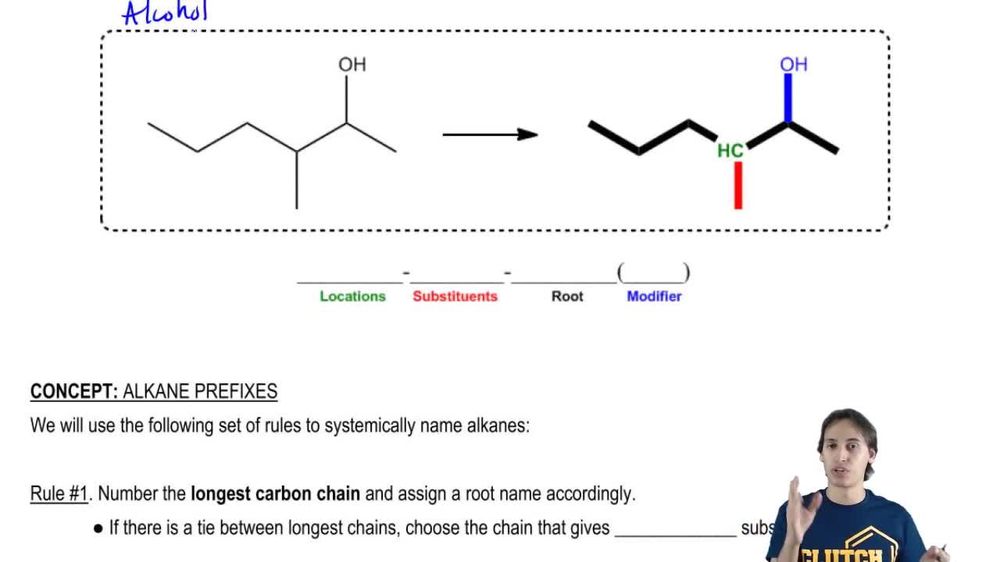
IUPAC nomenclature is a systematic method for naming organic chemical compounds. It provides a unique name that conveys the structure of the molecule, including the type of functional groups, the length of the carbon chain, and the position of substituents. Understanding IUPAC rules is essential for translating names into chemical structures.
Stereochemistry refers to the study of the spatial arrangement of atoms in molecules and how this affects their chemical behavior. The designation (R) in the name indicates a specific three-dimensional configuration around a chiral center, which is crucial for accurately drawing the structure. Recognizing stereochemical descriptors is vital for understanding isomerism in organic compounds.
Alkenes are hydrocarbons that contain at least one carbon-carbon double bond, which influences their reactivity and physical properties. The name '3-isopropylnon-1-ene' indicates the presence of an isopropyl group as a substituent on the nonene backbone. Familiarity with the structure and behavior of alkenes and their substituents is necessary for constructing the correct molecular structure.

 7:24 minutes
 Verified step by step guidance
 03:43
03:43