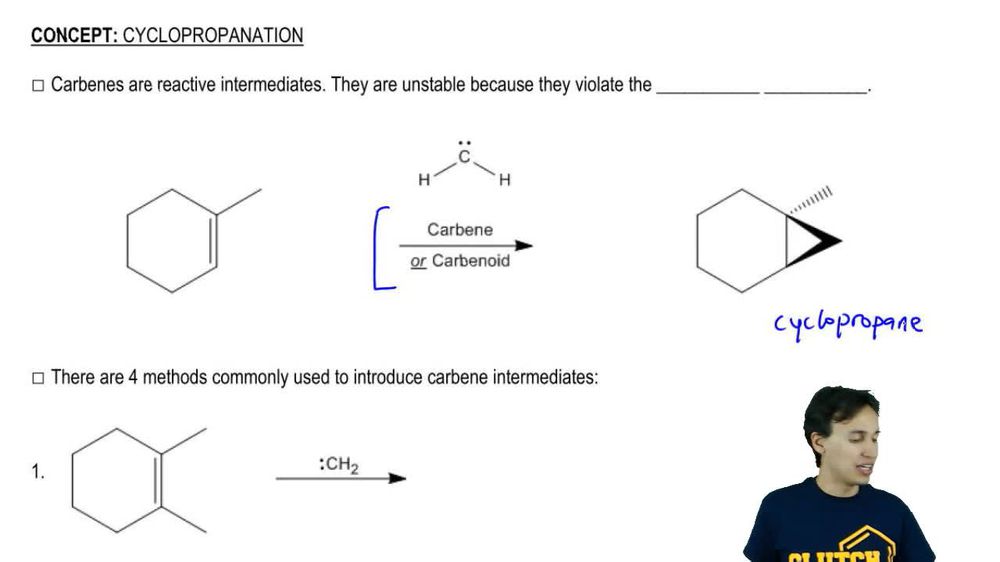
Cyclopropanation using any of the reagents discussed here is stereospecific. (a) What does this say about the mechanism?
Verified step by step guidance
1
Understand the term 'stereospecific': A stereospecific reaction is one in which the stereochemistry of the reactant determines the stereochemistry of the product in a specific way. This means that the reaction mechanism must preserve or control the spatial arrangement of atoms or groups in the molecule.
Recall the general mechanism of cyclopropanation: Cyclopropanation typically involves the addition of a carbene or a carbenoid to an alkene, forming a three-membered cyclopropane ring. The reaction occurs in a single concerted step, meaning all bond-making and bond-breaking events happen simultaneously.
Analyze the stereospecificity: Since the reaction is stereospecific, the stereochemistry of the starting alkene (cis or trans) is directly reflected in the stereochemistry of the cyclopropane product. For example, a cis-alkene will yield a cis-cyclopropane, and a trans-alkene will yield a trans-cyclopropane.
Relate stereospecificity to the mechanism: The stereospecificity suggests that the reaction proceeds through a concerted mechanism, where the carbene or carbenoid interacts with both π-bonded carbons of the alkene simultaneously. This concerted nature ensures that the relative spatial arrangement of substituents on the alkene is preserved in the product.
Conclude the implication for the mechanism: The stereospecificity of cyclopropanation indicates that the reaction does not involve intermediates that could allow for free rotation or rearrangement of substituents. Instead, it supports a concerted, single-step mechanism that maintains the stereochemical integrity of the reactant.
Verified video answer for a similar problem:
This video solution was recommended by our tutors as helpful for the problem above
Video duration:
5m
Play a video:
0 Comments
Key Concepts
Here are the essential concepts you must grasp in order to answer the question correctly.
Stereospecificity
Stereospecificity refers to a reaction where the configuration of the reactant determines the configuration of the product. In the context of cyclopropanation, this means that the addition of reagents leads to a specific stereochemical outcome, indicating that the mechanism involves a direct interaction between the reagent and the substrate that preserves the spatial arrangement of atoms.
The mechanism of cyclopropanation typically involves the formation of a three-membered ring through the concerted addition of a reagent, such as a carbene or a metal-carbene complex, to a double bond. This process is stereospecific because the transition state is influenced by the orientation of the double bond, leading to a specific stereochemical configuration in the product.
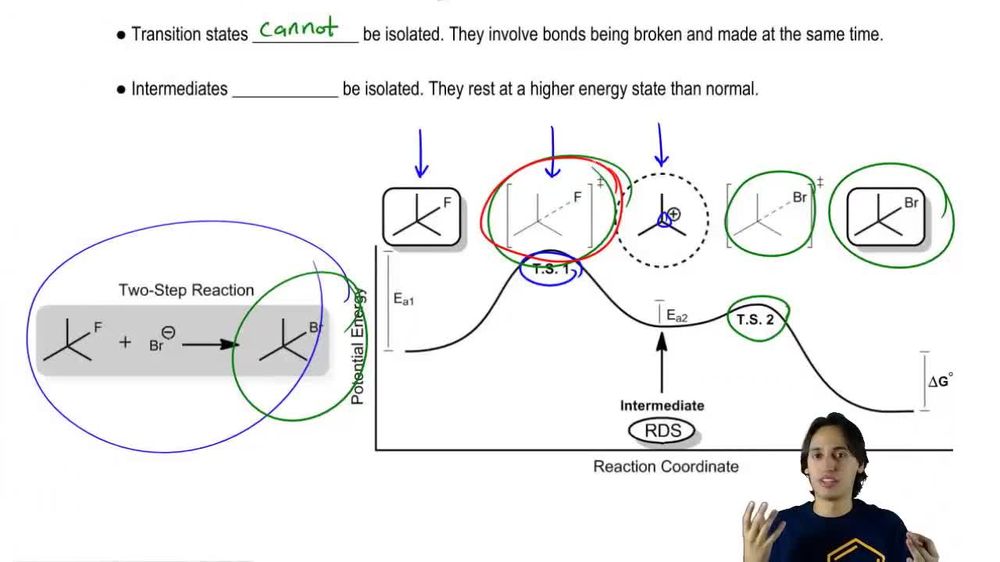
Transition state theory posits that during a chemical reaction, reactants pass through a high-energy transition state before forming products. In stereospecific reactions like cyclopropanation, the transition state is crucial as it dictates the stereochemical outcome, ensuring that the spatial arrangement of substituents is retained in the final product, thus confirming the stereospecific nature of the mechanism.

 5:14 minutes
 Verified step by step guidance
 15:39
15:39