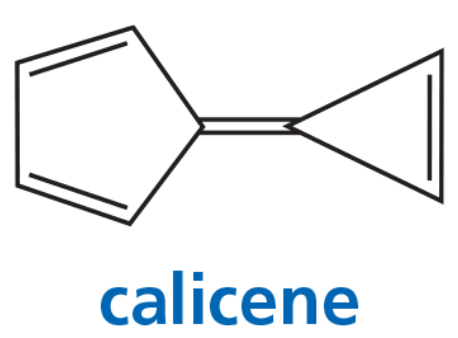
In what direction is the dipole moment in calicene? Explain.
Verified step by step guidance
1
Analyze the structure of calicene: Calicene consists of two aromatic rings connected by a double bond. One ring is a benzene ring, and the other is a cyclopropene ring. The cyclopropene ring has a strained geometry and contributes to the molecule's electronic properties.
Understand the concept of dipole moment: Dipole moment arises due to the separation of charges within a molecule. It depends on the electronegativity differences between atoms and the geometry of the molecule.
Examine the electron distribution: In calicene, the benzene ring is electron-rich due to its aromaticity, while the cyclopropene ring is electron-deficient because of its strained geometry and the presence of the double bond. This creates an electron density imbalance.
Determine the direction of the dipole moment: The dipole moment will point from the electron-rich benzene ring toward the electron-deficient cyclopropene ring. This is because the electron density is higher on the benzene ring, and the dipole moment vector points from negative to positive charge regions.
Summarize the explanation: The dipole moment in calicene is directed from the benzene ring toward the cyclopropene ring due to the difference in electron density and the molecular geometry.
Verified video answer for a similar problem:
This video solution was recommended by our tutors as helpful for the problem above
Video duration:
5m
Play a video:
0 Comments
Key Concepts
Here are the essential concepts you must grasp in order to answer the question correctly.
Dipole Moment
The dipole moment is a vector quantity that measures the separation of positive and negative charges in a molecule. It indicates the direction and strength of the polarity within the molecule, with the arrow pointing from the positive to the negative charge. A molecule with a dipole moment is polar, meaning it has distinct regions of partial positive and negative charge.
Molecular geometry refers to the three-dimensional arrangement of atoms within a molecule. The shape of a molecule influences its dipole moment, as the spatial distribution of polar bonds can either reinforce or cancel out the overall polarity. In calicene, the unique structure affects how the dipole moment is oriented based on the arrangement of its aromatic rings.
Aromaticity is a property of cyclic compounds that exhibit resonance stability due to the delocalization of π electrons across the ring structure. In calicene, the presence of aromatic rings contributes to its electronic properties and influences the distribution of electron density, which is crucial for determining the direction of the dipole moment.