Explain why [1,3] sigmatropic migrations of hydrogen cannot occur under thermal conditions, but [1,3] sigmatropic migrations of carbon can.
Verified step by step guidance
1
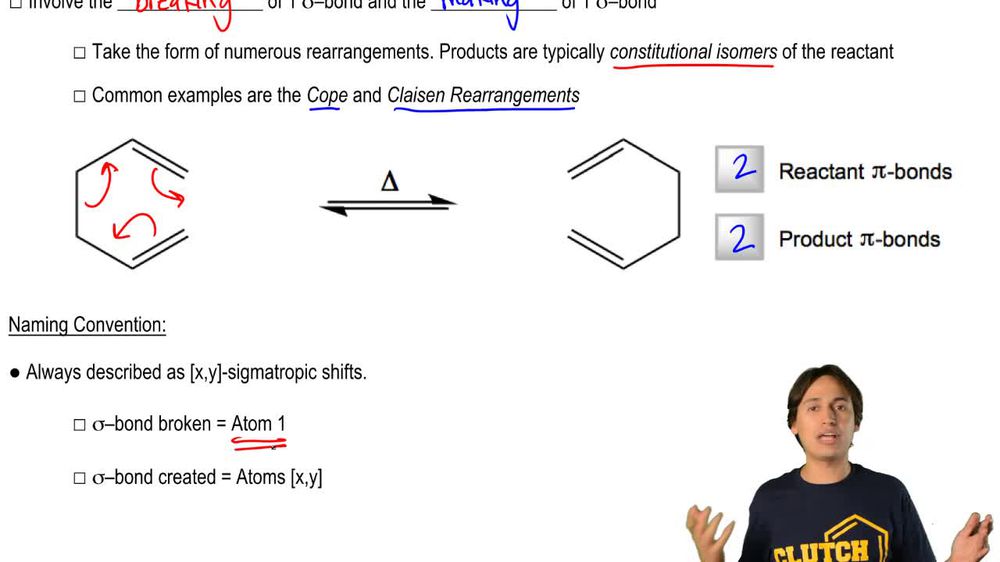
Understand the concept of sigmatropic rearrangements: Sigmatropic rearrangements are pericyclic reactions where a sigma bond migrates across a conjugated π-system, resulting in a new sigma bond. The reaction is classified as [m,n] based on the number of atoms in the migrating group and the distance it moves.
Apply the Woodward-Hoffmann rules: These rules determine whether a pericyclic reaction is thermally allowed or forbidden based on the conservation of orbital symmetry. For sigmatropic rearrangements, the reaction's feasibility depends on whether the total number of electrons involved in the π-system is 4n or 4n+2 (where n is an integer).
Analyze the [1,3] hydrogen migration: In a [1,3] sigmatropic hydrogen migration, the reaction involves a 4-electron system (2 electrons from the π-bond and 2 from the migrating hydrogen's sigma bond). According to the Woodward-Hoffmann rules, a 4-electron system requires an antarafacial (opposite face) migration to be thermally allowed. However, hydrogen, being a single atom, cannot achieve the necessary orbital overlap for an antarafacial migration, making the reaction thermally forbidden.
Analyze the [1,3] carbon migration: In a [1,3] sigmatropic carbon migration, the reaction also involves a 4-electron system. However, a carbon atom has a larger size and more flexible bonding geometry compared to hydrogen, allowing it to achieve the required antarafacial orbital overlap. This makes the [1,3] sigmatropic migration of carbon thermally allowed.
Summarize the difference: The key difference lies in the ability of the migrating group to achieve the necessary orbital overlap for an antarafacial migration. Hydrogen's small size and lack of flexibility prevent it from doing so, while carbon's larger size and bonding flexibility enable it to satisfy the orbital symmetry requirements under thermal conditions.
Verified video answer for a similar problem:
This video solution was recommended by our tutors as helpful for the problem above
Video duration:
7m
Play a video:
0 Comments
Key Concepts
Here are the essential concepts you must grasp in order to answer the question correctly.
Sigmatropic Rearrangements
Sigmatropic rearrangements are a type of pericyclic reaction where a sigma bond and a pi system undergo a concerted transformation. These reactions can be classified based on the number of atoms involved in the migration, such as [1,3] sigmatropic migrations, which involve the migration of a substituent across a three-atom bridge. Understanding the mechanism of these rearrangements is crucial for analyzing their feasibility under different conditions.
Thermal conditions refer to reactions occurring at elevated temperatures, where the energy provided can facilitate bond breaking and formation. In contrast, photochemical conditions involve the absorption of light, which can provide the necessary energy to promote certain reactions that are otherwise unfavorable under thermal conditions. The distinction between these conditions is essential for understanding why certain migrations are allowed or disallowed.
Orbital symmetry plays a critical role in determining the feasibility of pericyclic reactions. According to the Woodward-Hoffmann rules, the conservation of orbital symmetry must be maintained during a reaction. For [1,3] sigmatropic migrations of hydrogen, the symmetry requirements under thermal conditions are not satisfied, making these migrations forbidden, while carbon migrations can occur due to favorable symmetry interactions.

 7:12 minutes
 Verified step by step guidance
 03:20
03:20