Ammonia appears in [TABLE 2-2] as both an acid and a conjugate base. d. Show how methanol (CH3OH) can serve as both an acid and a base. Write an equation for the reaction of methanol with sulfuric acid.
Verified step by step guidance
1
Methanol (CH₃OH) can act as an acid by donating a proton (H⁺) to a base. When methanol donates a proton, it forms the methoxide ion (CH₃O⁻). This is an example of methanol acting as an acid.
Methanol can also act as a base by accepting a proton from an acid. When methanol accepts a proton, it forms the methanol cation (CH₃OH₂⁺). This is an example of methanol acting as a base.
To show methanol acting as an acid, consider its reaction with a strong base like sodium hydroxide (NaOH). The equation would be: CH₃OH + NaOH → CH₃O⁻ + Na⁺ + H₂O.
To show methanol acting as a base, consider its reaction with a strong acid like sulfuric acid (H₂SO₄). The equation would be: CH₃OH + H₂SO₄ → CH₃OH₂⁺ + HSO₄⁻.
In the reaction with sulfuric acid, methanol accepts a proton from sulfuric acid, demonstrating its ability to act as a base. This reaction highlights the dual nature of methanol as both an acid and a base.
Verified video answer for a similar problem:
This video solution was recommended by our tutors as helpful for the problem above
Video duration:
2m
Play a video:
0 Comments
Key Concepts
Here are the essential concepts you must grasp in order to answer the question correctly.
Acid-Base Duality
Acid-base duality refers to the ability of certain substances to act as both an acid and a base, depending on the reaction context. Methanol (CH3OH) can donate a proton, acting as an acid, or accept a proton, acting as a base. This dual behavior is crucial for understanding methanol's role in chemical reactions, such as its interaction with sulfuric acid.
Conjugate acid-base pairs are two species that transform into each other by the gain or loss of a proton. In the table, ammonia (NH3) and ammonium ion (NH4+) are an example, where NH3 acts as a base and NH4+ as its conjugate acid. Understanding these pairs helps in predicting the direction of acid-base reactions and the relative strength of acids and bases.
The pKa value is a measure of the acidity of a substance, indicating how easily it donates a proton. Lower pKa values correspond to stronger acids. In the table, methanol has a pKa of 15.9, indicating it is a very weak acid compared to sulfuric acid, which is a strong acid. This concept is essential for predicting the behavior of methanol in acid-base reactions.

 2:25 minutes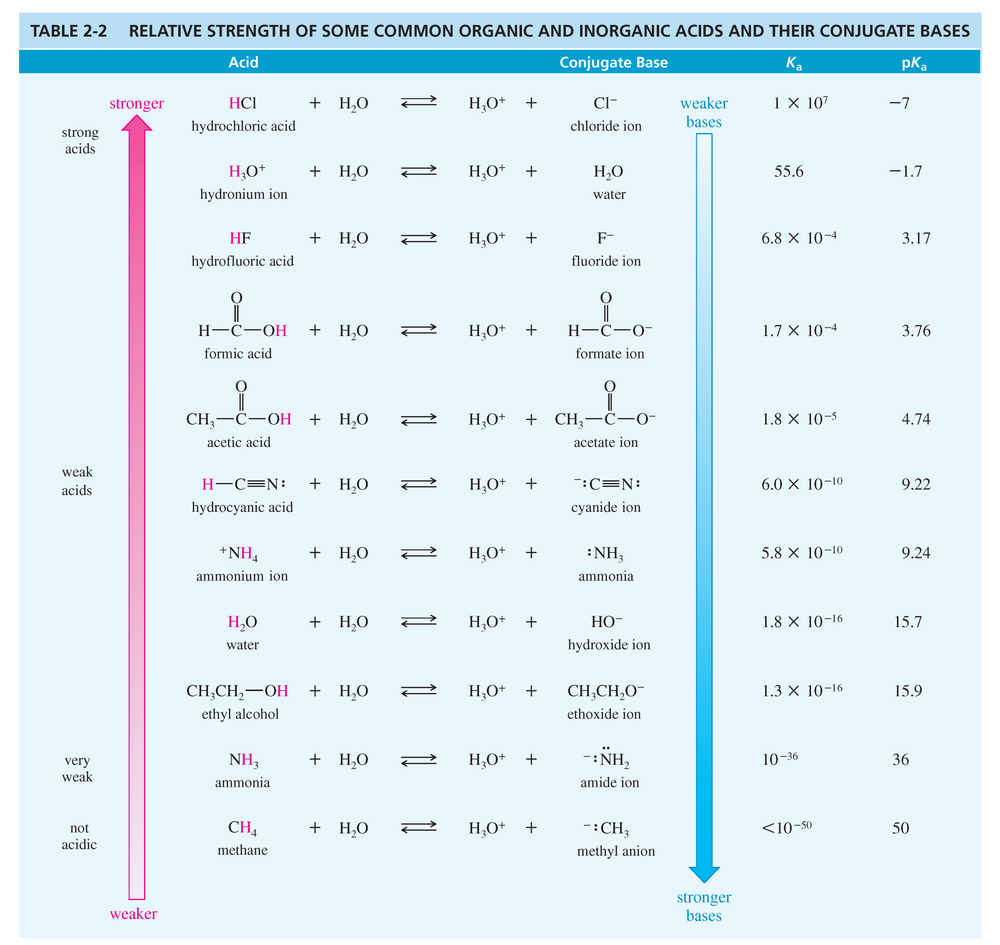
 Verified step by step guidance
 02:49
02:49