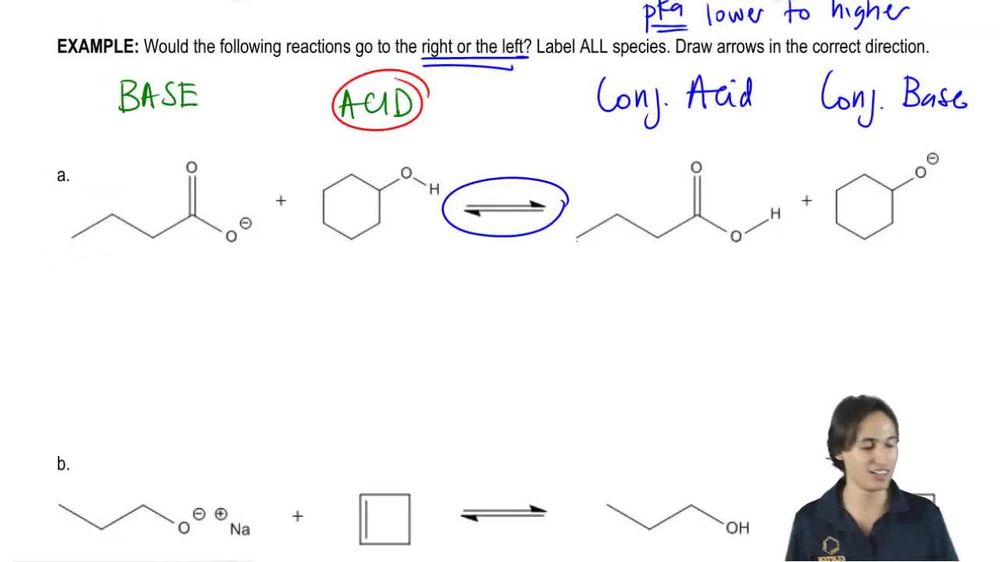
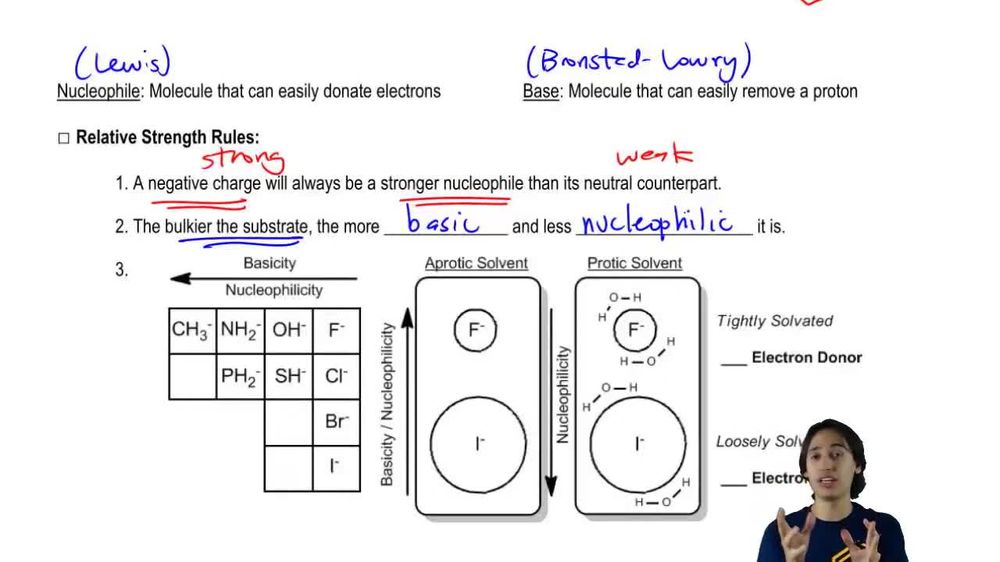
Ethyne (HC≡CH) has a pKa value of 25, water has a pKa value of 15.7, and ammonia (NH3) has a pKa value of 36. Draw the equation, showing equilibrium arrows that indicate whether reactants or products are favored, for the acid–base reaction of ethyne with b. −NH2. c. Which would be a better base to use if you wanted to remove a proton from ethyne, HO− or -NH2?
Verified step by step guidance
1
Step 1: Understand the acid-base reaction. Ethyne (HC≡CH) acts as an acid, and the base in question is −NH2 (amide ion). The reaction involves the transfer of a proton (H⁺) from ethyne to −NH2, forming the conjugate base of ethyne (HC≡C⁻) and the conjugate acid of −NH2 (NH3).
Step 2: Write the chemical equation for the reaction. The equation is: . Use equilibrium arrows to indicate the direction of the reaction.
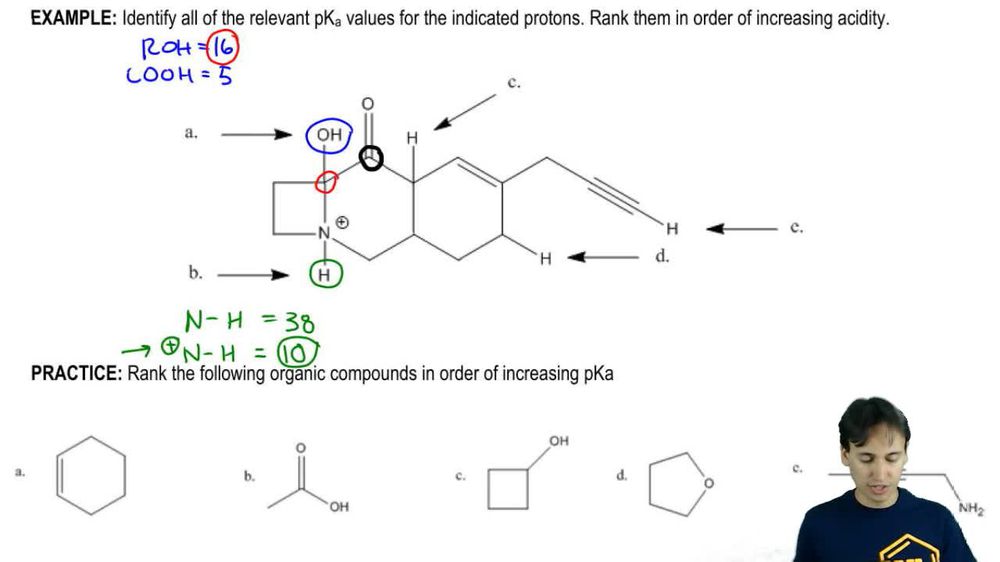
Step 3: Compare the pKa values to determine the direction of equilibrium. The pKa of ethyne is 25, and the pKa of ammonia (NH3) is 36. Since the pKa of ammonia is higher, it is a weaker acid compared to ethyne. The equilibrium will favor the side with the weaker acid and weaker base, which in this case is the products (HC≡C⁻ and NH3).
Step 4: Address part c of the problem. To determine whether HO⁻ or −NH2 is a better base for deprotonating ethyne, compare their conjugate acids' pKa values. The conjugate acid of HO⁻ is water (pKa = 15.7), and the conjugate acid of −NH2 is ammonia (pKa = 36). Since a stronger base has a weaker conjugate acid (higher pKa), −NH2 is a stronger base than HO⁻.
Step 5: Conclude that −NH2 is the better base to use for removing a proton from ethyne because it is stronger than HO⁻, as indicated by the higher pKa of its conjugate acid (NH3).
Verified video answer for a similar problem:
This video solution was recommended by our tutors as helpful for the problem above
Video duration:
6m
Play a video:
0 Comments
Key Concepts
Here are the essential concepts you must grasp in order to answer the question correctly.
pKa and Acid-Base Strength
The pKa value is a quantitative measure of the strength of an acid in solution; lower pKa values indicate stronger acids. In acid-base reactions, the equilibrium favors the formation of the weaker acid and base. Understanding pKa values helps predict the direction of the reaction and which species will act as the acid or base.
Acid-base reactions can be represented by equilibrium arrows, indicating the relative stability of reactants and products. The position of equilibrium is influenced by the strengths of the acids and bases involved. In this context, the reaction between ethyne and -NH2 will favor the formation of the weaker acid and base, which can be determined by comparing their pKa values.
To determine which base is better for deprotonating ethyne, one must compare the basicity of HO− (hydroxide ion) and -NH2 (amide ion). The stronger base will have a higher tendency to accept protons. Since -NH2 has a higher pKa than HO−, it is a stronger base and more effective at removing a proton from ethyne.