Show how you would synthesize the following aromatic derivatives from benzene. c. p-chlorotoluene
Verified step by step guidance
1
Step 1: Begin with benzene as the starting material. Benzene is an aromatic compound with a six-membered ring and alternating double bonds.
Step 2: Introduce a methyl group onto the benzene ring to form toluene. This can be achieved through a Friedel-Crafts alkylation reaction using methyl chloride (CH₃Cl) and a Lewis acid catalyst such as aluminum chloride (AlCl₃). The reaction proceeds via electrophilic aromatic substitution.
Step 3: Once toluene is formed, introduce a chlorine atom at the para position relative to the methyl group. This can be done through an electrophilic aromatic substitution reaction using chlorine gas (Cl₂) and a catalyst such as ferric chloride (FeCl₃). The methyl group is an electron-donating group, which directs the incoming chlorine to the para position due to its activating and ortho/para-directing effects.
Step 4: Carefully control the reaction conditions to ensure selective chlorination at the para position. This may involve using a stoichiometric amount of chlorine and monitoring the reaction to avoid over-chlorination.
Step 5: Purify the product, p-chlorotoluene, using techniques such as distillation or recrystallization to remove any unreacted starting materials or side products.
Verified video answer for a similar problem:
This video solution was recommended by our tutors as helpful for the problem above
Video duration:
3m
Play a video:
0 Comments
Key Concepts
Here are the essential concepts you must grasp in order to answer the question correctly.
Electrophilic Aromatic Substitution (EAS)
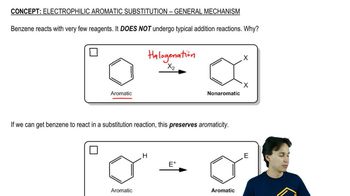
Electrophilic Aromatic Substitution is a fundamental reaction in organic chemistry where an electrophile replaces a hydrogen atom on an aromatic ring. This process is crucial for synthesizing various aromatic compounds, including derivatives of benzene. The reaction typically involves the generation of a highly reactive electrophile, which then attacks the electron-rich aromatic system, leading to the formation of a substituted product.
In the context of EAS, substituents on the aromatic ring can either activate or deactivate the ring towards further substitution. Activating groups, such as alkyl groups, increase the electron density of the ring, making it more reactive, while deactivating groups, like halogens, reduce reactivity. Understanding the influence of these groups is essential for predicting the position of new substituents in the synthesis of compounds like p-chlorotoluene.
Halogenation is a specific type of EAS where a halogen atom is introduced into an aromatic compound. In the case of synthesizing p-chlorotoluene, the process involves the chlorination of toluene, which is already an aromatic compound with a methyl group. The presence of the methyl group directs the incoming chlorine to the para position, resulting in the formation of p-chlorotoluene, demonstrating the regioselectivity of EAS reactions.