Explain the relative acidities. CH2═CHCH2OH, CH3CH2CH2OH, HC≡CCH2OH
Verified step by step guidance
1
Step 1: Begin by understanding the concept of acidity. Acidity is determined by the ability of a compound to donate a proton (H⁺). The more stable the conjugate base after losing a proton, the stronger the acid.
Step 2: Analyze the structure of each compound and identify the functional groups. CH2═CHCH2OH contains an alcohol group (-OH) attached to an allylic carbon, CH3CH2CH2OH contains an alcohol group attached to a saturated alkyl chain, and HC≡CCH2OH contains an alcohol group attached to a propargylic carbon (next to a triple bond).
Step 3: Consider the effects of resonance and electronegativity. In CH2═CHCH2OH, the allylic position allows for resonance stabilization of the conjugate base, making it more acidic. In HC≡CCH2OH, the triple bond increases the electronegativity of the adjacent carbon, stabilizing the conjugate base and increasing acidity. CH3CH2CH2OH lacks resonance or significant electronegativity effects, making it the least acidic.
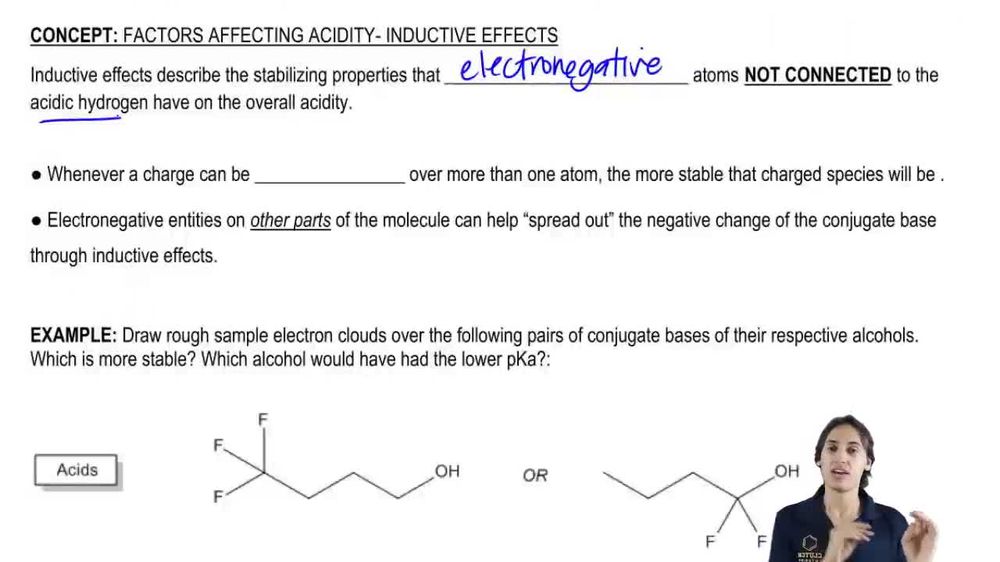
Step 4: Evaluate the inductive effects. Electronegative groups or bonds near the -OH group can pull electron density away, stabilizing the conjugate base. The triple bond in HC≡CCH2OH exerts a stronger inductive effect compared to the double bond in CH2═CHCH2OH, further increasing its acidity.
Step 5: Rank the compounds based on their relative acidities. HC≡CCH2OH is the most acidic due to the strong inductive effect and stabilization of the conjugate base. CH2═CHCH2OH is moderately acidic due to resonance stabilization. CH3CH2CH2OH is the least acidic as it lacks resonance or significant inductive effects.
Verified video answer for a similar problem:
This video solution was recommended by our tutors as helpful for the problem above
Video duration:
2m
Play a video:
0 Comments
Key Concepts
Here are the essential concepts you must grasp in order to answer the question correctly.
Acidity and pKa
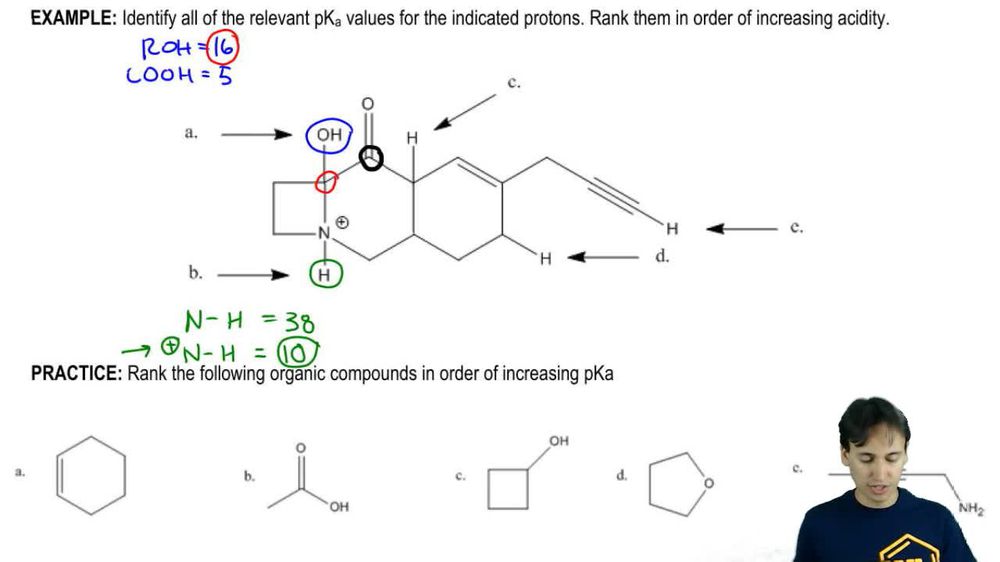
Acidity refers to the tendency of a compound to donate a proton (H+) in solution. The strength of an acid is often measured by its pKa value, where lower pKa values indicate stronger acids. Understanding the pKa helps predict the relative acidities of different compounds, as it reflects the stability of the conjugate base formed after deprotonation.
The inductive effect describes how the presence of electronegative atoms or groups can influence the acidity of a molecule by stabilizing or destabilizing the conjugate base. Electron-withdrawing groups increase acidity by stabilizing the negative charge on the conjugate base, while electron-donating groups decrease acidity by destabilizing it.
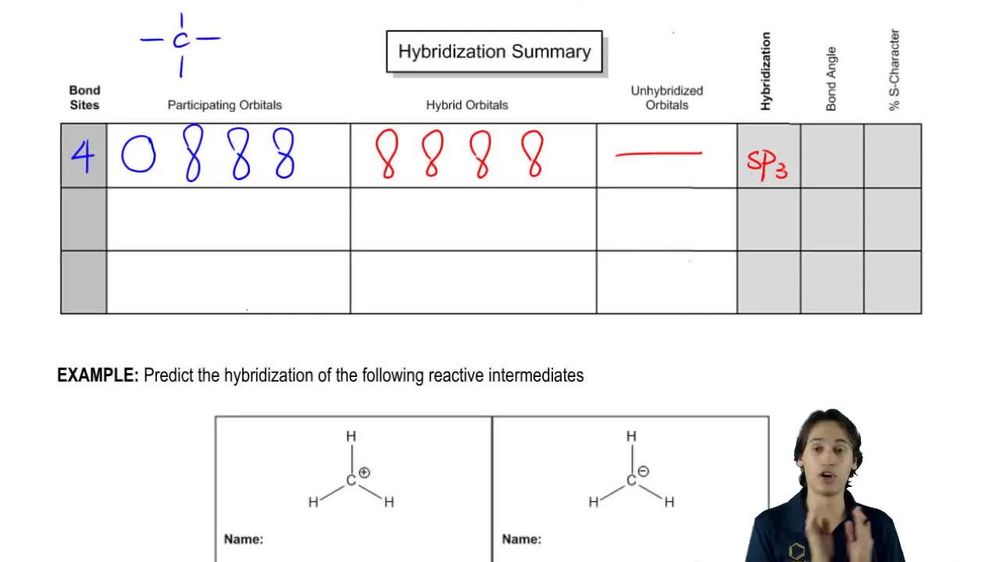
The hybridization of the atom bearing the acidic proton significantly affects acidity. For example, sp-hybridized carbons (like in alkynes) hold their electrons closer to the nucleus, resulting in stronger acids compared to sp2 (alkenes) or sp3 (alkanes) hybridized carbons. This is due to the increased s-character in sp hybridization, which stabilizes the negative charge on the conjugate base.