Show how you would use a Strecker synthesis to make (b) valine.
Verified step by step guidance
1
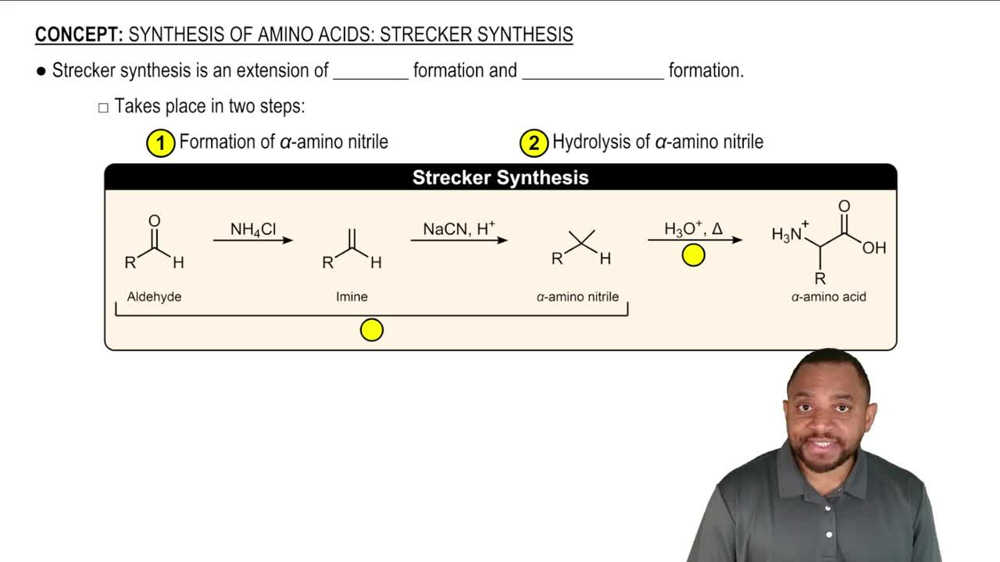
Step 1: Understand the Strecker synthesis process. Strecker synthesis is a method for synthesizing α-amino acids by reacting an aldehyde (or ketone), ammonia (or ammonium chloride), and hydrogen cyanide (HCN). The reaction proceeds through the formation of an imine intermediate followed by cyanohydrin formation and hydrolysis.
Step 2: Identify the target amino acid structure. Valine is an α-amino acid with the structure: (CH3)2CH-CH(NH3+)-COO−. This indicates that the starting aldehyde should have a branched alkyl group to match the valine side chain.
Step 3: Choose the appropriate aldehyde. To synthesize valine, the aldehyde used should be isobutyraldehyde ((CH3)2CHCHO), as it provides the correct branched alkyl group for the valine side chain.
Step 4: Perform the Strecker synthesis. React isobutyraldehyde with ammonia (NH3) and hydrogen cyanide (HCN). First, the aldehyde reacts with ammonia to form an imine intermediate. Then, the imine reacts with HCN to form an α-aminonitrile intermediate.
Step 5: Hydrolyze the α-aminonitrile. The α-aminonitrile is hydrolyzed under acidic conditions to yield the α-amino acid, valine. This step converts the nitrile group (-CN) into a carboxylic acid (-COOH), completing the synthesis.
Verified video answer for a similar problem:
This video solution was recommended by our tutors as helpful for the problem above
Video duration:
2m
Play a video:
0 Comments
Key Concepts
Here are the essential concepts you must grasp in order to answer the question correctly.
Strecker Synthesis
Strecker synthesis is a method for synthesizing amino acids from aldehydes or ketones. It involves the reaction of an aldehyde with ammonia and hydrogen cyanide, leading to the formation of an α-amino nitrile, which can be hydrolyzed to yield the corresponding amino acid. This process is significant in organic chemistry for constructing amino acids, which are the building blocks of proteins.
Synthesis of Amino Acids: Strecker Synthesis Concept 1
Amino Acid Structure
Amino acids are organic compounds characterized by the presence of both an amino group (-NH2) and a carboxyl group (-COOH), along with a unique side chain (R group) that determines the properties of the amino acid. In the case of valine, the side chain is isopropyl, making it a branched-chain amino acid. Understanding the structure of amino acids is crucial for grasping their roles in biochemistry and protein synthesis.
Hydrolysis is a chemical reaction involving the breaking of a bond in a molecule using water. In the context of Strecker synthesis, hydrolysis is used to convert the α-amino nitrile intermediate into the corresponding amino acid. This step is essential for completing the synthesis process and obtaining the desired amino acid product, such as valine, from the initial reactants.

 2:38 minutes
 Verified step by step guidance
 1:39
1:39