For each of the following structures, 1. Draw a Lewis structure; fill in any nonbonding electrons. 2. Calculate the formal charge on each atom other than hydrogen d. [(CH3)3O]+ e. CH3NC f. (CH3)4NBr
Verified step by step guidance
1
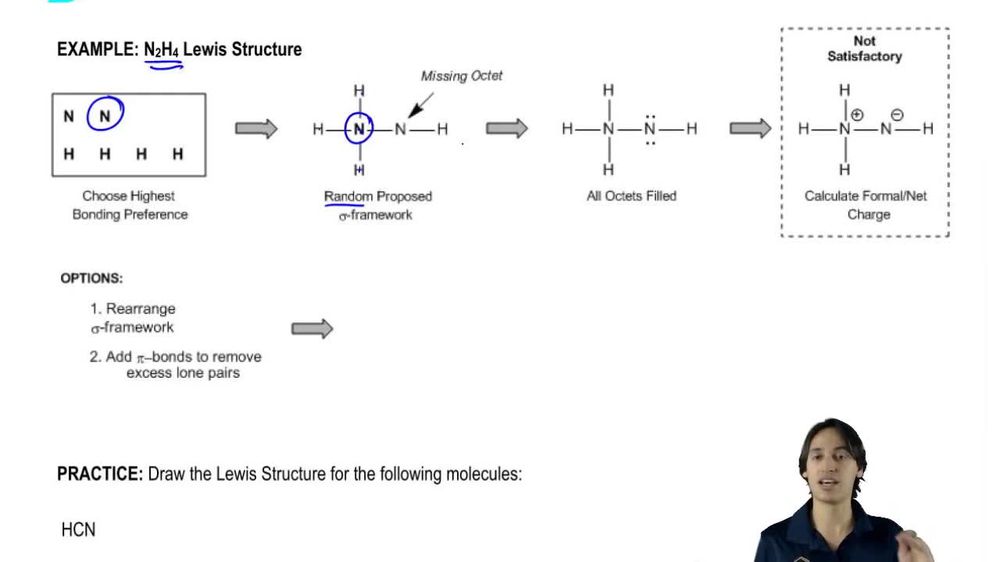
Step 1: For each molecule, start by identifying the total number of valence electrons. For example, in [(CH3)3O]+, calculate the valence electrons for carbon, hydrogen, and oxygen, and adjust for the positive charge.
Step 2: Draw the skeletal structure of the molecule. For [(CH3)3O]+, place the oxygen atom in the center with three CH3 groups attached to it. For CH3NC, connect the carbon atoms in a chain with nitrogen at the end. For (CH3)4NBr, place nitrogen in the center with four CH3 groups and a bromine ion nearby.
Step 3: Distribute the valence electrons around the atoms to satisfy the octet rule, starting with the outer atoms. Remember to account for the positive charge in [(CH3)3O]+ by removing one electron from the total count.
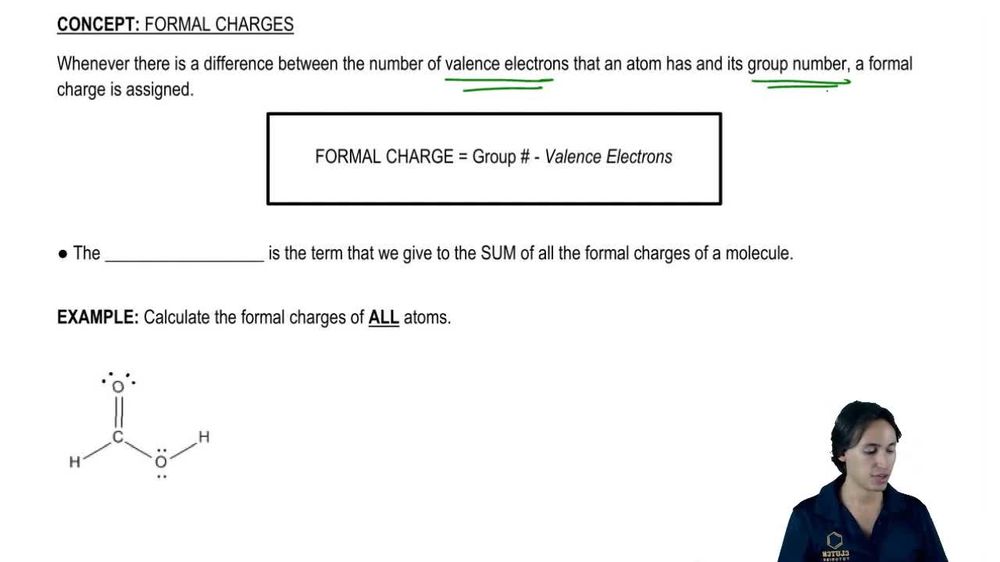
Step 4: Calculate the formal charge for each atom using the formula: Formal Charge = (Valence electrons) - (Nonbonding electrons) - 0.5*(Bonding electrons). Apply this to each atom in the structures, excluding hydrogen.
Step 5: Adjust the structure if necessary to minimize formal charges, ensuring that the most electronegative atoms carry negative charges if possible. Verify that the total charge of the molecule matches the given charge.
Verified video answer for a similar problem:
This video solution was recommended by our tutors as helpful for the problem above
Video duration:
9m
Play a video:
0 Comments
Key Concepts
Here are the essential concepts you must grasp in order to answer the question correctly.
Lewis Structures
Lewis structures are diagrams that represent the bonding between atoms of a molecule and the lone pairs of electrons that may exist. They are essential for visualizing the arrangement of atoms, the distribution of electrons, and the connectivity within a molecule. To draw a Lewis structure, count the total valence electrons, arrange the atoms, and distribute the electrons to satisfy the octet rule for each atom.
Formal charge is a theoretical charge assigned to an atom in a molecule, calculated using the formula: Formal Charge = (Valence Electrons) - (Nonbonding Electrons) - (Bonding Electrons/2). It helps in determining the most stable Lewis structure by ensuring that the sum of formal charges in a molecule equals the overall charge of the molecule. Atoms in a molecule are ideally assigned formal charges as close to zero as possible.
Nonbonding electrons, also known as lone pairs, are valence electrons that are not shared with another atom in a covalent bond. They are important in determining the shape and reactivity of molecules, as they occupy space and can influence molecular geometry according to VSEPR theory. In Lewis structures, nonbonding electrons are represented as pairs of dots around the atom.

 9:51 minutes
 Verified step by step guidance
 04:12
04:12